

Can You Sell AI Generated Art? Platform Rules Compared
Yes, on every major platform. We read the current terms of ChatGPT, Midjourney, Gemini, Canva, Firefly and Krater, plus Etsy and Amazon rules.
Yes, you can sell AI generated art. All six major generators we checked (ChatGPT, Midjourney, Google Gemini, Canva, Adobe Firefly and Krater) allow commercial use of what you make, with two exceptions: Midjourney's free tier is non-commercial only, and Midjourney requires a Pro or Mega plan if your business makes more than $1 million a year. The catch is not permission, it is protection: in the United States a purely AI generated image cannot be copyrighted, so anyone can copy it and you cannot stop them. Marketplaces add their own rules, and Etsy requires you to disclose AI use in the listing.
Key Takeaways
- Selling is allowed on every major platform if you are on a paid plan. Midjourney is the only one with conditions: free users get a non-commercial licence, and businesses over $1 million a year need Pro or Mega.
- Allowed to sell is not the same as owned. In the US, prompts alone do not make you the author, so a raw AI image has no copyright. You can sell it, but you cannot stop others from copying it.
- Three layers decide what you can do: copyright law, the generator's licence, and the marketplace's rules. Most guides only cover the last one.
- Midjourney images are public and remixable by default unless you pay for Stealth mode. Every other platform here keeps your generations private.
- ChatGPT, Gemini and Canva (free and Pro) can use your prompts and images to train their models unless you turn it off. Krater does not train on your content and has no setting to find.
- Etsy allows AI art only under "Designed by a seller" and requires a disclosure in the listing description. Amazon now requires a metadata tag on photorealistic AI people.
- The safest product is one where you did real work on top of the generation: edits, composition, text, layout. That human part is what copyright protects.
The three layers that decide whether you can sell
Most "how to sell AI art" guides jump to Etsy and print on demand. That skips the two layers underneath. Work through them in this order.
- Copyright law decides whether anyone owns the image at all. If nobody does, you can sell it and so can anyone else.
- The generator's licence decides what the platform lets you do with the output, whether it keeps a licence to your work, whether it publishes it, and whether it trains on it.
- The marketplace's rules decide whether you may list it and what you must disclose.
Layer 1: can AI art be copyrighted?
In the United States, not on its own. The US Copyright Office's January 2025 report on copyrightability concluded that "prompts do not alone provide sufficient control" for the person typing them to count as the author, and that copyright "does not extend to purely AI-generated material". In March 2025 the D.C. Circuit in Thaler v. Perlmutter confirmed that the Copyright Act "requires all eligible work to be authored in the first instance by a human being".
What is protected is your human contribution: the parts you drew or wrote, the way you selected, arranged and modified the AI output, and any composition you built around it. The Copyright Office says that is judged case by case. So a raw generation is unprotected. A poster where you composed three generations, added your own typography and adjusted colours has a protectable layer, even if the underlying generations do not.
Outside the US the picture differs. The UK has a provision for computer generated works, and China has granted copyright in AI images in individual cases. If you sell internationally, treat the US position as the strictest baseline.
Sources: US Copyright Office, Copyright and Artificial Intelligence, Part 2; Thaler v. Perlmutter, D.C. Cir. 2025.
Layer 2: what each platform lets you sell
The table covers the five questions a seller needs answered. Quotes are from each platform's current terms, checked on 20 September 2026.
| Platform | Can you sell it? | Conditions | Private by default? | Trains on your content? | Licence the platform keeps |
|---|---|---|---|---|---|
| ChatGPT (OpenAI) | Yes | None. May not claim output is human made | Yes | Consumer plans: yes, unless you opt out in Data Controls. Business and API: no | None over output. OpenAI assigns its rights in output to you |
| Midjourney | Paid plans: yes. Free: no | Free tier is Creative Commons Noncommercial. Businesses over $1M a year need Pro or Mega | No. Public and remixable unless on Stealth mode (Pro and Mega) | Broad licence covers reuse; no separate training opt out documented | Perpetual, irrevocable, sublicensable licence over your prompts and images |
| Google Gemini (Imagen, Veo) | Yes | None found in consumer terms | Yes | Consumer: yes, including human review, unless Gemini Apps Activity is off. Workspace: excluded | Service licence to host and improve services |
| Canva (Magic Media) | Yes | Output that includes Canva library content stays under Canva's content licence. AI audio has extra limits | Yes | Free and Pro: on by default, opt out in Privacy Settings. Teams and Enterprise: never | Service licence; library content stays licensed, not owned |
| Adobe Firefly | Yes | None. Marketed as commercially safe | Yes, unless you submit to the public gallery | Models trained on licensed stock, not customer content. Prompts may be reviewed for abuse | Service licence; gallery submissions get a wider licence |
| Krater | Yes | None. Output may be subject to the underlying model provider's terms | Yes. No gallery, no remixing | No. "We do not use your data to train AI models" | None claimed over your outputs or prompts |
Sources: OpenAI Terms of Use, OpenAI Business Terms, Midjourney Terms of Service, Midjourney, Using Images and Videos Commercially, Google Terms of Service, Gemini Apps Privacy Hub, Canva AI Product Terms, Adobe Generative AI User Guidelines, Krater Terms and Privacy.
The clauses that matter most for sellers
Midjourney's revenue rule. "If you are part of a business grossing more than $1,000,000 USD a year, you need a Pro or Mega Plan to use your images commercially for your company." If you are a freelancer making art for such a client, the client's revenue is what counts.
Midjourney's public default. "By default, Your Content is publicly viewable and remixable." Other members can see your prompts and images and make variations before you have listed the product. Stealth mode is only on Pro and Mega, and Midjourney only promises "best efforts" not to publish.
Midjourney's licence to your work. You grant Midjourney "a perpetual, worldwide, non-exclusive, sublicensable no-charge, royalty-free, irrevocable copyright license" over your prompts and your images that "survives termination". You own the image; Midjourney can also use it, forever.
OpenAI's assignment. "You (a) retain your ownership rights in Input and (b) own the Output. We hereby assign to you all our right, title, and interest, if any, in and to Output." That is the strongest ownership wording of the six. The "if any" is doing real work: OpenAI is passing on whatever rights exist, and under US law that may be none.
Canva's library exception. You own your output "except for Output that modifies or incorporates Licensed Content". If your Magic Media image is placed on top of a Canva stock element, the stock element stays under Canva's licence, which limits standalone resale.
Krater's position. Our terms say "You retain ownership of content you create using our service" and "We do not use your data to train AI models." Krater claims no licence over your prompts or generations and has no public gallery. Because Krater runs image and video models from several providers, our terms also note that "AI-generated content may be subject to the terms of underlying model providers." In practice: Krater takes nothing, and nothing you make is used to train anything.
Layer 3: marketplace rules
| Marketplace | AI art allowed? | What you must do |
|---|---|---|
| Etsy | Yes, under "Designed by a seller" | "Sellers must disclose within their listing description if an item is created with the use of AI." Items must "incorporate a human touch". Prompt bundles do not qualify |
| Amazon (Merch on Demand and listings) | Yes, subject to standard IP rules | Since July 2026, images with photorealistic AI generated people need the IPTC keyword "contains-synthetic-performer" in the metadata. You are responsible for holding the rights |
| Redbubble | No AI specific rule | Standard IP policy: uploads must be "your very own, original ideas" and not infringe others' rights |
| Shopify (your own store) | No AI specific rule | Acceptable Use Policy applies; IP disputes come from rights holders, not Shopify |
Sources: Etsy Creativity Standards, Redbubble IP and Publicity Rights Policy. Amazon's requirement was announced on Seller Central in July 2026; check your category's current guidance before uploading.
What actually gets sellers in trouble
None of the platforms above will stop you selling. These are the things that do:
- Prompting for a protected style or character. "In the style of" a living artist, or a recognisable character, brand or celebrity. The generator's licence does not protect you from the rights holder.
- Copying from a public feed. On Midjourney, other people's generations are public and remixable, but remixing is not the same as having rights to sell the result.
- Claiming it is hand made. OpenAI bans representing output as human made, and Etsy requires disclosure. Buyers who find out later leave the reviews that sink a shop.
- Selling a raw generation and expecting exclusivity. OpenAI and fal.ai both warn that output "may not be unique" and other users can receive similar results. If a competitor lists a near identical image, you have no copyright to enforce.
How to make AI art you can actually protect
The practical answer to the copyright gap is to do the human work that the Copyright Office says is protectable, and to do it on a platform that does not publish or train on your drafts.
- Generate variations privately. Use a platform where drafts are not public. On Krater every generation stays in your workspace; nothing is published.
- Select and compose. Pick from several generations, crop, combine, adjust colour. Selection and arrangement are protectable.
- Add original elements. Your own typography, hand drawn parts, a series concept, product mockups. These are yours.
- Keep your working files. Prompts, drafts, edit history. If you ever need to show what you contributed, this is the evidence.
- Disclose where required. Etsy always. Elsewhere, honesty costs nothing and avoids refunds.
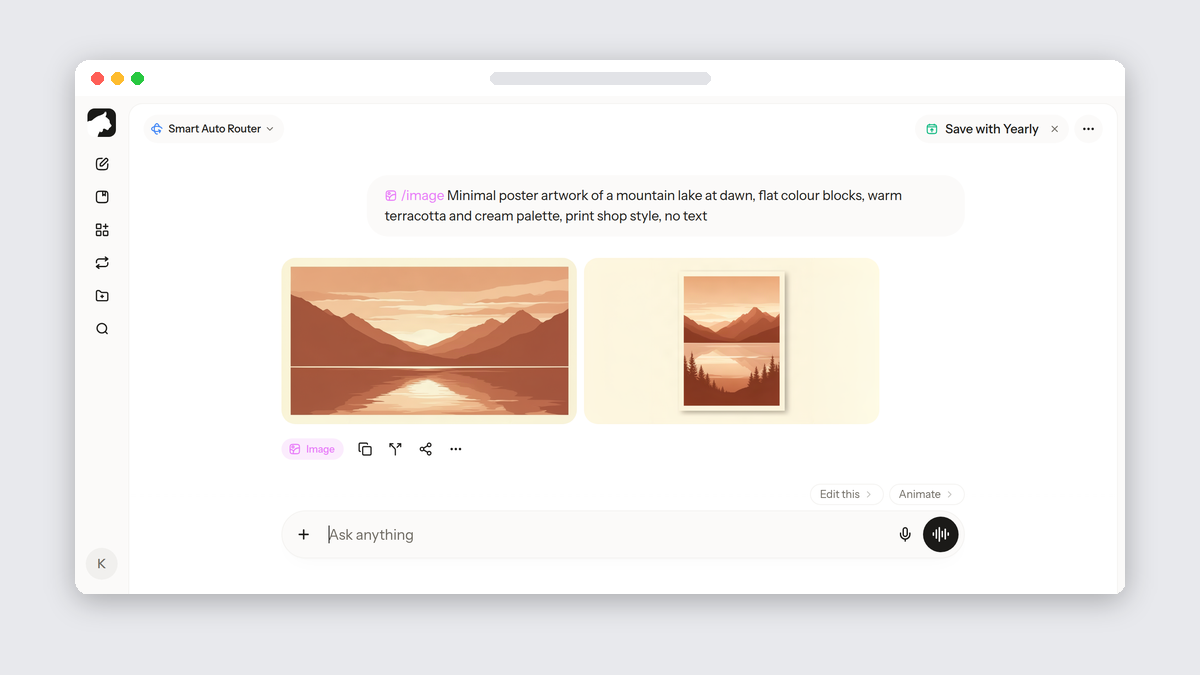
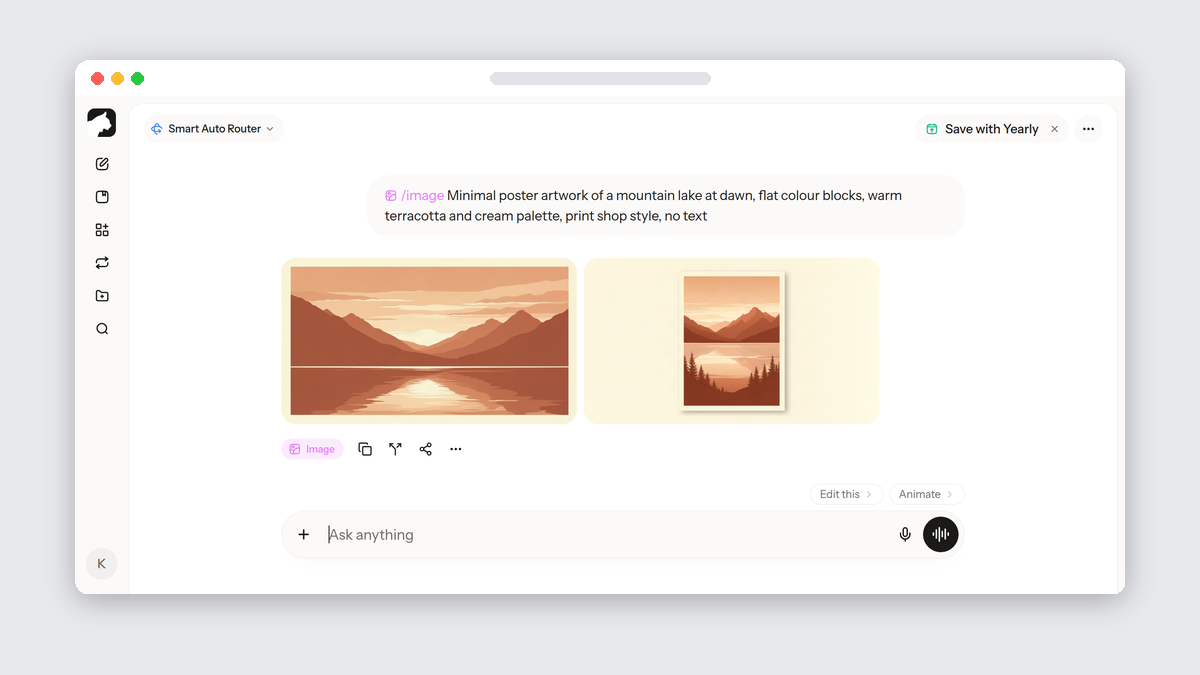
On Krater you can do the first three steps in one place: generate with any of the image models in /image, edit and iterate in the same chat, and keep the versions in Keep. The output is yours to sell, Krater keeps no licence to it, and it is never used for training.
Frequently Asked Questions
Can I sell AI generated art on Etsy?
Yes. Etsy classes it as "Designed by a seller" and requires you to state in the listing description that AI was used. The item must include a human touch, and prompt bundles are not allowed.
Can I sell images made with ChatGPT?
Yes. OpenAI's terms say you own the output and assign OpenAI's rights in it to you, on every plan. You may not claim the image was made by a human. Remember that OpenAI images carry C2PA and SynthID provenance marks that identify them as AI generated.
Can I sell Midjourney images?
Only on a paid plan. Free users get a non-commercial Creative Commons licence. Businesses with over $1 million in annual revenue need a Pro or Mega plan. Your images are public by default unless you use Stealth mode.
Do I own AI art I sell?
You own whatever rights exist, but in the US a purely AI generated image has no copyright, so there is nothing to own in the copyright sense. What you own is your human contribution: edits, composition, added elements. Read who owns AI generated images for the platform by platform breakdown.
Which AI image generator is best for selling art?
Any paid platform in the table permits selling. The differences are privacy and training: Midjourney publishes and remixes by default and keeps a perpetual licence; ChatGPT, Gemini and Canva train on consumer content unless you opt out; Krater and Adobe do not train on your work. If exclusivity of your drafts matters, pick a private platform.
Bottom Line
Permission to sell is the easy part; every major generator gives it on a paid plan. Protection is the hard part, and no platform can give you a copyright that the law does not. Do the human work on top of the generation, do it somewhere your drafts stay private and untrained, disclose where the marketplace asks, and you have a product you can sell and, in part, defend.