

Does Claude Pro Have a Student Discount? (2026)
A current guide to Claude Pro student pricing, Claude for Education and practical alternatives for students.
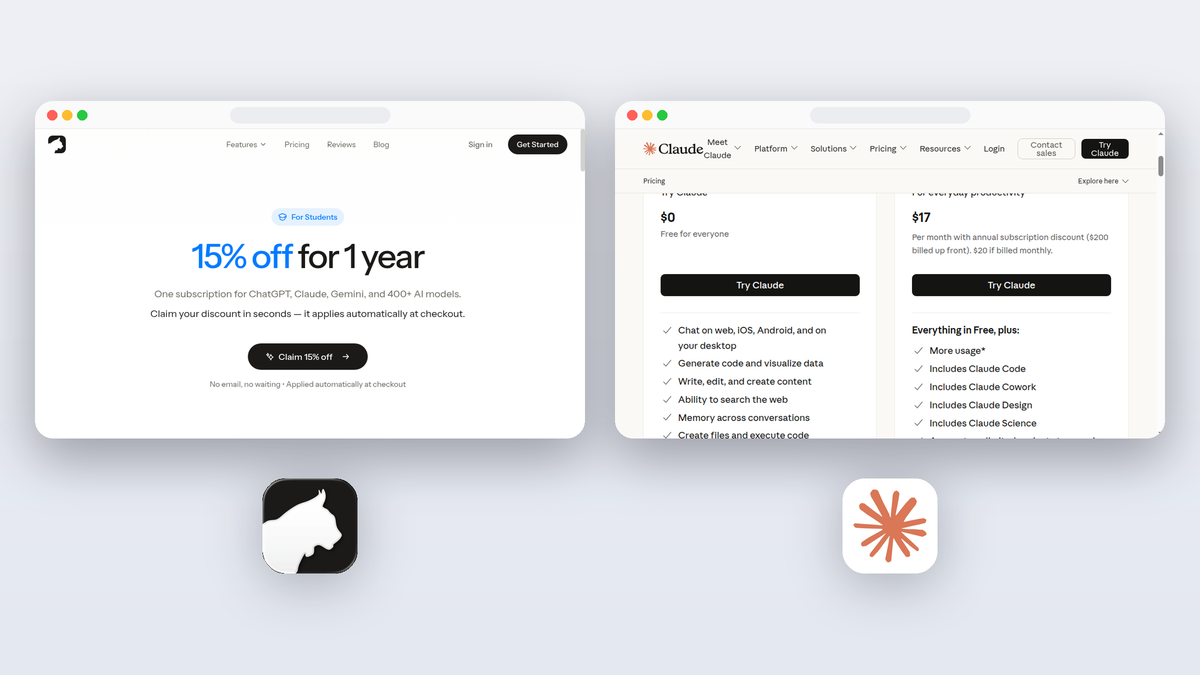
As of September 2026, Anthropic does not publicly document an individual Claude Pro student discount or a .edu checkout discount. Anthropic does offer Claude for Education as an institution-level, university-wide plan. Students can ask their university, use Claude Free or Claude Pro at $20/month, compare the ChatGPT and Google offers, or use Krater's 15% student discount for one year.
Key Takeaways
- Claude for Education is an institution-level university plan, not a public individual student checkout rate.
- There is no publicly documented individual Claude Pro student discount or .edu discount as of September 2026.
- Students can ask their university, use Claude Free, pay $20/month for Claude Pro or compare other offers.
- OpenAI and Google have separate 2026 student promotions with different eligibility and deadlines.
- Krater offers 15% off for one year at /students and includes 400+ models in a paid workspace.
What Anthropic actually offers students
Anthropic's Claude for Education page describes an institution-level plan intended for universities. That is materially different from a student entering a school email at a consumer checkout. The university, not an individual student, is the party that needs to establish the education arrangement. Anthropic's official pricing page is the right place to check consumer plans. As of September 2026, there is no publicly documented individual Claude Pro student discount or .edu checkout discount. A social post promising a special rate should not be treated as an Anthropic policy.Claude for Education can still matter to a student even though it is not an individual coupon. Ask whether the university has campus access, who administers the account, which students qualify, what happens to conversations and files, and whether access ends when the student leaves the institution.
The distinction protects students from making the wrong comparison. An institution-level contract may provide a campus route, while Claude Pro at $20/month is a personal consumer purchase. Those options have different ownership, privacy, support and renewal questions.
How to find out if your university has Claude
Start with the university IT help desk or digital learning team. They may know whether Claude for Education has been purchased or piloted. If the help desk cannot answer, ask the library, teaching and learning center, department administrator or procurement office which team handles institution-wide AI services.
Ask specific questions rather than asking only whether the school has Claude. Confirm whether access is available to all students or selected departments, whether a university email is required, whether the account is separate from a personal Claude account and which data students may upload.
Also ask about teaching guidance. A university may allow Claude for brainstorming but restrict its use in assessed work. Find out whether instructors set course-specific rules, whether conversations remain under institutional control and how a student should cite or disclose AI assistance.
If the answer is no, do not interpret that as a failed discount search. Move to the consumer options and compare the actual monthly cost with the amount of coursework the tool will support. The absence of a campus plan is a procurement fact, not a reason to trust an unofficial coupon.
Claude's consumer plans for students
Claude Free is the simplest way to learn whether the interface and writing style suit a student's work. Limits apply, and plan details can change, so check the live pricing page before planning a whole semester around a particular allowance.
Claude Pro is a personal subscription listed at $20/month. It can make sense for a student who writes frequently, works through substantial source material or wants more regular access than a free consumer account provides. The decision should include the student's editing time and cancellation plan.
Claude Max exists as a higher access tier for people with heavier usage. It is not a student discount, and a student should not choose it merely because a large plan sounds safer. First measure how often the normal plan becomes a genuine constraint and whether the work justifies the added subscription.
The consumer route belongs to the individual account owner. Keep school policy, privacy and assessment rules in view, especially when course files contain personal information or unpublished research.
Claude Pro, student offers and Krater Pro
| Option | Access route | Price or promotion | Useful fit | Important check |
|---|---|---|---|---|
| Claude Pro | Individual consumer account | $20/month | Long-form writing and careful document work | Personal renewal and usage limits |
| ChatGPT Plus offer | Eligible US student verification | Four free monthly billing periods, then $20/month | OpenAI centered study and creative work | Claim by October 31, 2026 |
| Google AI Pro offer | Eligible US college student redemption | One year at no charge, then standard price | Google centered study workflow | Redeem by December 31, 2026 |
| Krater Pro | Student offer at /students | 15% off for one year, then predictable $20/month pricing | 400+ models and multi-format projects | Paid workspace, no free plan |
There is no single winner in the table. Claude can be the right consumer choice when careful writing is the center of the week. The ChatGPT and Google promotions are worth checking for eligible US students. Krater is valuable when the student wants to compare providers and carry the same brief into research, documents and creative work.
Where Claude is strongest for coursework
Claude is often a natural fit for coursework that starts with a long reading and ends with a careful explanation. Give it a clearly scoped source, ask it to separate the author's claim from your interpretation and request a list of unresolved questions. The student remains responsible for checking the reading and preserving the original meaning.
Careful writing is another strong use. A student can ask for a critique of structure, transitions and assumptions without asking for a complete submission. That makes the model a useful second reader, especially when the prompt states the marking criteria and asks for evidence from the supplied draft.
A multi-model workspace helps when the assignment is not only a long essay. A student may need one model for a difficult explanation, another for a concise outline, a third for a spreadsheet or an image for a presentation. Comparing those outputs in Krater can reduce the temptation to force every task through one provider.
The practical measure is revision effort. Keep a copy of the source prompt, the first answer and the corrected result. If Claude consistently needs fewer factual and structural corrections, its focused strengths may justify the personal subscription. If the student keeps switching tools, a broader workspace may produce a smoother semester.
Krater for students
Krater's student offer is 15% off for one year at https://krater.ai/students. It is a paid offer, not a free plan. Students should use the page for current redemption details and should not assume that a school email creates an additional discount.
Krater provides 400+ models, including Claude Opus 5, GPT-6 Astra, Claude Fable 5.1 and Gemini 3.1 Pro. Personas can hold a course or research voice, Keep can hold source notes and Tasks can separate drafting from review. That structure matters when several assignments share the same references.
Predictable $20/month pricing on Pro gives students a clear normal renewal after the discounted first year. The value is not that every model is identical. The value is being able to choose a model for the work, keep the context in one place and create documents or media without starting over in a new product.
Three coursework prompts to copy
- Read the supplied chapter and create a claim map. For every major claim, quote the supporting passage, label the evidence type and state one limitation. If the source does not answer a question, write 'not established by the supplied text' instead of guessing.
- Review my draft against this rubric. Separate factual accuracy, argument structure, clarity and citation problems. Give one example from my draft for each issue, then suggest a revision plan without writing the final submission.
- I have three readings on the same question. Create a comparison matrix with agreement, disagreement, method and missing evidence. Keep each row tied to a supplied passage and finish with two questions suitable for a seminar discussion.
How to compare Claude with another model
A fair comparison uses the same source, prompt and success criteria. Ask both systems to identify the author's thesis, quote two supporting passages, list a limitation and propose a revision plan. Score source fidelity separately from prose quality because a smooth paragraph can still misread the underlying argument.
Repeat the comparison with a document that contains a table, footnote or qualification. Long context is valuable only when exceptions survive the summary. Note which details disappear, which questions receive guesses and how easy it is to locate the source passage behind an answer.
For writing, compare the correction burden. Give each model the same rough draft and rubric, then count factual changes, structural changes and optional style suggestions. A student who can see those categories can choose a tool for a real course rather than for a generic leaderboard.
Privacy and academic responsibility
Before uploading coursework, check whether the material contains another student's personal information, unpublished research or an instructor's restricted content. Remove identifiers when possible and use a short excerpt for a capability test. A useful assistant should not require a student to ignore a university policy.
AI assistance also needs an honest boundary. A student can use a model to ask questions about a reading, test an outline or find gaps in a draft while remaining responsible for the final argument. Course rules may require disclosure, citation or no use at all, so the syllabus and instructor's direction take priority.
A practical choice for the semester
Estimate the number of source-heavy assignments, the amount of drafting and the number of times a second model would help. A student who writes one paper may prefer Claude Pro. A student who rotates between research, images, spreadsheets and presentations may value a workspace that keeps those jobs together.
Run a small trial with a completed assignment rather than a hypothetical prompt. Compare how much setup, correction and export work each option requires. Include the time spent checking the answer because an apparently fast draft can become slow when its claims are difficult to trace.
Keep the account decision reversible. Do not upload an entire archive at the start, do not prepay a year without checking usage and do not let a promotional deadline replace a careful review of renewal and school policy.
A clear weekly routine is often more valuable than a dramatic model switch. Set one day for source review, one for drafting and one for checking the final work. The tool should support that rhythm while the student controls the academic decision.
Prompts to copy
Frequently Asked Questions
Is there a Claude Pro student discount?
As of September 2026, Anthropic does not publicly document an individual Claude Pro student discount or a .edu checkout discount.
What is Claude for Education?
Claude for Education is Anthropic's institution-level, university-wide plan. Students should ask their university whether campus access exists.
How much is Claude Pro for students?
Claude Pro is listed at $20/month for the consumer plan. Students should check the official pricing page for current terms and limits.
Can students use Claude Free?
Yes. Claude Free is a consumer route for students who want to learn the product before deciding whether a paid plan is justified.
Can students compare ChatGPT and Google offers?
Yes. Eligible US students can separately review OpenAI's four-month offer and Google's one-year Google AI Pro offer, each with its own deadline and renewal terms.
Does Krater have a student discount?
Yes. Krater offers 15% off for one year through /students. It is a paid workspace with 400+ models and predictable $20/month Pro pricing.
The Bottom Line
There is no public individual Claude Pro student discount to claim as of September 2026. Ask the university about Claude for Education, review Claude's consumer plans and compare the OpenAI, Google and Krater routes against the coursework you actually need to finish.