

How to Write a Business Plan With AI (Section by Section, With Prompts)
A section-by-section business plan workflow with prompts for owners and operators, including research discipline, projections, risks and a one-page version.
AI can give a business plan a clear structure, expose missing questions and turn a long set of notes into an executive summary. It cannot validate demand, supply your financial assumptions or guarantee funding. You need to provide the numbers, evidence, customer knowledge and operating decisions, then review every section for accuracy and consistency.
Key Takeaways
- Write the offer and customer problem before polishing the executive summary.
- Separate verified market evidence from assumptions that still need testing.
- Give AI your numbers and definitions, then check every calculation independently.
- Use risks and milestones to make the plan useful after a lender or investor reads it.
- Krater gives owners 400+ models, Personas, Keep and Tasks in one workspace, with Predictable $20/month pricing on Pro.
Set the planning brief
Begin with a one-page brief containing the business stage, location, legal structure if relevant, target customer, offer, launch or expansion date, capital available, people involved and the decision the plan must support. A plan for a bank loan has a different emphasis from a plan for an internal operating review. Tell AI who will read it and what they need to decide.
Create a source register beside the brief. Label each item as internal record, customer conversation, published market source, estimate or unresolved question. This keeps a fluent draft from making weak evidence sound settled. Ask the model to place assumptions in a separate list before it writes prose. That list becomes a practical research and testing backlog.
Write the offer and customer problem
Describe what you sell, who buys it, what triggers the purchase and why the customer chooses it instead of doing nothing or using another option. Include the delivery format, price logic, key constraints and the result the customer expects. Avoid broad claims such as “everyone needs this.” A focused initial customer is easier to reach, serve and learn from.
Ask AI to challenge the offer from three viewpoints: a potential customer, an operator and a sceptical lender. The customer asks whether the result matters. The operator asks whether it can be delivered repeatedly. The lender asks whether the revenue and costs are understandable. Use those questions to strengthen the plan, not to let the model invent testimonials or market demand.
Build the market section
A useful market section explains the customer group, the problem's frequency, the buying context, relevant alternatives and the evidence available. Include geography, seasonality and purchasing constraints when they affect the business. If you have a small sample, say so. A handful of conversations can reveal language and objections, but it is not proof of the whole market.
Ask AI to make a table with claim, source, confidence and next test. It can help compare public reports and organise notes, but you should open the original sources and check the dates, definitions and population covered. Do not quote a market-size figure that uses a different category from your actual offer. Clear limitations increase the usefulness of the plan.
Explain the go-to-market route
Set out how a prospect discovers the business, evaluates the offer, buys, receives the result and decides whether to return or refer someone. Name the channels you can operate consistently. A plan that lists every social network is less convincing than one that explains why two channels fit the customer and how the team will maintain them.
Describe the first experiments with a cost, owner, timing and success measure. AI can turn a rough launch idea into a sequence of landing page tests, conversations, demonstrations, partnerships or outbound messages. It should not invent conversion rates. Use a range only when you explain where it came from and how quickly you will replace it with your own evidence.
Plan operations people can run
Operations cover the work after a customer says yes. Map the steps, tools, suppliers, quality checks, handovers, support route and capacity limits. Note which work depends on one person or one supplier. If the business sells a service, explain how a request becomes a finished result. If it sells a physical item, explain purchasing, storage, fulfilment, returns and stock visibility.
Ask AI to convert the map into a weekly operating checklist and a list of failure points. Then ask an experienced operator to challenge it. The model may omit a quiet but essential task such as reconciliation, maintenance, consent, accessibility or end-of-day close. A plan is credible when it shows how ordinary work gets done, not just how the idea sounds.
Create financial projections from your numbers
Financial projections should begin with a small set of definitions: units sold, price, revenue timing, variable cost, fixed cost, payment delay, tax treatment and cash balance. Supply the numbers yourself from records or stated assumptions. AI can arrange a monthly table, explain the difference between profit and cash and show how a changed assumption affects the result, but it is not financial, tax or accounting advice.
Have the arithmetic checked in a spreadsheet or by a qualified professional. Ask the model to identify which assumptions drive the outcome and to produce base, stronger and weaker cases. Do not hide a cash gap inside an annual total. Show when money leaves and arrives. If a lender or investor will read the plan, label estimates clearly and keep the supporting calculation available.
Risks, milestones and decision gates
List risks by what could happen, how likely it is, the impact, early warning sign, owner and response. Include commercial, operational, supplier, staffing, compliance, technology and cash risks where relevant. A risk register is not an admission that the business will fail. It shows that the operator has thought about what changes the plan and what action follows.
Turn the first year into milestones that prove or disprove assumptions. A milestone might be ten paid customers in a defined segment, a repeat purchase rate, a completed service process or a supplier lead time within a target. Add a decision gate: continue, adjust, pause or stop. AI can make the table clear, but the owner must choose thresholds that reflect the actual business.
Make the one-page version
A bank or investor may ask for a short overview before reading the full plan. Include the customer problem, offer, evidence, route to revenue, current traction, amount requested, use of funds, key risks and the next milestone. Every sentence should point to a supporting section or source. Do not squeeze uncertainty out of the page just to make the business look finished.
Ask AI to produce three versions for different readers: a bank that wants repayment confidence, an investor who wants growth and a potential partner who wants a clear role. Keep the facts consistent while changing the emphasis. If the versions disagree about price, market or capacity, resolve the source data before sending anything.
Eight business plan prompts
1. Turn this planning brief into a business plan outline for [reader]. Separate facts, assumptions and open questions.
2. Challenge this offer as a customer, operator and sceptical lender. Ask only questions supported by the information provided.
3. Organise these market notes into claims, sources, confidence and next research tests. Do not create evidence.
4. Map the customer journey from discovery to repeat purchase and list the owner and measure for each stage.
5. Convert these operations notes into a weekly checklist, handover map and failure point register.
6. Build a monthly projection table from these supplied assumptions. Show formulas and flag missing definitions.
7. Create a risk register with trigger, impact, owner, mitigation and decision gate.
8. Condense the verified plan into a one-page brief for a bank, preserving uncertainty and the requested funding use.
Use a separate file for the source numbers and keep the original notes. The prompt can organise your reasoning, but it cannot turn an estimate into a fact.
Model comparison for business planning
| Approach | Useful strength | Best planning task |
|---|---|---|
| Fast model | Clear concise drafts | Executive summary |
| Reasoning model | Tests assumptions | Risks and milestones |
| Long context model | Holds many notes | Full plan consistency |
| Krater | 400+ models, Keep and Tasks | Plan, evidence and action in one workspace |
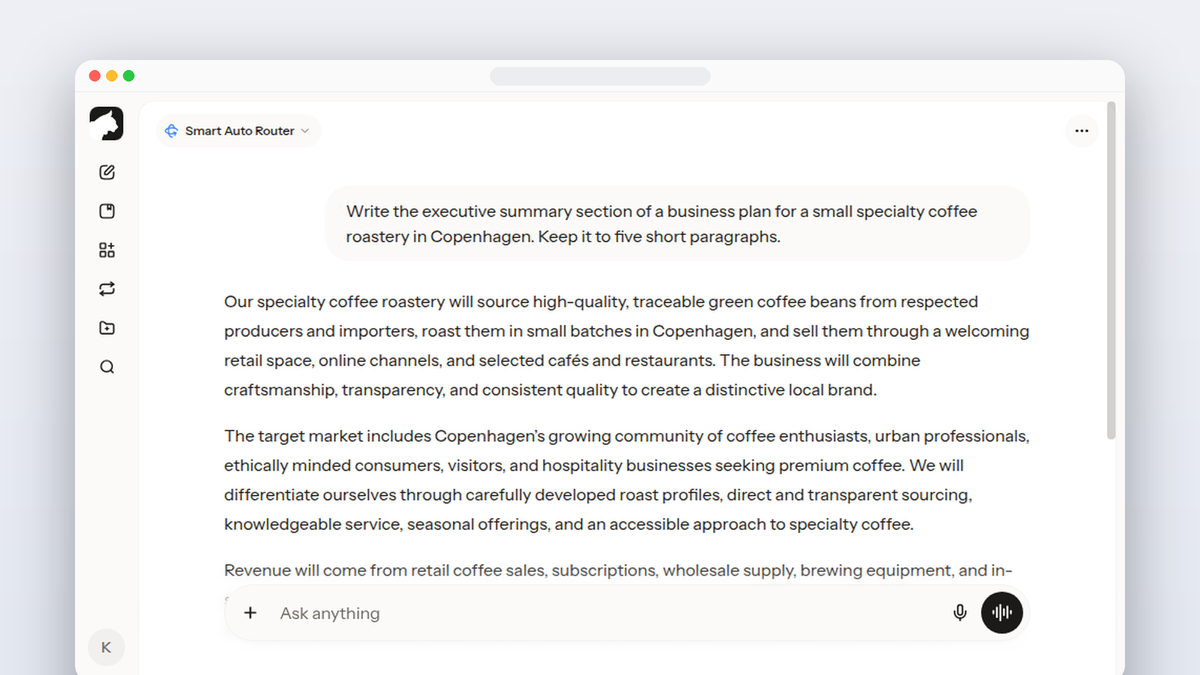
Use a reasoning model when a plan needs challenge and a long context model when many source notes must stay aligned. Krater gives an owner model choice, a place to keep the evidence and Tasks for the work that follows approval. The operating team still owns the numbers, commitments and final document.
Keep the plan alive after approval
A business plan should change when evidence changes. Schedule a monthly review of revenue, cash, acquisition, delivery capacity, customer feedback and risks. Mark what happened against the assumption and decide whether to continue, adjust or stop. A stale plan can be more dangerous than a short one because it gives old decisions an appearance of certainty.
Use /keep for verified sources and assumptions, /tasks for milestones and /personas for a lender, operator or customer perspective. Give every saved number a date and owner. The value of AI is not a document that sits untouched. It is a clearer loop from evidence to decision to work.
Prepare the plan for a hard question
Read the document as someone who wants to find the weak link. What happens if the launch takes twice as long? Which cost is missing from the monthly view? What proof shows that customers will pay rather than praise the idea? Which task depends on one person? Ask AI to create a hostile question list, then answer each question with a source, a test or an honest statement that the assumption remains open.
This exercise is especially useful before a bank, investor or partner meeting. The aim is not to make every answer sound certain. It is to show what you know, what you are testing and what decision follows new evidence. Put the response beside the relevant plan section and update the financial or operating table if the question exposes a contradiction. A plan becomes more credible when it can survive an uncomfortable but fair conversation.
Turn the document into a meeting pack
A plan becomes easier to use when the supporting material is ready beside it. Prepare a short glossary for terms, a table of the key assumptions, a list of open decisions and a folder of evidence. Ask AI to create a meeting agenda that starts with the decision required, then covers traction, use of funds, operations, risks and next steps. Keep the pack dated so an old forecast cannot be mistaken for the current one.
For each important number, write one sentence that explains what would make it change. For each milestone, identify the person who can report progress. This turns a plan into a shared operating language. A bank may focus on repayment and controls, while a partner may focus on delivery and responsibilities, but both should be able to trace the conversation back to the same source assumptions.
Frequently Asked Questions
Can AI write a complete business plan?
It can organise and draft from your evidence. You must provide and verify the customer knowledge, numbers, risks and operating decisions.
Can AI create financial projections?
It can structure supplied assumptions and explain scenarios. Check calculations independently and get professional advice where appropriate.
How long should a business plan be?
Long enough to support the decision, with a one-page version for initial conversations and detailed evidence behind important claims.
Should I include risks?
Yes. A clear risk register shows what could change the plan, who owns the response and when you will review the decision.
Can AI research my market?
It can organise sources and questions, but open the originals, check dates and collect your own customer evidence.
What can Krater do for a plan?
It lets you compare models, keep source material, create repeatable Personas and turn milestones into Tasks in one workspace.
The Bottom Line
Use AI to make a business plan easier to question, update and operate. Keep evidence separate from assumptions, supply your own numbers, test the route to revenue and use the finished plan as a decision system rather than a decorative document.