

How to Use AI to Write a Complaint, Dispute or Refund Request That Gets Results
A practical guide to writing clear complaints and refund requests with facts, templates, escalation steps and careful AI prompts.
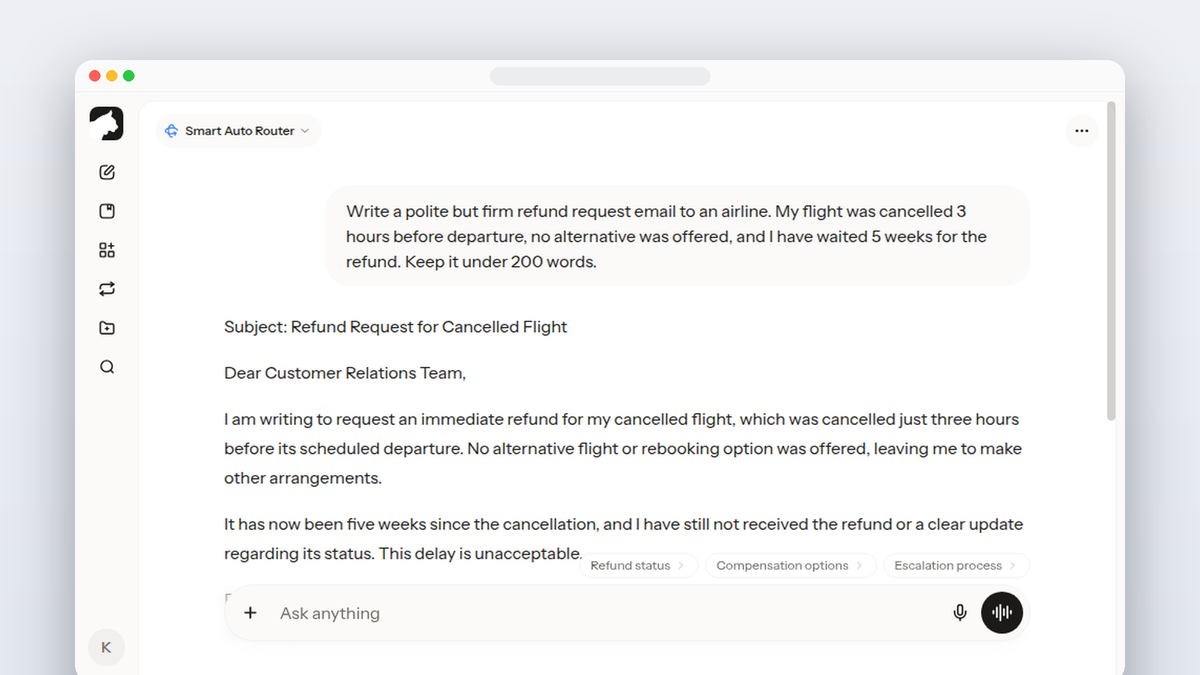
AI is most useful when it turns an emotional account into a short record of what happened, what the business promised and what remedy you want. You provide the dates, order details, evidence and outcome. The model can then produce a polite, firm or formal draft without removing the facts that make your request credible.
Key Takeaways
- Build a timeline before asking for polished wording.
- State the remedy you want and give the recipient an easy way to act.
- Use a tone ladder instead of jumping straight to threats.
- Consumer rights vary by country and this is not legal advice.
- Krater gives you 400+ models, Personas and saved drafts, with Predictable $20/month pricing on Pro.
Turn the story into a case file
Start with a private fact sheet. Record the order or account reference after removing information you do not need to share, the date of purchase, the promised delivery or service date, the amount paid, the exact problem and every attempt you made to resolve it. Copy the relevant wording from the receipt, contract or support email rather than paraphrasing a promise that may matter later. Attach a list of evidence, such as photographs, tracking events, screenshots and names of people who replied.
Ask AI to separate verified facts from your interpretation. If you write that a company ignored you, include the dates of the messages that received no response. If you say an item was unsafe, describe the visible defect and what you did next without asking the model to make a technical or legal finding. This structure keeps the draft calm while preserving the details a support agent or complaints team needs.
Choose the result before the tone
A complaint becomes easier to answer when the requested result is precise. You might want a full refund, a replacement, a repair, a corrected bill, a cancellation of a renewal or reimbursement for a reasonable direct cost. If more than one result would solve the problem, rank them. A company can then offer a workable option without guessing whether your priority is money, delivery, correction or an apology.
Give AI the remedy and a reasonable response date. Do not ask it to invent a deadline, a penalty or a legal entitlement. A sentence such as “Please confirm by 14 September whether you will refund the £85 delivery charge” is clearer than “I expect this fixed immediately.” Keep the amount, currency and transaction reference visible so a reader can route the request correctly.
Use a tone ladder
The polite version assumes the first reader can help: explain the issue, name the evidence and request the remedy. The firm version keeps the same facts but states that the previous contact did not resolve the matter and gives a response date. The formal version adds a numbered chronology, identifies the policy or service promise you are relying on and says which escalation route you will consider if the matter remains unresolved.
Ask for all three versions, then choose the least intense one that still protects your position. A dramatic opening can make a simple correction slower because the reader starts defending the business instead of solving the problem. Remove insults, guesses about motives and threats you would not carry out. Keep one sentence that explains the practical impact, such as a missed event or an unexpected charge, because it helps the recipient understand why the request matters.
Late delivery request
For a late delivery, list the order date, promised date, tracking history, current status and the consequence of the delay. Say whether you still want the parcel or whether the delay means you want to cancel and receive a refund. If the parcel eventually arrives damaged or incomplete, send that as a separate update with photographs rather than burying it in the original chronology.
A useful request asks the business to confirm the next action: locate the shipment, give a reliable delivery date, cancel the order or refund the payment. Include the original delivery promise only if you can quote it accurately. AI can make the message sound smoother, but you must check the tracking number, dates and amount before sending.
Faulty product request
Describe what the product does, what it should do, when the fault appeared and which reasonable checks you already made. Avoid diagnosing an electrical or mechanical cause unless a qualified person has done so. If the fault could create a safety risk, stop using the item and contact the seller through its safety or returns channel rather than experimenting with more troubleshooting.
Ask for a replacement, repair or refund according to the solution that actually works for you. Mention whether the item is within a stated warranty or returns period, but do not tell the model to declare that a legal guarantee definitely applies. Photograph the product, packaging and serial label when appropriate, and keep proof of postage if you return it.
Subscription charge request
Unexpected subscription charges need a compact account history. State when you signed up, what you believed the renewal terms were, the date and amount of the charge, whether you cancelled and whether you used the service after the charge. Do not paste a full card number, password or security code into an AI prompt. Use only the last few digits if the business needs a way to identify the payment.
Ask for cancellation confirmation and a refund review rather than assuming the first agent can reverse every payment. If you received a renewal notice, quote the part that was unclear or absent. If you knowingly accepted a renewal but still want goodwill, say so plainly. Honest wording gives the company room to make a discretionary offer without forcing you into a claim you cannot support.
Service failure request
For a missed appointment, poor repair, failed installation or unusable service, write down the agreed scope and what was delivered. Include the time you waited, the part that remains unfinished and the practical cost of putting it right. If a business has a service ticket, use that reference in the subject line and put the requested remedy in the first paragraph.
A good draft distinguishes a disappointing preference from a measurable failure. “The room was not my preferred colour” is different from “the agreed paint was not applied and the wall is unfinished.” Ask AI to mark any sentence that sounds like an opinion so you can decide whether it belongs. Keep the final message short enough for a busy manager to scan.
Escalate in an orderly way
If the first response does not solve the issue, send a second message that quotes the earlier reference, states what remains unresolved and attaches only the evidence needed for review. Ask for a named complaints process, supervisor review or written final response. Keep a log of dates, channels and promises. A tidy record is more useful than sending the same long message to several inboxes.
Depending on your country and the type of transaction, later options might include asking your card provider about a chargeback, contacting an ombudsman or sector complaints scheme, or considering a small claims process. Rules, eligibility and deadlines vary, so treat those as routes to research rather than instructions to follow automatically. This guide is not legal advice. Check official guidance or speak to a qualified adviser when the amount or risk is significant.
Six prompts for a stronger draft
1. Turn these notes into a dated timeline. Separate facts I can prove from assumptions and list missing evidence.
2. Draft a polite complaint asking for [remedy]. Keep every date, amount and reference exactly as provided.
3. Rewrite this message in a firm but non-threatening tone. Do not add legal claims or facts I did not give you.
4. Produce a formal escalation letter with numbered events, attached evidence and a clear response requested by [date].
5. Compare a refund, replacement and repair request for this situation and show what information each needs.
6. Check this complaint as a support manager. List anything unclear, excessive, private or likely to slow a useful response.
Read each prompt result against your source notes. The model should improve order and clarity, not decide what happened or create leverage from a rule it has not verified. Save the final version with the date sent and the evidence attached.
Model comparison for complaint writing
| Approach | Useful strength | Best use |
|---|---|---|
| Fast model | Clean short wording | First support message |
| Reasoning model | Sorts chronology and remedies | Complex service failure |
| Long context model | Compares correspondence | Escalation record |
| Krater | 400+ models, Personas and Keep | Draft, store and revise one case file |
A fast model is enough for a short delivery query. A reasoning model helps when several contacts and remedies are involved, while a long context model can compare a redacted chain of emails. Krater lets you keep the evidence list, try different writing approaches and turn a response deadline into a Task without moving between separate subscriptions.
Protect privacy while you ask for help
Remove passwords, full payment details, identity numbers, private health information and unrelated names before sharing correspondence. Replace them with labels such as CUSTOMER, ORDER REF and SUPPORT AGENT. Keep the original document offline or in a secure system, then use the redacted copy for drafting. Check links and attachments before forwarding a generated message.
Use /keep for a redacted chronology, /tasks for response dates and /personas for a calm complaints reviewer. These tools can organize your work, but they do not give the model authority to send a complaint or decide whether a legal route applies.
Check the draft before sending
Read the subject line first. It should identify the order, service or account issue without revealing private information to the wrong inbox. Then check the opening paragraph for the requested result. A support team should not have to reach the final paragraph to discover that you want a refund rather than an explanation. Confirm that the amount, currency, date and reference match the receipt.
Read the chronology as someone who has never seen the case. Remove repeated emotion, unclear pronouns and claims that rely on a missing attachment. Open every file you plan to include and make sure it shows what you say it shows. Save a copy of the sent message and note the response date. If the company replies with a question, answer that question directly instead of pasting the entire complaint again.
Follow up without losing the record
If there is no response, send a short follow-up that names the original date, reference and unanswered request. Do not rewrite the whole story unless new facts have appeared. If the business gives a partial answer, quote the part you accept and identify the part that remains unresolved. This makes the next reader's job easier and shows that you are trying to narrow the disagreement.
Keep a private folder with the receipt, original promise, photographs, messages, sent drafts and responses in date order. Record phone calls as notes rather than relying on memory, and check the rules where you live before recording audio. A clear record also helps when a family member or adviser needs to understand the matter. Escalation is easier when the history is complete but the next request is short.
Frequently Asked Questions
Should I sound angry in a complaint?
Usually no. Describe the impact clearly, name the remedy and reserve strong language for facts that genuinely require emphasis.
Can AI tell me whether I have a consumer right?
It can help you find questions, but rights vary by country and situation. Check official guidance or get qualified legal advice.
What evidence should I attach?
Attach the smallest set that proves the timeline, payment, promise and problem. Keep originals and avoid unrelated personal information.
How long should a refund request be?
Aim for a short opening with the remedy, followed by a dated chronology and a concise evidence list.
Can I mention a chargeback?
You can ask a card provider about its process, but do not threaten a route you have not checked or that may not apply.
Can Krater send the complaint for me?
Use it to draft, compare and organize. Review the final wording and send it through the channel you choose.
The Bottom Line
A successful complaint is not the loudest one. It is the one a reader can verify, route and resolve. Give AI a clean chronology, a specific remedy and a measured tone, then check every detail before sending.