

Best AI for Studying and Exam Prep: Flashcards, Practice Tests and Revision Plans
A clear guide to using AI as a study partner without handing over the thinking, including prompts, practice tests and revision planning.
The best AI for studying helps you retrieve ideas, practice questions, understand mistakes and plan review sessions. It should not replace your own thinking or produce work that your school expects you to complete independently. Use it to ask questions, create practice material and give feedback on an answer you wrote yourself.
Key Takeaways
- Active recall means trying to remember before checking the notes.
- Spaced repetition schedules reviews across growing gaps.
- Ask for marking guidance and hints rather than finished homework answers.
- Keep a realistic revision calendar with a minimum plan for busy days.
- Krater gives you 400+ models for study planning, with Personas, Keep and Tasks around Pro at Predictable $20/month pricing.
Active recall in plain English
Active recall means trying to remember an answer before looking at the page. Reading a chapter again can feel familiar without proving that you can retrieve the idea during an exam. Close the notes, write what you remember, answer a question or explain a diagram from memory. Then compare your attempt with the source and mark the exact gap.
AI is useful for turning a lesson into retrieval questions, but ask it to wait for your answer or to hide the answer under a clear heading. If it gives you the solution immediately, you have practiced recognition rather than recall. Use short rounds that force you to produce an answer yourself.
Spaced repetition without the jargon
Spaced repetition means returning to an idea after a gap that grows when you remember it. You might review a new formula today, tomorrow, three days later, a week later and again before the exam. The gap is not a punishment. It makes your brain rebuild the route to the answer, which is why the memory becomes easier to retrieve later.
Ask AI to turn missed questions into a review queue rather than giving every card the same date. A card you missed twice needs a shorter gap and a simpler explanation. A card you answer confidently several times can wait longer. Keep the schedule realistic so it fits around class, work, sleep and meals.
Turn notes into useful flashcards
Good flashcards contain one clear question and one answer that is short enough to check. Instead of copying a whole paragraph, ask for a definition, a comparison, a cause and effect relationship, an example and one question that catches a common mistake. Keep the source page or lecture label beside the card so you can revisit the explanation when the answer is not enough.
Give AI your notes after removing private details and ask it to mark uncertainty. It should not invent a definition because the paragraph was unclear. Your review set should contain a mix of facts, processes and application questions, not only vocabulary. Rewrite cards that feel like tiny essays.
Build a practice test with marking guidance
A useful practice test has a clear syllabus boundary, a mix of easy and difficult questions, realistic time limits and a marking scheme. Ask for the questions first, then request an answer key with points for method, evidence, calculation and conclusion. Keep the key hidden while you work. When you mark yourself, write why a point was lost rather than only recording a percentage.
Tell AI what your teacher or exam board expects if you know it, but check the result against official material. Ask for a second version that changes the numbers or scenario without changing the skill being tested. This prevents you from memorizing one pattern instead of learning how to use the method.
Make a revision calendar you can follow
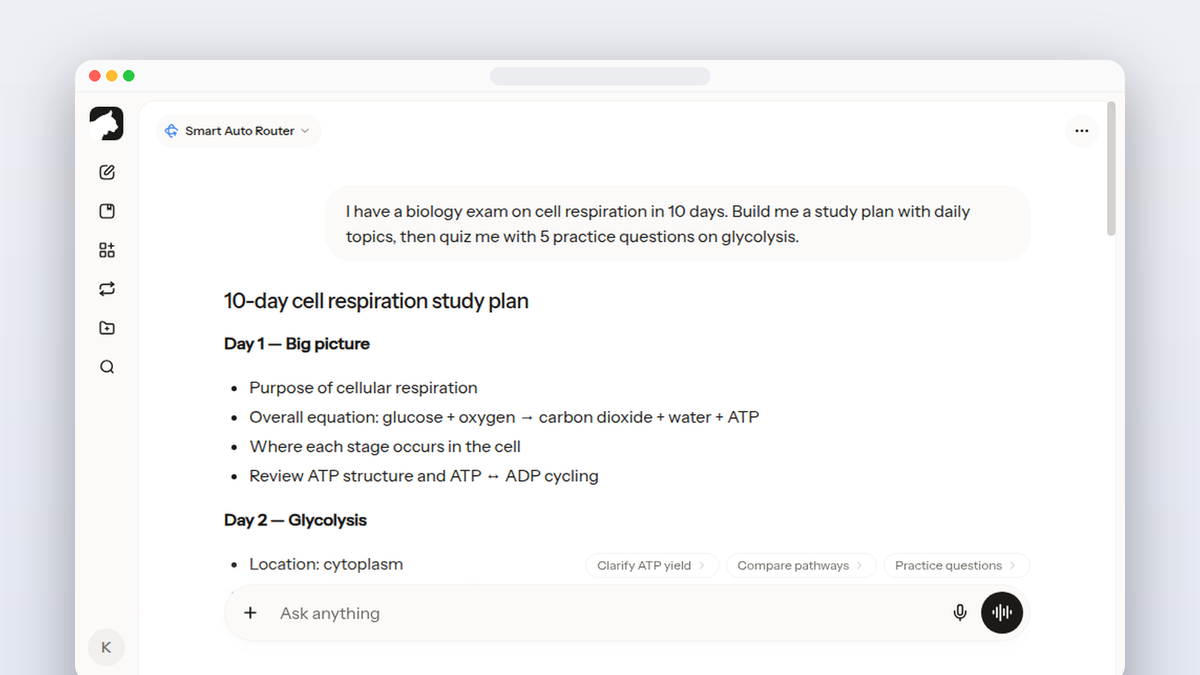
Start with the exam date, available study blocks, topics, confidence ratings and fixed commitments. Put difficult subjects into the time of day when you can think clearly, then leave short review blocks for older material. A calendar that assumes five perfect hours every evening will fail after one late shift, family obligation or tired morning.
Ask AI for a plan with a minimum version and an optional extra version. The minimum might be twenty minutes of recall and one marked question. The extra could be a second topic or a longer practice section. This gives you a way to continue on a difficult day instead of abandoning the whole plan.
Use the explain-back method
The explain-back method is simple: study an idea, close the source and explain it as if you were teaching someone who has not seen it. Notice where you use a vague phrase, skip a step or rely on a word without understanding it. Then reopen the source only to repair that gap. Repeat until the explanation has a clear beginning, middle and example.
Ask AI to act as a curious younger student and ask one question at a time. Do not ask it to write the explanation for you. You want it to expose the point where your understanding becomes fuzzy. Then ask for a short checklist of the ideas you should explain again tomorrow.
Six study prompts you can copy
Turn these notes into 12 active recall questions. Hide the answers below a separate heading and label the source idea for each question.
Create flashcards from this chapter. Use one clear question per card, include definitions, comparisons and application examples, and mark anything uncertain.
Write a 30 minute practice test on these topics with a marking scheme. Do not reveal the answer key until I ask.
Make a revision calendar from today to my exam date. Include spaced reviews, rest and a minimum plan for busy days.
Act as a curious student. Ask me to explain this concept one step at a time, then point out where my explanation needs evidence or a missing link.
Review my answer against this rubric. Mark what is correct, identify the first missing step and give me a similar question to try without writing the answer.
Save these as routines such as /flashcards, /practice-test and /explain-back. The labels are reminders, not shortcuts around doing the work yourself.
Academic honesty and smart help
Using AI to explain a difficult concept, generate practice questions or give feedback on your own draft is different from submitting generated work as if you wrote it. Check your school's policy before using a tool, especially for take-home assessments, personal reflections, code or source based writing. If the rules are unclear, ask a teacher rather than guessing.
A good boundary is explain, question, practice and feedback. Ask the model to show the next step, give you a hint or point to the gap in your reasoning. Do not paste a question from a live assessment and ask for a finished response when the purpose is to measure your independent work.
Model comparison for studying
| Model type | Useful strength | Good study task |
|---|---|---|
| Fast model | Short practice and variations | Flashcards and quick quizzes |
| Reasoning model | Step checks and difficult problems | Marking your method |
| Long context model | Large notes and syllabus | Revision calendar |
| Krater | 400+ models and saved study workflows | Compare explanations and keep progress |
A fast model is useful for many small questions, a reasoning model can challenge a calculation, and a long context model can organize a large set of notes. Krater lets you compare those approaches, use a Persona as a patient tutor and keep your review plan in one workspace.
When parents can help
Parents do not need to become subject experts to support AI assisted study. Ask your student to explain the goal, show the source and say what kind of help is allowed. You can help protect study time, listen to an explain-back session, quiz flashcards or notice when the plan is too ambitious.
Avoid turning every homework session into surveillance. A useful question is, “Show me the part you can do without help and the part you want to understand better.” That keeps the student responsible for the thinking while giving them a calm person to talk to.
The week before an exam
In the final week, switch from collecting resources to retrieving and correcting. Use short mixed quizzes, one timed section and a review list built from mistakes. Sleep, food, movement and a packed bag are part of preparation because a tired brain cannot show what it knows.
Ask AI for a final checklist, not a flood of new notes. Include exam rules, equipment, travel time, permitted materials and a plan for the first five minutes. On the day, follow the official instructions and use your own judgment.
Make each study session observable
A useful session leaves evidence of what you can now do. At the start, write the topic and a small success condition, such as solving four percentage problems or explaining two causes from memory. At the end, record which answers were secure, which needed a hint and which were guesses. This turns a vague feeling of revision into information for the next session.
Use /keep to save a compact error log, /tasks to schedule the next retrieval and /personas to switch between a patient tutor and a strict examiner. Ask for hints in levels. The first hint might identify the relevant rule, the second might show the first step and the third can explain the method after you have tried.
When a practice test goes badly, do not ask for a reassuring summary. Ask the model to group mistakes by concept, careless reading, calculation or missing evidence. Choose one group for the next session. A small correction repeated after a gap usually produces more progress than an enormous new set of notes. Keep a second column for the correction you made and a third for the date you will retrieve it again.
You can also use a model to vary the surface of a question while keeping the underlying skill stable. A history question can change the source excerpt, a maths question can change the numbers and a language exercise can change the situation. Ask it to explain which skill stays constant, then solve the new version without looking at the earlier answer. That protects you from memorizing the shape of one worksheet. Finish by writing one sentence about why your method worked. That final explanation is valuable because it shows whether you can transfer the idea to a new context rather than repeat the wording of the model. Keep the explanation beside the original question so you can compare your first attempt with the improved one. If the explanation uses a term you cannot define, add that term to tomorrow's retrieval list instead of copying the sentence into your notes. Return to the original source and write the definition in your own words. A correct phrase that you cannot explain is not yet secure knowledge. Mark the source page so you can find the fuller explanation later.
Frequently Asked Questions
Can AI study for me?
No. It can organize practice and explain gaps, but you need to retrieve, solve and review the material yourself.
What is active recall?
It is trying to produce an answer from memory before looking at the source.
What is spaced repetition?
It is reviewing material after planned gaps that grow when you remember it.
Can AI mark my practice test?
It can apply a rubric and identify likely gaps, but compare it with your official marking guidance.
Is using AI for homework cheating?
It depends on the assignment and your school's rules. Use explain, practice and feedback modes unless your teacher permits more.
Which model is best for revision?
Choose a model that handles your notes and gives useful explanations, then compare actual practice results.
The Bottom Line
Use AI to make studying more active, not more passive. Ask for questions, hide the answers, explain concepts aloud, mark your own work and return to difficult ideas after a gap. Keep the source material and your school rules in view. The goal is not an AI written answer. It is a stronger memory and a clearer understanding.