

How to Use AI to Prepare for a Job Interview (Mock Questions, Answers and Salary Talk)
A practical interview preparation workflow covering mock questions, STAR examples, questions for employers, salary preparation and the final checklist.
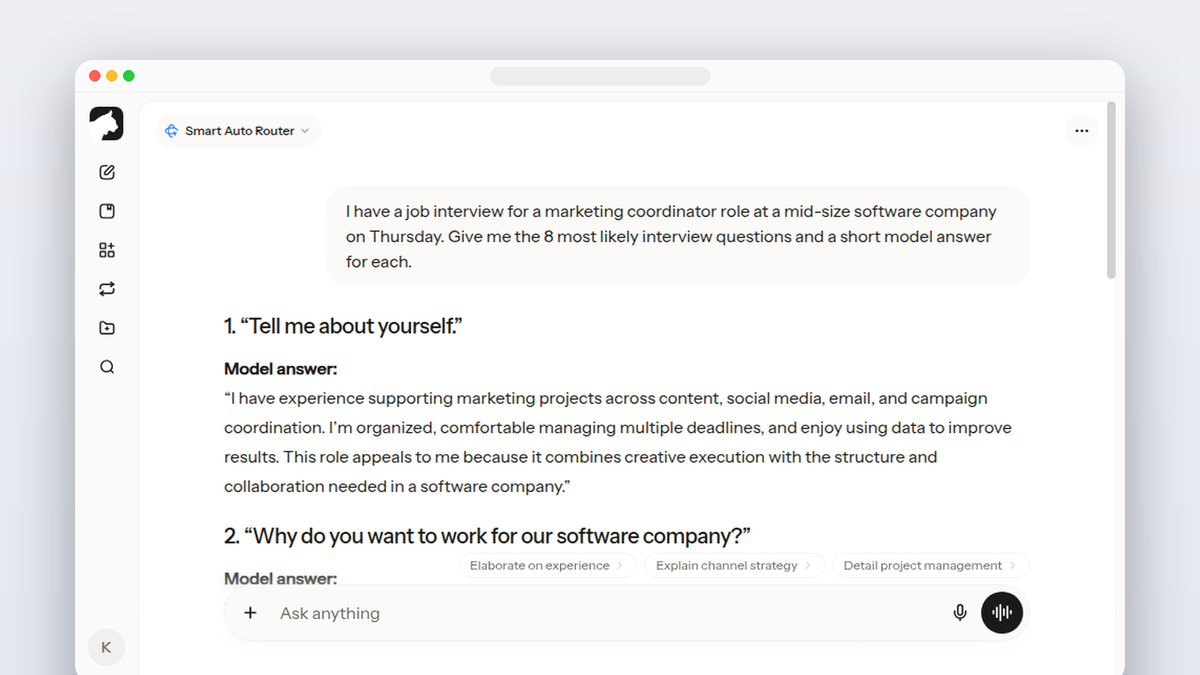
AI can help you turn a job description and your own work history into a focused interview practice plan. It can identify likely themes, ask follow-up questions, tighten a STAR answer and help you rehearse salary language. It cannot know what the panel will ask or invent experience you do not have, so your examples and judgement remain the source of truth.
Key Takeaways
- Analyse the job description into responsibilities, evidence and likely questions.
- Build STAR answers from real situations rather than polished fiction.
- Use a mock interview that asks one question and follows up on vague answers.
- Prepare salary language around research, scope and the whole package.
- Krater lets you compare 400+ models, keep interview notes and practise with Personas, with Predictable $20/month pricing on Pro.
Start with the role, not generic questions
Paste a redacted job description and ask AI to group its requirements into outcomes, recurring responsibilities, tools, behaviours and signals of seniority. Add the company information you have verified, but do not ask the model to guess private interview plans. Mark each requirement as strong evidence, partial evidence, transferable evidence or a genuine gap. This produces a preparation map instead of a list of generic questions.
Look for verbs that reveal what the employer needs: improve, own, analyse, coordinate, launch, reduce, explain or lead. Turn each verb into a question about a real moment from your work, study or volunteering. If the role involves customers, prepare an example about a difficult conversation. If it involves delivery, prepare an example where priorities changed and you still produced a result.
Build honest STAR answers
The STAR structure is situation, task, action and result. The situation and task provide enough context to understand the problem. The action should focus on what you personally decided or did, not a vague description of the team. The result can be a number, a changed process, a customer outcome or a lesson that altered your next decision. Ask AI to flag where you have described activity without showing a result.
Do not let the model inflate a small contribution into leadership or turn an estimate into a measured outcome. If you improved a handover but did not measure the minutes saved, say that the team adopted a clearer checklist and explain how you know it helped. Interviewers can ask for detail. A modest, specific example is stronger than a grand claim you cannot defend.
Create a mock interview loop
Ask for one question at a time and answer aloud before reading any suggested wording. Tell the model to ask a follow-up whenever your answer lacks context, ownership or evidence. After five questions, request a review grouped into clarity, relevance, credibility and concision. Repeat the questions you missed rather than starting a new list every time you feel uncomfortable.
Practise with different interview styles. A hiring manager may explore outcomes and priorities, a future teammate may test collaboration and a specialist may examine your method. Ask AI to switch roles while keeping the same job description. Include one interruption or clarification request so you learn to pause and answer the actual question rather than delivering a memorised speech.
Prepare questions to ask them
Good questions help you understand how the role works. Ask what success looks like after three months, which decisions belong to the role, how priorities are set, what a strong handover looks like and where the team is currently blocked. If the job description is vague, ask how work is measured and which responsibilities take the most time.
Choose questions that match the conversation rather than reading a fixed script. If the interviewer describes a new process, ask what has been learned so far. If they mention a customer problem, ask how the team sees improvement. Avoid asking for information already stated clearly on the website. You want the questions to show preparation and help you decide whether the role suits you.
Prepare salary talk without bluffing
Research a range using several credible sources, then note the location, seniority, industry, contract type and benefits that make comparisons imperfect. Decide the minimum package that would make a move sensible, the target you would be pleased to accept and the conditions that matter beyond salary. AI can help you rehearse the wording, but it cannot verify a private budget or promise that a company will match your number.
A calm script might say, “Based on the scope of the role and the market information I reviewed, I am targeting a range of X to Y. I would also like to understand the full package and how progression works.” If asked for a current salary, decide in advance how you will respond within the rules that apply where you live. Do not invent another offer or claim research you did not do.
Use your own documents safely
Start with your resume, the job description and a private evidence sheet. Remove references' contact details, customer names, confidential figures and any information covered by a work agreement. Use labels such as CLIENT A and PROJECT B. Ask the model to preserve the truth of the example while improving its order. Keep the original files separate so a polished draft never becomes the only record.
Link preparation to the application you actually sent. If a resume says you reduced errors, be ready to explain the baseline, the change and how you checked the result. If a cover letter names a company priority, understand where that came from. Interview practice should expose unsupported claims before a panel does.
The day-before and day-of checklist
The day before, confirm the time zone, location or video link, interviewer names, accessibility needs and documents you may need. Choose a quiet place, test audio and keep water nearby for a remote call. Prepare three evidence stories, three questions and one salary sentence. Stop practising early enough to sleep. More prompts at midnight rarely improve recall.
On the day, read the role's three main outcomes rather than a full script. Take a breath before answering, ask for clarification when needed and use a short pause after a difficult question. If you make a mistake, correct it plainly and continue. Send a concise follow-up that thanks the interviewer and mentions one specific part of the conversation without turning it into a second application.
Six interview preparation prompts
1. Analyse this redacted job description into outcomes, skills, behaviours and likely interview themes.
2. Ask me one interview question at a time for this role. Follow up when my answer lacks ownership or evidence.
3. Turn these real notes into a STAR outline without inventing numbers, titles or responsibilities.
4. Act as a sceptical hiring manager and ask what detail would make each answer credible.
5. Help me draft three questions for the interviewer based on these stated responsibilities.
6. Role-play a salary conversation using this researched range and keep the tone calm, direct and truthful.
Use the prompts as rehearsal tools. Replace every bracket with your own evidence, then practise speaking without looking at the generated prose.
Model comparison for interview preparation
| Approach | Useful strength | Best task |
|---|---|---|
| Fast model | Quick rewrites | Short answer polish |
| Reasoning model | Maps requirements | Question priorities |
| Long context model | Compares documents | Resume and job description |
| Krater | 400+ models and saved practice | Interview loop, Keep and Tasks |
A long context model is useful when the role description and your evidence sheet are substantial. A reasoning model can expose missing links between a requirement and your example. Krater lets you compare different responses, save the verified evidence and run a repeatable mock interview with a Persona without losing the original facts.
Keep your voice in the room
A panel is not grading a paragraph. It is listening for judgement, ownership and the ability to work with other people. Use generated wording as a rehearsal aid, then shorten it until you can say it naturally. Replace corporate phrases with the words you use when explaining work to a colleague. If an answer sounds perfect on the page but awkward aloud, it is not ready.
Use /keep for verified examples, /tasks for interview logistics and /personas for a challenging but fair interviewer. Review the notes after each practice round and mark what still needs evidence. The goal is not to sound machine-made. It is to arrive prepared enough to think clearly.
Recover when an answer goes badly
A difficult question does not automatically ruin an interview. Pause, repeat the question in your own words and ask for a moment to think if the format allows it. If you realise that your first answer missed the point, say so and give the relevant example. Honest correction demonstrates awareness. AI can help you rehearse recovery phrases, but the useful habit is learning to listen before you respond.
After the interview, write down the questions you remember and where your evidence felt thin. Do not try to reconstruct every facial expression or turn a delayed reply into a verdict. Ask the model to classify the gaps as missing knowledge, weak structure, unclear wording or nerves. That classification gives you a next practice step. If you receive feedback, keep the exact wording and decide which part you can act on.
Prepare for a panel or practical task
Some interviews include several people or a short exercise. Ask AI to map each stated responsibility to the person most likely to care about it, then prepare one question for each perspective. For a practical task, practise explaining your assumptions before showing the result. A panel may be assessing how you think, communicate trade offs and ask for missing information, not merely whether the final answer is polished.
If the exercise includes confidential material, use fictional or public examples during rehearsal. Explain which part of your method would change when you receive real data. Ask the model to give you a time limit and an interruption so you can practise prioritising. When the interview ends, note what you would improve in the process, not just what you would change in the final answer.
Translate preparation into evidence
For each important requirement, keep a small card with the situation, your decision, the action you took and the result you can defend. Add one sentence about what you would do differently now. These cards are easier to review than a full script and flexible enough to answer several questions. If two examples prove the same skill, choose the one with clearer ownership and a result you can explain.
Ask a trusted person to listen for missing context and jargon. A listener who does not know your workplace is useful because they will notice when you assume the panel understands an internal acronym. Replace that acronym with the task it represented. Clear translation is a professional skill, especially for roles where you will explain decisions to customers, colleagues or senior leaders.
Frequently Asked Questions
Can AI write my interview answers?
It can help structure your real examples and rehearse wording. You should supply the facts and speak in your own voice.
What if I do not have a perfect example?
Use a smaller truthful example, explain what you learned and connect it to how you would handle the role.
How many STAR stories should I prepare?
Three to five flexible stories can cover many themes if you understand the decisions, actions and results in each one.
Should I give a salary number first?
That depends on the context and local rules. Research a range and prepare a calm response before the interview.
Can AI predict the interview questions?
It can identify likely themes from the description, but no model can guarantee what a panel will ask.
Can Krater record my mock interview?
Use the workspace for preparation and notes according to your privacy needs. Review what information you store before uploading it.
The Bottom Line
Use AI to make preparation specific, honest and repeatable. Analyse the role, practise real evidence, prepare thoughtful questions and research salary language, then let the interview be a conversation rather than a performance of generated text.