

How to Use AI to Understand Medical Letters, Bills and Insurance Documents
A cautious guide to using AI for plain language medical paperwork, bills and insurance questions, with strong privacy and human review boundaries.
AI can help you turn a confusing medical letter, bill or insurance document into plain language and a list of questions. It is not medical, legal, billing or insurance advice. Redact names, dates of birth, patient IDs, policy numbers, addresses and account details before pasting anything. Call a qualified human when the matter affects urgent care, treatment, coverage or a payment deadline.
Key Takeaways
- Use AI for translation and preparation, never as a diagnosis or final coverage decision.
- Redact names, IDs, policy numbers, addresses and account details before sharing a document.
- Ask for a plain language summary with the original term preserved beside it.
- Check bill line items against the provider statement and call the billing office about discrepancies.
- Krater gives you 400+ models and saved workflows with Predictable $20/month pricing on Pro, but privacy review remains your responsibility.
Important safety and privacy boundaries
This guide is not medical advice, diagnosis, treatment advice, legal advice or insurance advice. AI can misread a scan, misunderstand a code, omit a qualification or sound certain when the source is unclear. It cannot examine you, see your full medical history or replace a doctor, pharmacist, nurse, insurer or billing specialist.
Before you paste anything, make a redacted copy. Remove your name, date of birth, address, phone number, medical record number, policy number, member ID, claim number, barcode, account number and any other identifier. Replace them with labels such as PATIENT or CLAIM A. Do not paste passwords or portal login details.
Translate a medical letter into plain language
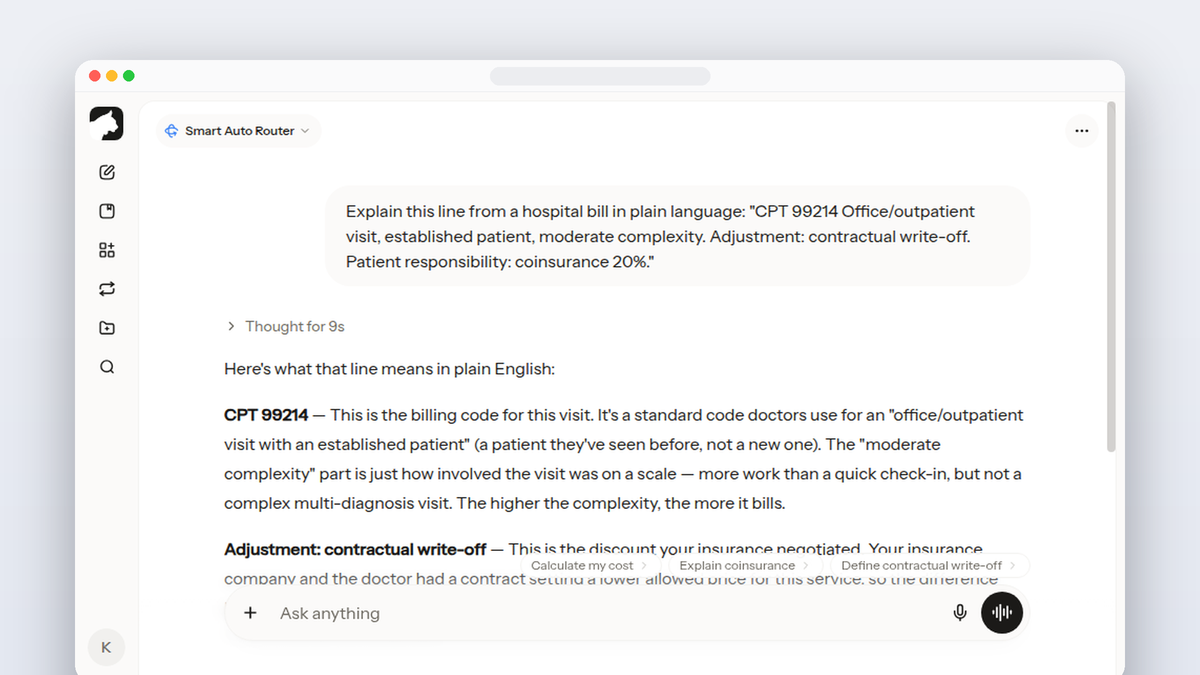
Ask AI to preserve the original medical terms while placing a plain language explanation beside each one. Request a separate list of what the letter asks you to do, dates or appointments it mentions, words that are uncertain and questions you should ask the sender. A useful summary does not erase the original wording because you may need it when speaking to a clinic.
Compare the summary with the source paragraph by paragraph. If the letter mentions a result, ask what the result says and what it does not say. Do not ask the model to predict what happens next or to tell you whether a treatment is right for you. Take those questions to a clinician.
Make a question list for your doctor
Bring the original letter, your redacted notes and the questions you want answered. Ask AI to group questions into meaning, next steps, alternatives, side effects, preparation, timing and who to contact. Put your most important three questions first because an appointment may be shorter than you expect.
Use plain wording and mention what you do not understand. For example, ask what a term means in your situation, what change would require a call and which symptoms should receive urgent attention. Let the clinician answer in context. AI can help you remember to ask, but it cannot decide which answer applies to your body.
Check medical bill line items
Make a table with service date, provider, description, code if shown, amount billed, insurance adjustment, payment, amount due and question. Compare the bill with the explanation of benefits and any receipt you have. Look for duplicated dates, a service you did not receive, a payment applied to the wrong account, a missing adjustment or a deadline that needs attention.
Ask AI to identify rows that deserve a call, not to declare that a bill is wrong. Billing codes and insurance rules are specialized and can differ by plan. Contact the provider billing office or insurer using a trusted number from your card or statement, not a number supplied by an unverified message.
Draft an appeal or clarification letter
An appeal letter should state the decision or charge, the date, the reason you believe a review is needed, the documents attached and the action you request. Keep it factual and within the deadline. AI can organize your notes into a calm draft, but you should confirm the policy wording, claim number and recipient before sending.
Ask for a version that does not overstate your case. List the evidence you actually have and mark anything missing. If an advocate, clinician or legal adviser needs to review the letter, give them the source documents and the draft together. Keep proof of submission and a copy of what you sent.
Build an insurance glossary
Insurance letters often use terms such as deductible, copayment, coinsurance, allowed amount, prior authorization, out of network, explanation of benefits and appeal. Ask AI to define each term in plain language and give a neutral example, then compare the definition with your insurer's official glossary or member documents.
Never assume that a general definition answers your plan question. Ask the insurer what the term means for the specific service, provider and date. Keep a note of the representative's name, call date, reference number and promised follow up, but do not paste sensitive identifiers into a public conversation.
Six privacy safe prompts
Translate this redacted medical letter into plain language. Keep every original medical term, list the actions and dates, and mark anything you cannot explain from the text.
Turn this redacted letter into questions for my doctor. Group them by meaning, next step, timing and what would require a call.
Compare these redacted bill rows with the explanation of benefits. Flag duplicates, missing adjustments and questions for the billing office without deciding that an error occurred.
Draft a factual appeal letter from these redacted notes. Preserve the deadline, requested action and documents, and mark every field I must verify.
Explain these insurance terms in plain language, then list what I must ask my insurer because a general definition cannot answer my plan question.
Review this redacted document for privacy risks before I share it. Identify names, IDs, policy numbers, addresses, barcodes and account details that should be removed.
When to call a human immediately
Call emergency services or urgent medical care for urgent symptoms rather than asking AI what they mean. Contact your doctor, pharmacist or clinic when a letter concerns a new result, medication, dosage, procedure or symptom you do not understand. Contact the provider billing office for a charge question and your insurer for coverage, network, authorization or appeal rules.
Also call when the document has a deadline, the stakes are high, the information conflicts or you cannot tell whether it applies to you. Keep the document open during the call and write down the answer. A human conversation may take longer than a generated summary, but it gives you a chance to explain context and ask what to do next.
Model comparison for paperwork
| Model type | Useful strength | Good task |
|---|---|---|
| Long context model | Reads several pages | Summarize a redacted packet |
| Reasoning model | Organizes discrepancies | Build a bill question list |
| Fast model | Plain language drafts | Glossary and appointment notes |
| Krater | 400+ models and saved context | Compare explanations and keep checklists |
Use a long context model for a carefully redacted packet, a reasoning model to organize questions and a fast model for a short glossary. Krater can keep a checklist and let you compare model responses, but it does not change the privacy or medical boundaries.
A careful final review
Read the plain language version beside the original. Check every date, number, name of a service, deadline and requested action. Mark what the model inferred and remove it if the source did not say it. Then decide which human should answer the remaining question and how you will contact them safely.
Do not let a neat summary delay care or a payment response. If the deadline is close, send a short clarification request while preparing the fuller question list. Keep your own records in a secure place and use AI only for the part of the work it can safely support.
Organize a safe document workflow
Make three copies of your paperwork: the original in a secure place, a redacted working copy and a short question sheet. Give each document a neutral label rather than a name or policy number. Write down the date you received it and the deadline, because a plain language summary is not useful if it causes you to miss an appeal or payment window.
Use /keep for the redacted glossary and question list, /tasks for calls and deadlines and /personas for a plain language explainer. Ask the model to quote the exact source phrase beside every explanation. If it cannot locate the phrase, mark the statement as uncertain and take it to the appropriate office.
Do not combine documents simply because they concern the same person. A medical letter, an explanation of benefits and a provider bill may use related words while following different rules. Work on one question at a time, retain the source page and decide whether the next call belongs with the clinic, insurer, provider billing team or a patient advocate. When you call, ask the representative to repeat the answer in plain language and note any reference number they provide.
For a bill review, begin with arithmetic that you can see. Add the line items, subtract listed adjustments and payments and compare the result with the amount due. Treat the calculation as a question generator, not proof of an error. A service date may be grouped differently, an insurer may process a claim later or a statement may show a balance from another page. Keep the original statement open while someone explains it.
For an appeal, separate facts from arguments. Facts include the date, decision, document title, wording quoted from the notice and evidence attached. The argument is why you believe the decision should be reconsidered. Ask AI to keep those parts separate and mark missing evidence. A shorter factual letter sent before the deadline is usually more useful than a polished letter sent late. Keep a copy of the notice, the submitted letter and delivery proof. If the organization offers an appeal form, use its headings rather than hiding the answer in a long narrative. Ask a trusted person to check names, dates and attachments, but do not send them more personal information than they need. If an urgent symptom or treatment question appears while you are reviewing paperwork, stop the document workflow and contact a qualified human. A checklist can make a call calmer, but it should never become a reason to wait. Keep urgent questions at the top of the page and circle any deadline that needs action today. If another person is helping you, tell them which answer you need and which details are private before sharing the page. You can hand over a question list without handing over the entire document. Ask the office to explain any abbreviation you still do not understand, and write the answer next to the original term. Keep the date of that explanation in your notes.
Frequently Asked Questions
Is AI medical advice?
No. It can explain wording and prepare questions, but it cannot diagnose, treat or replace a qualified clinician.
What should I redact?
Remove names, dates of birth, addresses, IDs, policy and claim numbers, barcodes, account details and passwords.
Can AI check a medical bill?
It can organize line items and flag questions, but a provider billing office or insurer must explain codes and coverage.
Can AI write an insurance appeal?
It can organize a factual draft. Verify policy wording, dates, recipients and evidence before sending.
When should I call a human?
Call for urgent symptoms, treatment questions, medication issues, coverage decisions, deadlines or anything the document does not clearly answer.
Can Krater store medical documents?
Follow your own privacy rules and do not upload sensitive documents without approval. Redaction and human review remain essential.
The Bottom Line
AI can make medical paperwork less intimidating when you use it as a careful translation and preparation aid. Redact aggressively, compare every summary with the source, write questions for the right human and act on deadlines. Never use a fluent answer as a diagnosis, treatment decision or coverage guarantee.