

Krater AI Cost Index: What the Same Ecommerce Work Costs Across AI Models
The same AI workload can cost dramatically different amounts depending on the model. The Krater AI Cost Index compares public prices across product descriptions, ad copy, support replies, documents, images, and video.
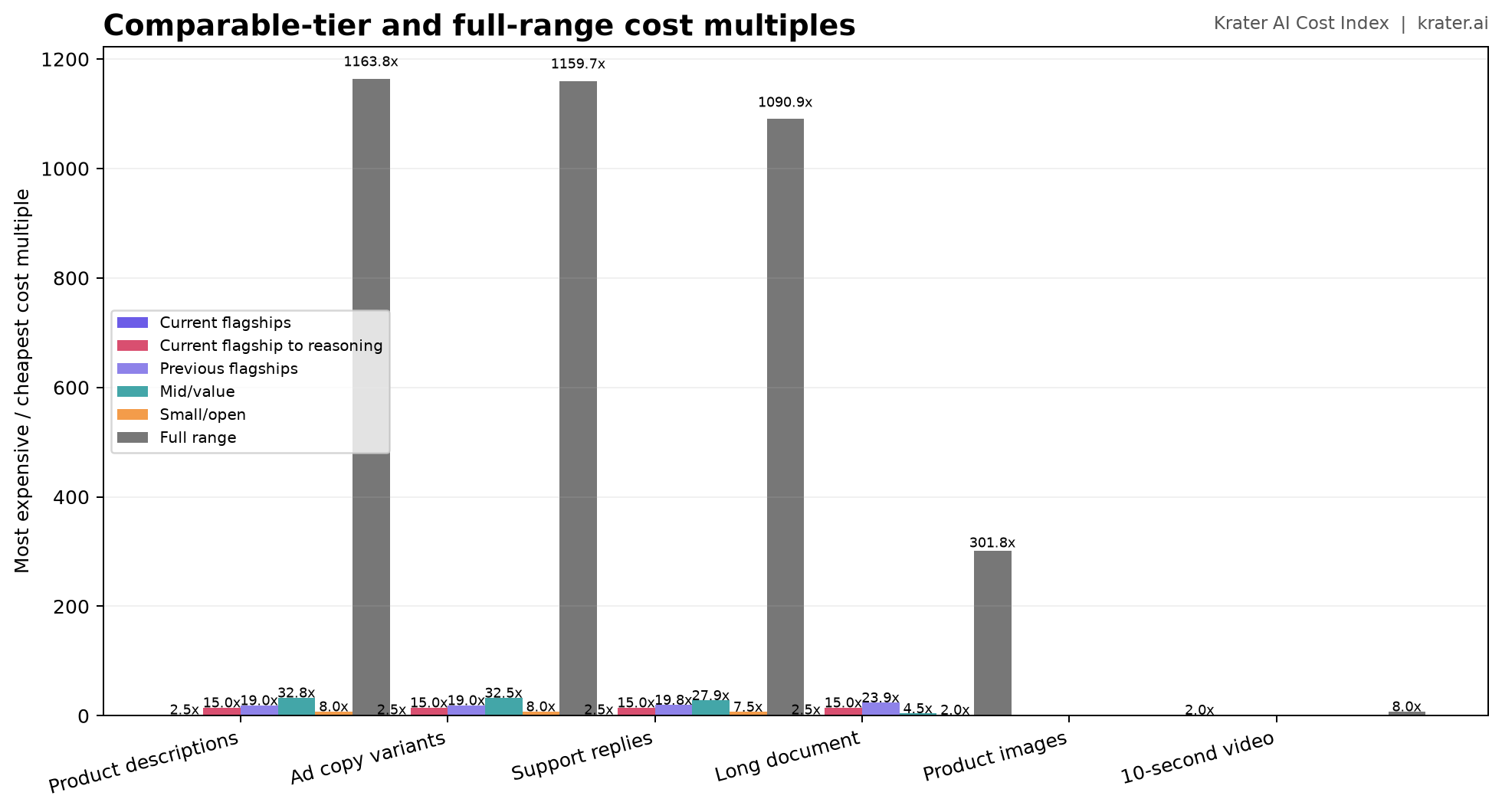
The primary finding is within current-generation flagship models: the same 1,000 product descriptions cost 2.5x more on OpenAI: GPT-5.5 than on Google: Gemini 3.1 Pro Preview, or $8.35 versus $3.34. Pro/reasoning variants carry a separate premium: the highest reasoning variant costs 15.0x more than the cheapest current flagship. Across the entire sample, the secondary spread is 1,163.8x, but that spans different generations and product classes. Price is not quality, and the cheapest model may not be suitable for the job.
Key takeaways
For the complementary production-log view of which model classes actually ran work, see the Krater Model Usage Index.
- The index contains 25 text models from OpenRouter plus public fal.ai image and video prices, captured on 2026-08-11.
- Within current-generation flagships, the text-job spreads range from 2.5x to 2.5x.
- For product descriptions, current flagships span 2.5x. The lowest current flagship to highest reasoning variant is 15.0x.
- Previous-generation flagships, mid/value models, and small/open models remain in the data and are labeled rather than silently dropped.
- The full-range product-description figure is 1,163.8x, but it spans different generations and product classes. Price is not quality, and the cheapest model may not be suitable for the job.
- Media uses different units. One hundred 1MP product images span 2.0x; one 10-second video spans 8.0x.
- A representative monthly ecommerce workload costs $23.77 using the median selected model for each job. That figure is an illustration, not a universal bill.
What the index measures
The index turns public provider prices into repeatable ecommerce workloads. It does not ask which model writes the best copy, produces the best image, or generates the best video. It asks a narrower question: if the input and output assumptions are held constant, how much does the listed API price change when the model changes?
That distinction matters. A larger model may justify its price for a difficult task, while a smaller model may be entirely adequate for a short support reply. The index makes that tradeoff visible without pretending that price is a quality score.
Current-generation and product-class headline comparison
The current-generation flagship column is the primary apples-to-apples comparison. Pro/reasoning is shown separately because those variants carry a distinct premium. The full-range column is secondary and spans different generations and product classes.
| Job | Current flagships | Current flagship to reasoning | Previous flagships | Mid/value | Small/open | Full range |
|---|---|---|---|---|---|---|
| 1,000 product descriptions | 2.5x | 15.0x | 19.0x | 32.8x | 8.0x | 1,163.8x |
| 1,000 ad copy variants | 2.5x | 15.0x | 19.0x | 32.5x | 8.0x | 1,159.7x |
| 1,000 customer support replies | 2.5x | 15.0x | 19.8x | 27.9x | 7.5x | 1,090.9x |
| One long document analysis pass | 2.5x | 15.0x | 23.9x | 4.5x | 2.0x | 301.8x |
| 100 product images at 1MP | Not applicable | Not applicable | Not applicable | Not applicable | Not applicable | 2.0x |
| One 10-second video | Not applicable | Not applicable | Not applicable | Not applicable | Not applicable | 8.0x |
Verdict: The primary current-generation flagship result for product descriptions is 2.5x. The separate current-flagship-to-reasoning figure is 15.0x. The larger full-range figures remain visible for transparency, with the explicit caveat that price is not quality and the cheapest model may not be suitable.
How different tools handle AI costs
| Option | Pricing basis | What this index can compare | Limitation |
|---|---|---|---|
| Krater Pro (Recommended) | One subscription with a shared credit pool | 350+ models and multiple modalities in one workspace. Readers comparing that model with autonomous agent products can see Best Manus Alternatives. | Credits can run out; request ceilings, API and team controls exist; upstream provider capacity can still affect a model |
| OpenRouter API | Public per-token model prices | Text model input and output price comparisons | Prices and model availability can change; this index is a dated snapshot |
| fal.ai APIs | Output-unit pricing such as image, megapixel, second, or video | Image and video generation price comparisons | Resolution, audio, duration, and endpoint settings can change the bill |
| Direct provider APIs | Provider-specific token or output pricing | Can be compared when a public price is available | Different providers expose different units, discounts, and availability rules |
Verdict: Krater is a workspace for choosing among 350+ models and modalities through metered credits, while the public APIs in this study expose the underlying list-price differences. A raw API price is not a workspace: direct API access does not by itself provide Krater's interface, storage, Agents, shared workspace, or multimodal tooling. Krater does not remove usage controls or upstream capacity constraints.
1,000 product descriptions
Assumption: 350 input tokens and 220 output tokens per description.
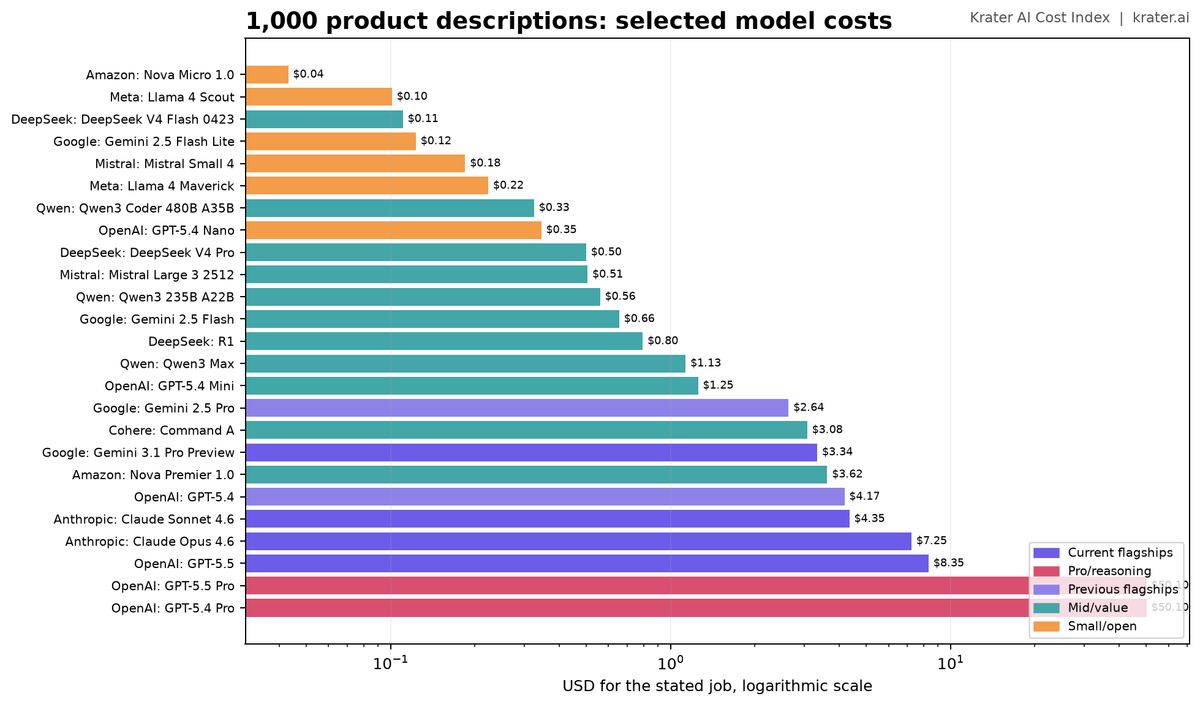
Primary comparable-group result: The primary apples-to-apples result is the current-generation flagship spread: Google: Gemini 3.1 Pro Preview at $3.34 versus OpenAI: GPT-5.5 at $8.35, or 2.5x. The two Pro/reasoning variants themselves span 1.0x. Comparing the lowest current flagship with the highest reasoning variant gives 15.0x.
Other groups: Mid/value spans 32.8x, small/open spans 8.0x, and previous-generation flagships span 19.0x.
Secondary full-range result: The secondary full-range figure is 1,163.8x, from $0.04 to $50.10, across models with very different capability, generation, and product class. Price is not quality, and the cheapest model may not be suitable for this job.
Reproducible arithmetic: For Nova Micro: 1,000 x (350 x $0.000000035 + 220 x $0.00000014) = $0.04305. For GPT-5.5 Pro: 1,000 x (350 x $0.00003 + 220 x $0.00018) = $50.10.
| Comparison group | Lowest listed cost | Highest listed cost | Multiple | Mid-tier reference |
|---|---|---|---|---|
| Current-generation flagships | Google: Gemini 3.1 Pro Preview: $3.34 | OpenAI: GPT-5.5: $8.35 | 2.5x | Anthropic: Claude Sonnet 4.6: $4.35 |
| Pro/reasoning variants | OpenAI: GPT-5.5 Pro: $50.10 | OpenAI: GPT-5.5 Pro: $50.10 | 1.0x | OpenAI: GPT-5.5 Pro: $50.10 |
| Previous-generation flagships | Google: Gemini 2.5 Pro: $2.64 | OpenAI: GPT-5.4 Pro: $50.10 | 19.0x | OpenAI: GPT-5.4: $4.17 |
| Mid/value models | DeepSeek: DeepSeek V4 Flash 0423: $0.11 | Amazon: Nova Premier 1.0: $3.62 | 32.8x | Google: Gemini 2.5 Flash: $0.66 |
| Small/open models | Amazon: Nova Micro 1.0: $0.04 | OpenAI: GPT-5.4 Nano: $0.35 | 8.0x | Google: Gemini 2.5 Flash Lite: $0.12 |
| Lowest current flagship to highest reasoning variant | Google: Gemini 3.1 Pro Preview: $3.34 | OpenAI: GPT-5.5 Pro: $50.10 | 15.0x | Anthropic: Claude Sonnet 4.6: $4.35 |
| Entire eligible range | Amazon: Nova Micro 1.0: $0.04 | OpenAI: GPT-5.5 Pro: $50.10 | 1,163.8x | DeepSeek: R1: $0.80 |
Bottom line: A public list price is one input to model selection. Quality, context handling, reliability, tools, and the task's acceptance criteria still matter.
1,000 ad copy variants
Assumption: 200 input tokens and 120 output tokens per variant.
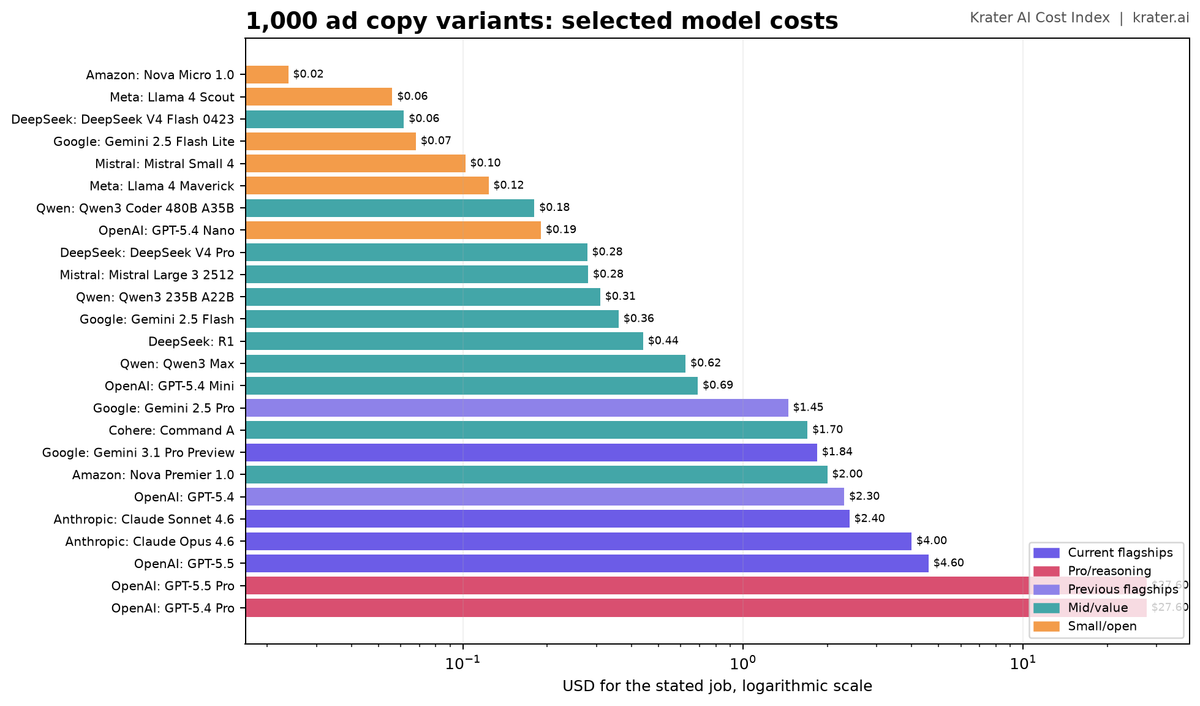
Primary comparable-group result: The primary apples-to-apples result is the current-generation flagship spread: Google: Gemini 3.1 Pro Preview at $1.84 versus OpenAI: GPT-5.5 at $4.60, or 2.5x. The two Pro/reasoning variants themselves span 1.0x. Comparing the lowest current flagship with the highest reasoning variant gives 15.0x.
Other groups: Mid/value spans 32.5x, small/open spans 8.0x, and previous-generation flagships span 19.0x.
Secondary full-range result: The secondary full-range figure is 1,159.7x, from $0.02 to $27.60, across models with very different capability, generation, and product class. Price is not quality, and the cheapest model may not be suitable for this job.
Reproducible arithmetic: For Nova Micro: 1,000 x (200 x $0.000000035 + 120 x $0.00000014) = $0.0238. For GPT-5.5 Pro: 1,000 x (200 x $0.00003 + 120 x $0.00018) = $27.60.
| Comparison group | Lowest listed cost | Highest listed cost | Multiple | Mid-tier reference |
|---|---|---|---|---|
| Current-generation flagships | Google: Gemini 3.1 Pro Preview: $1.84 | OpenAI: GPT-5.5: $4.60 | 2.5x | Anthropic: Claude Sonnet 4.6: $2.40 |
| Pro/reasoning variants | OpenAI: GPT-5.5 Pro: $27.60 | OpenAI: GPT-5.5 Pro: $27.60 | 1.0x | OpenAI: GPT-5.5 Pro: $27.60 |
| Previous-generation flagships | Google: Gemini 2.5 Pro: $1.45 | OpenAI: GPT-5.4 Pro: $27.60 | 19.0x | OpenAI: GPT-5.4: $2.30 |
| Mid/value models | DeepSeek: DeepSeek V4 Flash 0423: $0.06 | Amazon: Nova Premier 1.0: $2.00 | 32.5x | Google: Gemini 2.5 Flash: $0.36 |
| Small/open models | Amazon: Nova Micro 1.0: $0.02 | OpenAI: GPT-5.4 Nano: $0.19 | 8.0x | Google: Gemini 2.5 Flash Lite: $0.07 |
| Lowest current flagship to highest reasoning variant | Google: Gemini 3.1 Pro Preview: $1.84 | OpenAI: GPT-5.5 Pro: $27.60 | 15.0x | Anthropic: Claude Sonnet 4.6: $2.40 |
| Entire eligible range | Amazon: Nova Micro 1.0: $0.02 | OpenAI: GPT-5.5 Pro: $27.60 | 1,159.7x | DeepSeek: R1: $0.44 |
Bottom line: A public list price is one input to model selection. Quality, context handling, reliability, tools, and the task's acceptance criteria still matter.
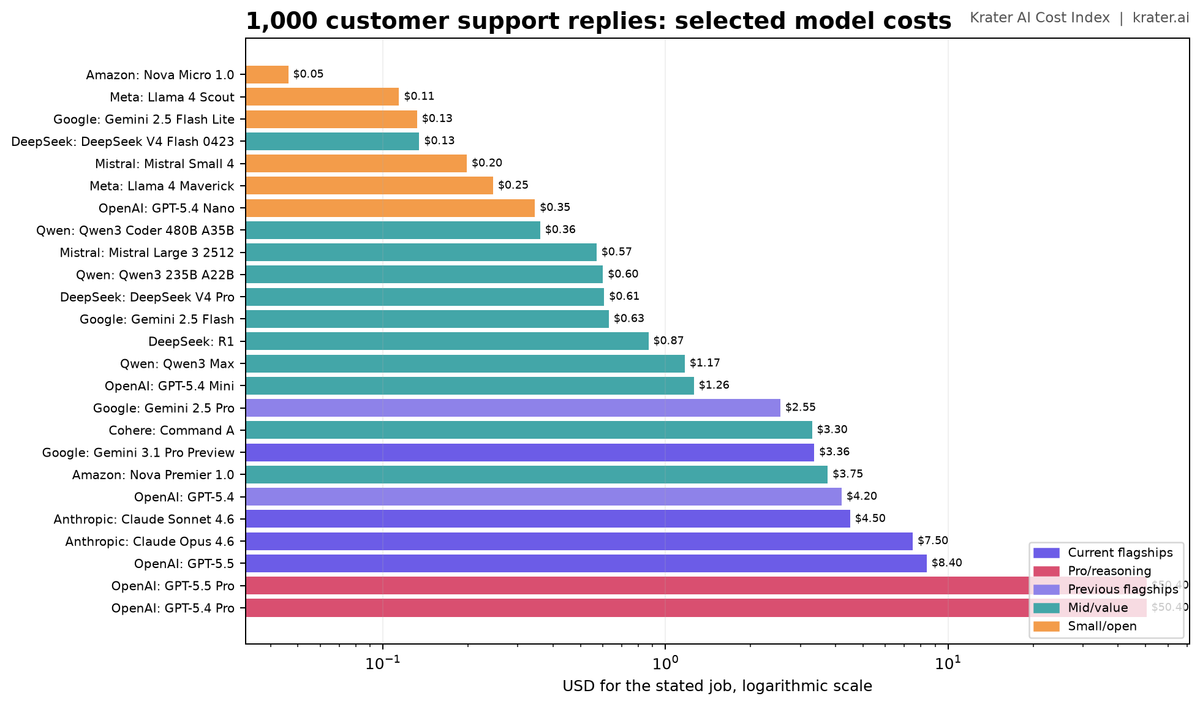
1,000 customer support replies
Assumption: 600 input tokens and 180 output tokens per reply.
Primary comparable-group result: The primary apples-to-apples result is the current-generation flagship spread: Google: Gemini 3.1 Pro Preview at $3.36 versus OpenAI: GPT-5.5 at $8.40, or 2.5x. The two Pro/reasoning variants themselves span 1.0x. Comparing the lowest current flagship with the highest reasoning variant gives 15.0x.
Other groups: Mid/value spans 27.9x, small/open spans 7.5x, and previous-generation flagships span 19.8x.
Secondary full-range result: The secondary full-range figure is 1,090.9x, from $0.05 to $50.40, across models with very different capability, generation, and product class. Price is not quality, and the cheapest model may not be suitable for this job.
Reproducible arithmetic: For Nova Micro: 1,000 x (600 x $0.000000035 + 180 x $0.00000014) = $0.0462. For GPT-5.5 Pro: 1,000 x (600 x $0.00003 + 180 x $0.00018) = $50.40.
| Comparison group | Lowest listed cost | Highest listed cost | Multiple | Mid-tier reference |
|---|---|---|---|---|
| Current-generation flagships | Google: Gemini 3.1 Pro Preview: $3.36 | OpenAI: GPT-5.5: $8.40 | 2.5x | Anthropic: Claude Sonnet 4.6: $4.50 |
| Pro/reasoning variants | OpenAI: GPT-5.5 Pro: $50.40 | OpenAI: GPT-5.5 Pro: $50.40 | 1.0x | OpenAI: GPT-5.5 Pro: $50.40 |
| Previous-generation flagships | Google: Gemini 2.5 Pro: $2.55 | OpenAI: GPT-5.4 Pro: $50.40 | 19.8x | OpenAI: GPT-5.4: $4.20 |
| Mid/value models | DeepSeek: DeepSeek V4 Flash 0423: $0.13 | Amazon: Nova Premier 1.0: $3.75 | 27.9x | Google: Gemini 2.5 Flash: $0.63 |
| Small/open models | Amazon: Nova Micro 1.0: $0.05 | OpenAI: GPT-5.4 Nano: $0.35 | 7.5x | Google: Gemini 2.5 Flash Lite: $0.13 |
| Lowest current flagship to highest reasoning variant | Google: Gemini 3.1 Pro Preview: $3.36 | OpenAI: GPT-5.5 Pro: $50.40 | 15.0x | Anthropic: Claude Sonnet 4.6: $4.50 |
| Entire eligible range | Amazon: Nova Micro 1.0: $0.05 | OpenAI: GPT-5.5 Pro: $50.40 | 1,090.9x | DeepSeek: R1: $0.87 |
Bottom line: A public list price is one input to model selection. Quality, context handling, reliability, tools, and the task's acceptance criteria still matter.
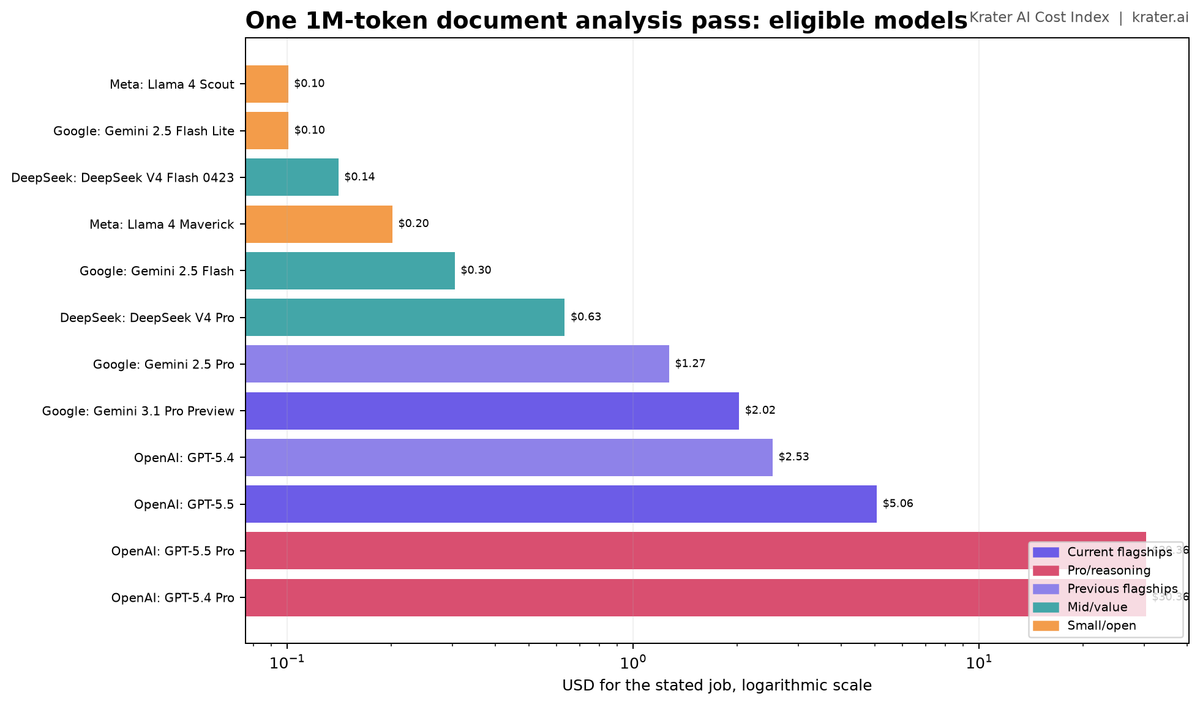
One long document analysis pass
Assumption: 1,000,000 input tokens and 2,000 output tokens. Only models with at least 1,002,000 tokens of context were eligible.
Primary comparable-group result: The primary apples-to-apples result is the current-generation flagship spread: Google: Gemini 3.1 Pro Preview at $2.02 versus OpenAI: GPT-5.5 at $5.06, or 2.5x. The two Pro/reasoning variants themselves span 1.0x. Comparing the lowest current flagship with the highest reasoning variant gives 15.0x.
Other groups: Mid/value spans 4.5x, small/open spans 2.0x, and previous-generation flagships span 23.9x.
Secondary full-range result: The secondary full-range figure is 301.8x, from $0.10 to $30.36, across models with very different capability, generation, and product class. Price is not quality, and the cheapest model may not be suitable for this job.
Reproducible arithmetic: For Llama 4 Scout: 1,000,000 x $0.0000001 + 2,000 x $0.0000003 = $0.1006. For GPT-5.5 Pro: 1,000,000 x $0.00003 + 2,000 x $0.00018 = $30.36.
| Comparison group | Lowest listed cost | Highest listed cost | Multiple | Mid-tier reference |
|---|---|---|---|---|
| Current-generation flagships | Google: Gemini 3.1 Pro Preview: $2.02 | OpenAI: GPT-5.5: $5.06 | 2.5x | Google: Gemini 3.1 Pro Preview: $2.02 |
| Pro/reasoning variants | OpenAI: GPT-5.5 Pro: $30.36 | OpenAI: GPT-5.5 Pro: $30.36 | 1.0x | OpenAI: GPT-5.5 Pro: $30.36 |
| Previous-generation flagships | Google: Gemini 2.5 Pro: $1.27 | OpenAI: GPT-5.4 Pro: $30.36 | 23.9x | OpenAI: GPT-5.4: $2.53 |
| Mid/value models | DeepSeek: DeepSeek V4 Flash 0423: $0.14 | DeepSeek: DeepSeek V4 Pro: $0.63 | 4.5x | Google: Gemini 2.5 Flash: $0.30 |
| Small/open models | Meta: Llama 4 Scout: $0.10 | Meta: Llama 4 Maverick: $0.20 | 2.0x | Google: Gemini 2.5 Flash Lite: $0.10 |
| Lowest current flagship to highest reasoning variant | Google: Gemini 3.1 Pro Preview: $2.02 | OpenAI: GPT-5.5 Pro: $30.36 | 15.0x | Google: Gemini 3.1 Pro Preview: $2.02 |
| Entire eligible range | Meta: Llama 4 Scout: $0.10 | OpenAI: GPT-5.5 Pro: $30.36 | 301.8x | DeepSeek: DeepSeek V4 Pro: $0.63 |
Bottom line: A public list price is one input to model selection. Quality, context handling, reliability, tools, and the task's acceptance criteria still matter.
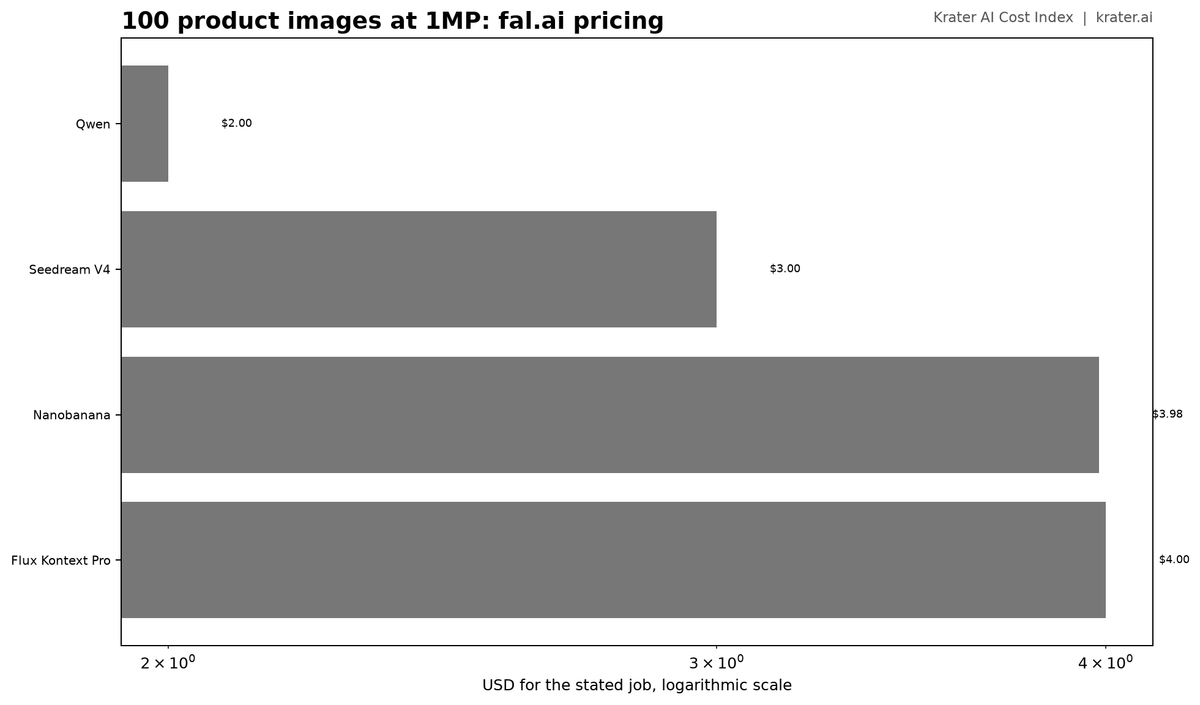
100 product images
Assumption: 100 images at the 1MP normalization used by the fal.ai pricing page.
Primary comparable-group result: The eligible range runs from Qwen at $2.00 to Flux Kontext Pro at $4.00, a 2.0x spread.
Secondary full-range result: This is an output-price comparison, not a quality ranking. Price is not quality, and the cheapest option may not be suitable for every result.
Reproducible arithmetic: For Qwen: 100 x $0.02 = $2.00. For Flux Kontext Pro: 100 x $0.04 = $4.00.
Per-image view: The selected prices are $0.02 per image at the low end, $0.04 at the high end, and $0.03 for the median-cost reference. fal.ai normalizes this table to 1MP output.
| Comparison group | Lowest listed cost | Highest listed cost | Multiple | Mid-tier reference |
|---|---|---|---|---|
| Entire eligible range | Qwen: $2.00 | Flux Kontext Pro: $4.00 | 2.0x | Seedream V4: $3.00 |
Bottom line: A public list price is one input to model selection. Quality, context handling, reliability, tools, and the task's acceptance criteria still matter.
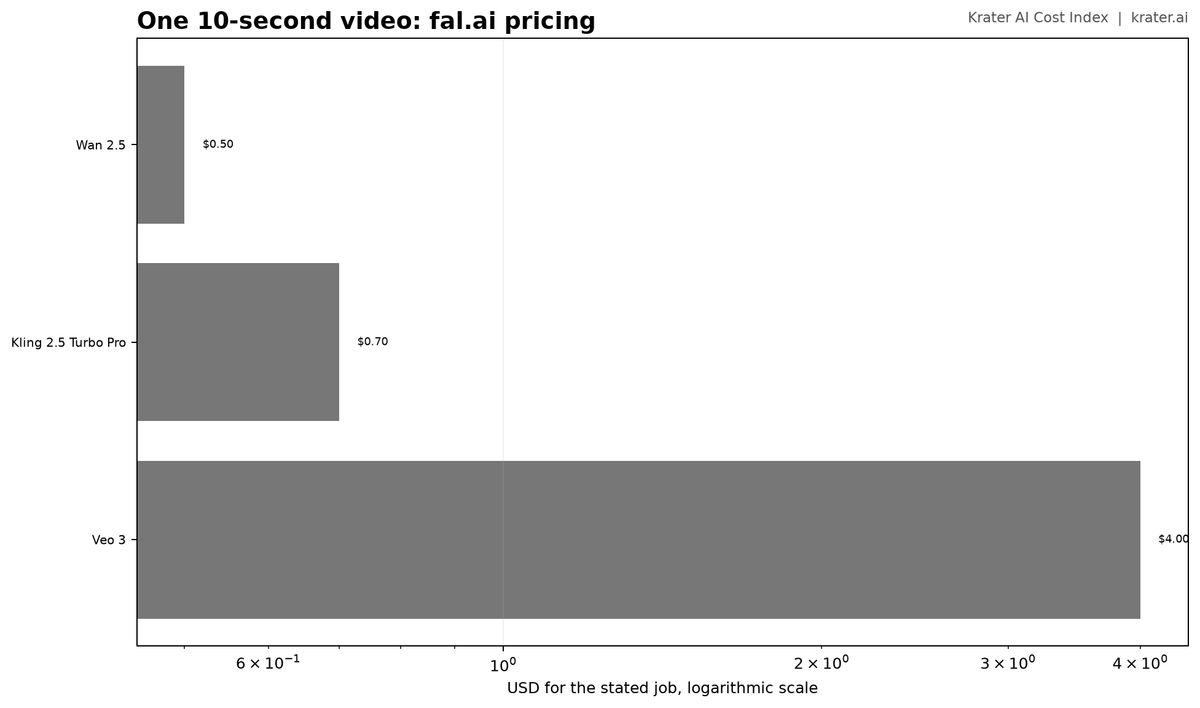
One 10-second video
Assumption: A 10-second output at the listed per-second price, without adding audio or resolution adjustments.
Primary comparable-group result: The eligible range runs from Wan 2.5 at $0.50 to Veo 3 at $4.00, a 8.0x spread.
Secondary full-range result: This is an output-price comparison, not a quality ranking. Price is not quality, and the cheapest option may not be suitable for every result.
Reproducible arithmetic: For Wan 2.5: 10 x $0.05 = $0.50. For Veo 3: 10 x $0.40 = $4.00. Ovi is excluded because fal.ai lists it per video and does not define a duration for that unit.
Per finished minute: Scaling the listed per-second prices to 60 seconds gives $3.00 for Wan 2.5, $24.00 for Veo 3, and $4.20 for Kling 2.5 Turbo Pro.
| Comparison group | Lowest listed cost | Highest listed cost | Multiple | Mid-tier reference |
|---|---|---|---|---|
| Entire eligible range | Wan 2.5: $0.50 | Veo 3: $4.00 | 8.0x | Kling 2.5 Turbo Pro: $0.70 |
Bottom line: A public list price is one input to model selection. Quality, context handling, reliability, tools, and the task's acceptance criteria still matter.
The representative ecommerce workload
To connect unit prices to an operating calendar, this index uses one explicit monthly scenario: 10,000 product descriptions, 2,000 ad copy variants, 10,000 customer support replies, four long document analysis passes, 100 product images, and 10 ten-second videos. This is a scenario for reproducibility, not a claim about a typical merchant.
The scenario uses the median selected model for each job. The per-job references are DeepSeek: R1 at $0.80 per 1,000 descriptions, DeepSeek: R1 at $0.44 per 1,000 ad variants, DeepSeek: R1 at $0.87 per 1,000 replies, DeepSeek: DeepSeek V4 Pro at $0.63 per document pass, Seedream V4 at $3.00 per 100 images, and Kling 2.5 Turbo Pro at $0.70 per 10-second video.
| Monthly activity | Multiplier | Reference cost | Monthly subtotal |
|---|---|---|---|
| Product descriptions | 10 x 1,000 | $0.80 | $7.95 |
| Ad copy variants | 2 x 1,000 | $0.44 | $0.88 |
| Support replies | 10 x 1,000 | $0.87 | $8.70 |
| Long document analysis | 4 passes | $0.63 | $2.54 |
| Product images | 1 x 100 | $3.00 | $3.00 |
| Ten-second videos | 1 x 10 seconds | $0.70 | $0.70 |
| Scenario total | Defined above | Median selected references | $23.77 |
Interpretation: In this scenario, choosing the reference models is more consequential than simply increasing or decreasing activity by a small percentage. That does not mean model choice dominates every real bill. Media resolution, long context, retries, caching, provider discounts, and quality requirements can all matter. It means the model price should be an explicit line item in workflow design.
Charts from the Krater AI Cost Index
Methodology and source data
Sources: OpenRouter's public models API at openrouter.ai/api/v1/models supplied model IDs, names, modalities, context lengths, and prompt and completion prices. fal.ai's public pricing page at fal.ai/pricing supplied the image and video output prices. The exact snapshot date is 2026-08-11.
Model selection and tier criteria: The text sample contains 25 named models. Current-generation flagships are exactly Gemini 3.1 Pro Preview, Claude Sonnet 4.6, Claude Opus 4.6, and GPT-5.5. Pro/reasoning variants are GPT-5.5 Pro and GPT-5.4 Pro. Previous-generation flagships are Gemini 2.5 Pro, GPT-5.4, and GPT-5.4 Pro; GPT-5.4 Pro is intentionally represented in both the previous-generation and Pro/reasoning views because it has both attributes. Mid/value includes established general-purpose models below those groups. Small/open includes models explicitly labeled nano, flash-lite, or small, plus selected openly weighted Llama families. These groups are based on generation, product class, and model-family naming, not price alone. They are comparison groups, not quality rankings.
Exclusions: Batch variants were excluded so the comparison uses standard listed prices. Long-document rows require at least 1,002,000 tokens of context. Models without both prompt and completion prices were excluded from text jobs. Ovi was excluded from the 10-second comparison because fal.ai prices it per video without defining the duration of that unit. Image prices use fal.ai's 1MP normalization. Video prices use ten seconds, with no audio or resolution surcharge.
Update schedule: This study is designed to update monthly. Each update should pull a fresh OpenRouter response, capture the fal.ai page, record the new snapshot date, preserve the prior CSV, and recalculate every chart and table. Prices, model IDs, context limits, and endpoint rules can change between snapshots.
The downloadable raw dataset for this snapshot is ai-cost-index.csv. It contains the full priced rows used for the tables and charts, including source URL, snapshot date, model ID, generation group, tier, job, assumptions, unit prices, and calculated cost.
Cite this study
Ready-to-copy attribution: Krater.ai, "Krater AI Cost Index," 2026-08-11, https://krater.ai/blog/ai-cost-index.
License: The charts, tables, and text of this study are available under CC BY 4.0. Reuse is permitted with attribution and a link to https://krater.ai/blog/ai-cost-index. The license applies to Krater's original presentation and writing, not to the underlying public pricing facts.
Frequently asked questions
Does the highest price mean the model is best?
No. This is a price index, not a quality benchmark. A costly model may be the right choice for a difficult reasoning or long-context task, while a smaller model may meet the requirements for a routine reply.
Why do the numbers differ from a provider's own calculator?
The arithmetic uses the exact assumptions stated here and the public prices captured on the snapshot date. Provider calculators may include caching, batch rates, regional rules, minimums, rounding, media settings, or a newer price sheet.
Why are images and video not priced per token?
fal.ai exposes output-based units for these examples. The image table normalizes to 1MP, while the video table uses seconds. Those units make media comparisons possible, but they are not interchangeable with text tokens.
Can I reproduce the study?
Yes. Start with the cited OpenRouter endpoint and fal.ai pricing page, use the assumptions in the methodology, and compare your fresh response with the downloadable CSV. A later snapshot may produce different results.
Does Krater remove all usage limits?
No. Krater uses a shared credit pool and metered usage. Credits can run out, requests have ceilings, public API and team controls exist, and upstream provider capacity can still affect a selected model. The value of the workspace is access to 350+ models and multiple modalities through one subscription, not the absence of controls. A raw API price is not a workspace: direct API access does not by itself provide Krater's interface, storage, Agents, shared workspace, or multimodal tooling.
Bottom line
The Krater AI Cost Index makes a simple operational point: identical AI work does not have one inevitable price. In this snapshot, 1,000 product descriptions range from $0.04 to $50.10, and the highest listed option is 1,163.8x the lowest. The responsible conclusion is not "always pick the lowest price." It is "make the model and unit assumptions visible, then choose deliberately."
Related reads
- Best AI for ecommerce
- AI tools for ecommerce
- Claude usage limits
- Is ChatGPT getting worse?
- Why is ChatGPT so slow?
- What is AI throttling?
Get 15% off for 12 months
Use code BLOG15YEAR for 15% off a Krater subscription for 12 months. Krater brings 350+ models, image, video, voice, music, coding, documents, and Agents into one workspace with one shared credit pool.