

Best AI for Parents: Homework Explanations, Bedtime Stories and Family Schedules
A practical parent guide to homework explanations, custom stories, weekly routines, chores, meals, privacy and useful AI prompts.
The best AI for parents is a patient helper that explains a tricky idea, turns a few family constraints into a workable schedule and creates an imaginative story without taking over your judgement. You still decide what is suitable for your child, what information stays private and when a teacher, doctor or safeguarding professional should be involved.
Key Takeaways
- Ask for explanations and practice instead of submitting generated homework.
- Give stories boundaries for age, mood, length and sensitive topics.
- Build a family schedule around real transitions, not just a list of tasks.
- Do not share children's full names, faces, school details or private records.
- Krater brings 400+ models, Personas, Keep and image creation together, with Pro at Predictable $20/month pricing.
What a parent actually needs from AI
Family life rarely presents one clean task. You may be helping with fractions while packing a lunch, calming a child after a difficult day and trying to remember which activity needs a costume. AI is useful when it reduces the number of small decisions. Ask for a three-minute explanation, five practice questions, a story with a gentle ending or a schedule that includes travel and preparation time.
It is less useful when you hand over a vague instruction such as “organise my family.” The result may look tidy while ignoring nap times, medication routines, sensory needs, homework deadlines or the fact that one adult is commuting. Start with the constraints you know. Treat the first answer as a draft to edit with the family, not as an authority on your child.
Homework help without doing the work
Tell the model what the child has tried, where the explanation stopped making sense and what the assignment asks for. Ask it to use a simpler example, a visual analogy or one question at a time. For a maths problem, request a hint before a solution. For reading, ask for vocabulary support and comprehension questions. For science, ask the model to distinguish the classroom concept from an experiment that requires adult supervision.
Keep the child involved by asking them to explain the answer back in their own words. You can say, “Show me the first step and tell me why it comes next.” If the model supplies a complete answer, cover it and ask for a fresh practice question. Academic honesty matters even in primary school because the purpose is to build the child’s understanding, not merely to finish a worksheet.
Personalised bedtime stories
A good story prompt gives the model a small cast, a setting, a length, a feeling and a safe resolution. Use a nickname or fictional character instead of a child's full name. You might ask for a quiet story about a fox who learns to leave a noisy market, or an adventure where a nervous astronaut practices asking for help. State whether you want repetition, rhyme, a calming rhythm or a chapter that ends without a cliffhanger.
Set boundaries explicitly. Ask the model not to include death, realistic violence, frightening images, unsafe instructions or a character that humiliates the child. Read the story before sharing it because a harmless sounding prompt can still produce a strange fear or an unhelpful lesson. A story can support a routine, but it should not be used to diagnose anxiety or replace a conversation about something that is worrying your child.
Build a weekly family schedule
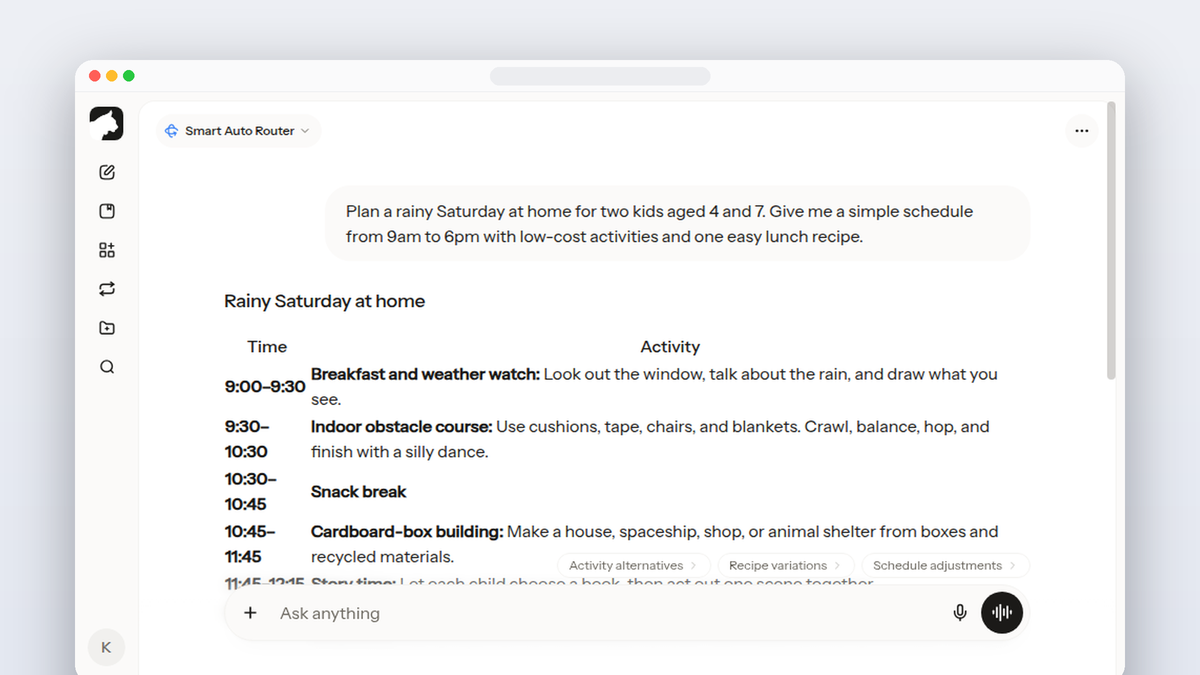
Make one list of fixed events and another of flexible jobs. Fixed events include school, work shifts, appointments and regular transport. Flexible jobs include laundry, meal preparation, reading, sports kit, pet care and clearing the table. Add transition time and a buffer for the day that usually goes wrong. Ask AI to create a version for the fridge, a phone-friendly checklist and a fallback plan for a late pickup.
A schedule works better when each chore has a clear finish line. “Tidy room” is hard to measure; “put clothes in the basket, books on the shelf and rubbish in the bin” is visible. Let children choose between two suitable jobs where possible. Ask the model to rotate responsibilities without assuming every child has the same ability, energy or tolerance for noise.
Chores, meals and the handover problem
Give every adult a handover note with what changed, what is urgent and what can wait. AI can turn that note into a morning checklist, a school bag reminder or a dinner plan based on ingredients you already have. Link the plan to real actions such as defrosting food or charging a device. The point is to remove the memory burden, not to create a beautiful list nobody opens.
For food, include allergies and preferences without treating a generated menu as medical advice. Check labels yourself and keep cross contamination in mind. A child who refuses mixed textures may need a different serving arrangement from a child who dislikes a flavour. The model can suggest alternatives, but a parent who knows the child should make the final call.
Screen time and digital boundaries
AI can help you write a family media agreement with simple rules for devices, games, homework, bedtime and asking before taking a photograph. Keep it short enough to read aloud. Decide which rooms are device-free, where chargers live and what happens when a child sees something upsetting. A generated policy should never replace the settings, reporting tools and supervision offered by the actual service.
Do not put a child's full name, face, school, address, voice recording, medical detail or private conversation into a prompt unless you have a clear and appropriate reason. Remove identifying details from homework photographs and crop out school logos. Explain to older children that an AI tool is a service receiving information, not a secret diary. Review the account's privacy controls and your household's consent rules.
Six useful parent prompts
1. Explain [topic] to a [age] year old using one example, then ask three questions without giving the answers.
2. Turn this child-safe idea into a 700-word bedtime story with a calm ending, no frightening scenes and a repeated reassurance.
3. Build a weekly family schedule from these fixed events and chores. Include travel, preparation and one recovery buffer.
4. Create a chore menu with three choices for each child and a visible definition of done.
5. Make five practice questions for [subject] at this level. Give hints first and a marking guide separately.
6. Draft a family screen agreement in plain language. Include privacy, bedtime, reporting upsetting content and adult review.
Read the output aloud and edit it for your family's reality. If a child is upset, confused or at risk, stop prompting and speak with the appropriate adult or professional.
Model comparison for family life
| Approach | Useful strength | Good family task |
|---|---|---|
| Fast model | Quick simple wording | Morning checklist |
| Reasoning model | Balances constraints | Weekly schedule |
| Long context model | Uses several notes | Homework revision plan |
| Creative model | Varied imagination | Bedtime story |
| Krater | 400+ models, Keep and Personas | Compare and reuse family workflows |
Different tasks call for different strengths. A fast model can rewrite a school notice, a reasoning model can fit activities around travel, and a creative model can produce story options. Krater gives you one place to keep a redacted routine, compare approaches and turn the chosen plan into repeatable work with Personas and Tasks.
Make the system supportive, not controlling
A family plan should leave room for tired days, changes of mind and the child who needs more time. Ask AI to show the assumptions behind a schedule and identify what can be dropped first. If a plan requires an adult to be in two places at once, the problem is the plan, not the family's discipline. Keep one small win visible so the routine feels helpful rather than like another scorecard.
Use /keep for a household checklist, /tasks for appointments and /personas for a patient homework explainer. Review saved material regularly and delete anything that no longer needs to exist. A tool should make family conversations easier, not make children feel watched by an invisible manager.
Adjust the routine after a real week
Do not judge a family schedule by whether it looks balanced on Sunday night. Compare it with what actually happened. Which transition took longer? Which child needed help before leaving? Did the cooking plan create a late cleanup or did a chore depend on a tool that was already in use? Ask AI to compare the intended routine with a short factual log and suggest two changes, not a complete redesign.
Make the next version easier to follow at the moment it matters. Put the bag reminder beside the door, move the reading slot before the child becomes overtired or split one large chore into a start and finish step. Let children point out instructions that are confusing. A schedule earns trust when it changes in response to lived experience and when the people using it can explain why a task exists.
Support different ages and abilities
A plan for a preschooler should rely on pictures, short transitions and an adult nearby. A plan for a teenager can include more ownership, but it still needs a clear deadline and a way to ask for help. Ask AI to rewrite the same routine for two ages without lowering the respect shown to either child. If a child has an accessibility need, start with the advice and preferences of the child and the professionals who support them.
Avoid using a generated label to explain behaviour. A tired child may need food, quiet or connection rather than a new reward chart. If a routine repeatedly fails, look at the environment and the demand before blaming motivation. The model can suggest alternatives, but a parent should decide what is compassionate, safe and realistic. Family tools work best when they make support visible rather than turning every moment into compliance.
Make room for connection
A schedule should protect unplanned time as carefully as it protects appointments. Ask AI to leave a short window for a walk, a conversation, reading together or simply doing nothing. These spaces are where a child may mention a worry that never appears in a checklist. If every minute has a task attached, the family can complete the plan and still feel that nobody had time for one another.
Review the routine with the children in language they understand. Ask what feels easy, what feels rushed and which job they would like to learn. You may discover that the best change is moving one responsibility to an adult for a week while a child recovers from illness or a difficult school period. A flexible plan communicates care more clearly than an impressive timetable. Keep noticing what makes everyone feel welcome and heard, especially during busy weeks. Small adjustments can protect patience, confidence and family connection.
Frequently Asked Questions
Can AI do my child's homework?
Use it to explain, quiz and give feedback on the child's attempt. Do not submit generated work as if the child wrote it.
Can I use my child's name in a prompt?
Avoid full names and identifying details. Use a nickname or a fictional character and remove school, address and image information.
How can AI make bedtime stories safer?
Set age, length, mood and content boundaries, then read the story yourself before sharing it.
Can AI plan family meals?
It can suggest ideas from your constraints, but check allergies, labels, nutrition needs and family preferences yourself.
Should children use AI alone?
That depends on age, tool settings and family rules. Younger children need close adult involvement and clear privacy boundaries.
What can Krater help with?
It can help compare models, save redacted routines and organise repeatable family planning. You remain responsible for suitability and privacy.
The Bottom Line
Use AI as a patient assistant for the parts of family life that benefit from explanation, imagination and structure. Keep children’s information private, keep learning active and leave the final judgement with the adults who know the family.