

Best AI for Writing Speeches, Toasts and Eulogies
A sensitive guide to using AI for speeches, wedding toasts and eulogies, with story questions, timing guidance and practice prompts.
AI can help you organize stories and find a shape for a speech, toast or eulogy, but the heart of the piece must come from your relationship with the people listening. Give it real memories, the occasion, the time limit and the tone you can genuinely deliver. Read every line aloud and remove anything you would never say.
Key Takeaways
- A speech needs a clear opening, a few connected ideas and a closing people can remember.
- A toast should be warm, brief and safe for the whole room.
- A eulogy needs accuracy, dignity and room for complicated feelings.
- Use AI to interview you for stories, not to invent memories.
- Krater brings 400+ models, Personas, Keep and image generation together, with Pro at Predictable $20/month pricing.
A simple speech structure
A general speech can use five movements: welcome the room, explain why the occasion matters, share two or three specific stories, name what you hope people carry forward and close with thanks or a clear wish. The structure gives listeners a route through the piece. It does not mean every paragraph needs a lesson.
Start with the audience and occasion. A retirement speech, a community award and a school presentation may all contain gratitude, but the relationship and the promise of the ending differ. Ask AI to suggest structures from your facts, then choose the one that feels natural when you say it aloud.
How a toast works
A toast is usually shorter than a speech and more social. Open by naming the people or moment, offer one or two stories that show character, say something generous about the future and invite the room to raise a glass. Avoid turning the toast into a private conversation that only one friend understands.
Humour should reveal affection rather than expose a secret. Do not mention old relationships, embarrassing photographs, health information, money or a story that the person has asked you not to repeat. Ask AI to flag lines that depend on the audience knowing private context.
How a eulogy works
A eulogy can acknowledge the person, share the qualities people will remember, tell a few grounded stories, recognize the loss and offer thanks or comfort. It does not need to pretend the relationship was simple. A truthful sentence about a complicated life can be more respectful than a list of perfect adjectives.
Use names, dates and relationships carefully. Ask a family member to check facts and agree on stories that should remain private. AI can help organize the material, but a human who knew the person must decide what belongs in the room.
Interview yourself for real stories
Ask questions that produce scenes rather than summaries. Where were you? What did the person say? What small habit made you laugh? When did they help someone? What did they teach you without making a speech about it? Write the answer in your own words before asking AI to group the material.
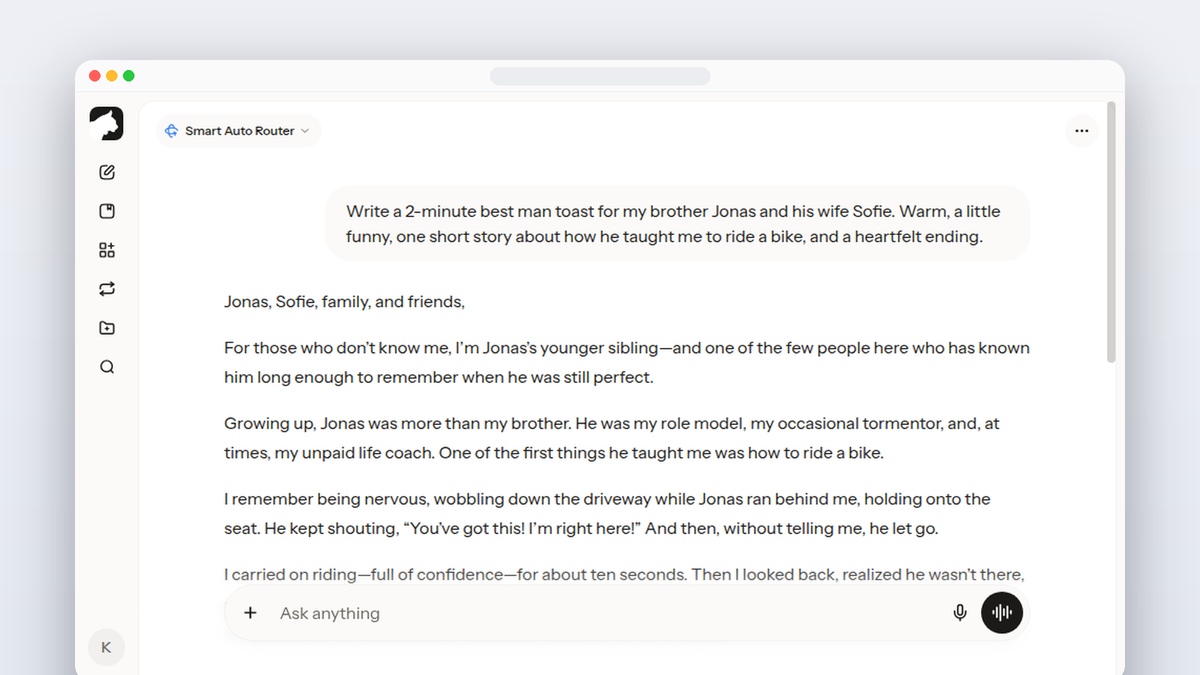
Interview me one question at a time for a wedding toast. Look for two specific stories, one quality they reveal and a warm closing. Do not invent details or make the humour cruel.
Help me sort these memories for a eulogy. Separate verified facts, personal impressions, stories that need a family check and details that should remain private.
Ask me questions that will find a scene rather than a general compliment. Wait for my answer before asking the next question.
Length guidance by minutes
A comfortable speaking pace is often around one hundred and twenty to one hundred and fifty words per minute, but pauses, laughter and emotion change the real timing. A two minute toast might therefore be about two hundred and fifty words, while a five minute speech could be six hundred to seven hundred words. A eulogy may need more room, but the service schedule and the family's wishes matter more than a target.
Write a little shorter than the maximum time. Mark pauses, names and moments where the room may respond. Practice with a phone timer and cut repeated introductions before cutting the story that makes the person real.
Humour guardrails
Good humour gives the audience a shared way to feel close. Bad humour asks one person to absorb embarrassment so everyone else can laugh. Do not use private medical details, sexual stories, old betrayals, jokes about grief or a punchline that depends on a guest being confused.
Ask AI for a risk review that labels a line as warm, unclear, too private or likely to embarrass someone. Then make the call yourself. A gentle story told with affection is usually stronger than a clever line that needs explaining.
Sensitivity in a eulogy
A eulogy is not the place to settle a family argument or present a cleaned up version of a person that nobody recognizes. Include the details that help people see them: the phrase they used, the food they made, the patience they showed, the work they took pride in or the way they welcomed someone.
Take breaks while writing. Ask a trusted person to listen to a draft and tell you where the meaning is clear or where a sentence feels too private. Keep a version with notes and a version you can print. Do not rely on a live chat or a phone battery at the service.
Practice and delivery
Read the speech aloud standing up. Mark the names you might rush, underline the sentence that carries the point and add a breath after a story. Practice once for timing, once for eye contact and once with the pages printed in the format you will use. If you become emotional, pause, breathe and continue from the next marked line.
Turn this speech into a delivery copy. Add pause marks, emphasis suggestions and places where I should look up. Do not change the wording or add jokes.
Shorten this toast to two minutes while keeping the specific story, the clear congratulations and the final invitation to raise a glass.
Act as a gentle rehearsal partner. Ask me one delivery question at a time and point out sentences that are hard to say aloud.
Model comparison for speeches
| Model type | Useful strength | Good task |
|---|---|---|
| Writing model | Structure and alternatives | Shape a first draft |
| Reasoning model | Order and timing | Cut repetition and check facts |
| Long context model | Many memories and notes | Organize story material |
| Krater | 400+ models and Personas | Compare tones and keep drafts |
Use a writing model for options, a reasoning model for timing and structure, and a long context model for a large memory packet. Krater gives you a place to keep the draft, use a Persona for a gentle editor and compare approaches without losing the source stories.
A final human review
Before you print, check every name, relationship, date, place and quote. Remove invented connective tissue, generic praise and any line that sounds like a speech generator. Ask whether the person being honored would recognize the story and whether the audience can understand why it matters.
For a toast, ask the person of honour whether any story is off limits. For a eulogy, ask the family or service leader about timing and content. AI can make the page neat, but only people can decide what is loving, true and appropriate.
Gather stories without putting people on the spot
If the draft feels general, interview someone who knows the subject well. Ask where they met, what ordinary habit made them laugh, which challenge they handled quietly, what object or place brings them to mind and what they would want a younger person to learn from them. Write down the answer in the speaker's words before asking AI to organize it.
Use /keep for approved stories, /tasks for questions still needing an answer and /personas for a respectful editor that removes repetition without adding sentiment. Give the model permission to mark a gap instead of filling it. An honest note that says more detail is needed is safer than a vivid but invented scene.
Read the finished piece to one trusted listener who understands the occasion. Ask them where they felt close to the person, where they became confused and whether any line should stay private. Make the final changes yourself. Delivery improves when you know why every sentence is there. Print the pages in large enough type, number them and mark the point where you can skip ahead if time runs short.
A speech is also a physical task. Decide where you will stand, whether you need a microphone, how you will hold notes and where water can sit without becoming a distraction. Practice the first thirty seconds until you can begin after a breath. Practice the final sentence as well, because a clear ending helps the room know when to applaud, raise a glass or sit with the moment.
Keep a private version of your interview notes separate from the public draft. Stories may contain details that helped you remember but do not belong in the room. Ask the model to identify names, places, dates or family details that need permission before inclusion. The final speech should be specific enough to feel real and restrained enough to respect the people inside it. For a wedding toast, check that both partners are comfortable with every personal detail. For a retirement or award speech, ask whether colleagues can be named. For a eulogy, let the family decide which memories belong to a public service. You can ask for a version with the sensitive section removed so a second reader can review the structure without receiving the private story. When you shorten the draft, remove repeated praise before removing the one detail that makes the person recognizable. A specific action, phrase or small habit often carries more feeling than a paragraph of general compliments. Leave room for silence after a meaningful story. The audience may need a moment to recognize their own memory in it. If you are speaking at a service, ask whether the microphone, lectern and lighting will change how you read. If you are making a toast, practice looking up at the person rather than reading every line. A speech succeeds through connection, not only through wording. Before the event, confirm who introduces you and where you can stand. Small practical details remove avoidable nerves. Bring a printed backup even if you plan to use a phone or tablet. Mark the page where you will begin, and carry a pencil so you can note a last minute name change without rewriting the whole piece. If the room is noisy, simplify the first sentence and speak toward the person furthest away with calm confidence today.
Frequently Asked Questions
Can AI write a eulogy?
It can help organize your memories and suggest a structure, but the stories, facts and final judgment must come from people who knew the person.
How long should a toast be?
Often two to three minutes is enough. Practice with a timer and leave room for pauses and laughter.
Can AI add jokes to a speech?
It can suggest options, but you should remove anything private, cruel, humiliating or difficult for the room.
How do I make a speech sound like me?
Give the model your own phrases and edit every sentence aloud until you would genuinely say it.
Should I memorize a eulogy?
Practice enough to know the flow, but printed notes are sensible when emotion or accuracy matters.
What if I cry while speaking?
Pause, breathe, sip water and continue from a marked line. A moment of emotion is not a failure.
The Bottom Line
The best AI for a speech is an assistant that helps you find the shape without replacing the relationship behind it. Bring real stories, verify every fact, protect private details and practice aloud. A short, honest piece that sounds like you will usually stay with people longer than a polished speech full of borrowed phrases.