

ChatGPT Enterprise Pricing 2026: What OpenAI Publishes and What It Does Not
ChatGPT Enterprise has no published price. What OpenAI publishes instead (Business seats at $20 to $125), the reported $60 a seat and 150 seat minimum, credit and token billing options, and the cheaper routes for small teams. Checked 1 Oct 2026.
OpenAI does not publish a ChatGPT Enterprise price. The business pricing page lists it as custom pricing through sales, with volume discounts, invoicing and both credit-based and token-based billing options. What is published is ChatGPT Business: a Standard seat at $20 a month billed annually or $25 monthly, and a Premium seat at $100 a month billed annually or $125 monthly, for teams of 2 to 200. The Enterprise number most third-party guides repeat, around $60 per user a month with a 150-seat annual minimum, is reported rather than official, so treat it as a negotiating anchor. For most teams under 200 people, Business is the real purchase; Enterprise is only needed for SCIM, Enterprise Key Management, custom data retention, data residency or contractual terms a small team does not use.
Key Takeaways
- ChatGPT Enterprise has no list price. Sales quotes it per contract, with volume discounts and invoicing.
- The reported figure is about $60 per seat a month with a 150-seat annual minimum, a roughly $108,000 a year floor. Reported, not official.
- ChatGPT Business, the plan formerly called ChatGPT Team, is self-serve: Standard seats $20 a month billed annually ($25 monthly), Premium seats $100 ($125 monthly), 2 to 200 seats.
- Since August 2026, new Business workspaces cap at 200 seats, per OpenAI's help center as reported by third-party trackers.
- Enterprise adds SCIM, Enterprise Key Management, role-based access, domain verification, ISO certifications, custom data retention, data residency in ten regions, expanded context, 24/7 priority support and SLAs.
- Enterprise contracts can be priced on credits or tokens instead of per-seat, a newer option worth asking about if your usage is uneven.
- Claude publishes an actual enterprise number: $20 a seat a month plus usage billed at API rates, billed annually, self-serve.
What OpenAI publishes: ChatGPT Business
On openai.com/business/pricing, read 1 October 2026, the self-serve team plan is ChatGPT Business. It was called ChatGPT Team until earlier this year, so older articles and invoices may still say Team.
| Seat | Price | What you get |
|---|---|---|
| Business Standard | $20 a month per seat billed annually, $25 monthly | All ChatGPT, ChatGPT Work and Codex features, connectors for Google Workspace, Slack, GitHub and Microsoft 365, workspace agents, company knowledge, shared projects |
| Business Premium | $100 a month per seat billed annually, $125 monthly | 5x the Standard usage with no five-hour limit, for power users; seats can be mixed in one workspace |
Both seat types include SAML SSO and MFA, centralized billing and administration, usage analytics and spend controls, and no training on business data by default. The plan covers teams of 2 to 200 employees, and OpenAI's help pages show the 200-seat cap applies to workspaces created from 24 August 2026.
What OpenAI does not publish: ChatGPT Enterprise
The Enterprise block on the same page says only "Custom pricing. Contact our sales team to discuss enterprise pricing." The two footnotes that do carry real information are the billing options: credit-based and token-based pricing are both available for Enterprise plans. That means an Enterprise contract does not have to be a flat per-seat number at all; it can be negotiated as pooled workspace credits or straight token rates.
For scale, OpenAI's help pages sell $100 of workspace credits as 2,500 credits, which fixes the public credit value at $0.04. Third-party trackers reading the enterprise rate card report the same $0.04 per credit on every model row they checked, with a frontier chat message billed around 10 credits and a deep research task around 50 credits at list rates. Those are reported numbers on public help material, not your contract rate; volume discounts change them.
What Enterprise reportedly costs
Because no list price exists, every number in circulation comes from buyers and press coverage rather than OpenAI. The repeated figure across 2025 and 2026 reporting is about $60 per seat a month, a 150-seat minimum, billed annually up front, a floor of roughly $108,000 a year before credits or overage. Treat all three numbers as a negotiating anchor, not a price list: real contracts vary with seat count, term length, credits purchased and negotiated discounts.
If your team is under that 150-seat line, the practical choice is Business or a competitor plan, not Enterprise. If you are above it, the quote you get back depends on how well you frame expected usage, which is why the credit and token billing options matter.
Business vs Enterprise: what the extra layer buys
| Business | Enterprise | |
|---|---|---|
| Price | Published: $20 to $125 per seat a month | Custom quote; credit, token or seat based |
| Seats | 2 to 200 | Set per contract |
| SSO | SAML SSO and MFA | SAML SSO plus SCIM provisioning |
| Encryption | Standard | Enterprise Key Management (EKM) |
| Access controls | Admin roles | Role-based access controls, domain verification, IP allowlisting |
| Certifications | SOC 2 Type 2 | ISO 27001, 27017, 27018, 27701 on top |
| Data handling | No training on business data by default | Same default, plus custom data retention and residency in ten regions |
| Context window | Standard | Expanded context for longer inputs and larger files |
| Support and terms | Standard support | 24/7 priority, SLAs, custom legal terms, AI advisors for eligible customers |
| Billing | Card or annual billing | Invoicing and volume discounts |
Source: the feature table on openai.com/business/pricing, read 1 October 2026. The honest read is that Enterprise is a compliance and control purchase. If nobody in your company has said the words SCIM, EKM, data residency or custom retention, you are probably buying seats, and seats are cheaper on Business.
Estimating your own number
Use the published Business seats as the baseline and the reported Enterprise figure as the ceiling.
| Team | Business Standard (annual) | Business Premium (annual) | Enterprise (reported) |
|---|---|---|---|
| 10 people | $200 a month | $1,000 a month | Below reported minimum |
| 50 people | $1,000 a month | $5,000 a month | Below reported minimum |
| 150 people | $3,000 a month | $15,000 a month | About $9,000 a month reported |
| 500 people | Over the 200-seat cap, Enterprise only | Over the cap | Custom quote |
Three things move the real quote: seat count against volume discount tiers, whether you negotiate credit-based billing for heavy automated usage, and contract length. Going in with a usage estimate, for example seats times typical sessions per day, is what turns "contact sales" into a real number in the first call.
How the alternatives price teams
Anthropic Claude publishes its numbers. Claude Team runs 2 to 150 seats at $25 a seat a month, or $20 billed annually, with Premium seats at $125 or $100 for 5x Standard usage. Claude Enterprise is $20 a seat a month plus usage billed at API rates, billed annually, self-serve or through sales, and includes SCIM, audit logs, custom data retention and role-based access. That $20-per-seat-plus-usage structure is the most transparent enterprise offer among the big labs.
Google bundles Gemini into Google Workspace editions rather than selling a separate enterprise chat SKU for most customers, and Microsoft sells Microsoft 365 Copilot at a published $30 per user a month on annual terms. If your organization already pays for Workspace or Microsoft 365, those bundles are usually the first comparison a procurement team runs.
When a team does not need an enterprise plan at all
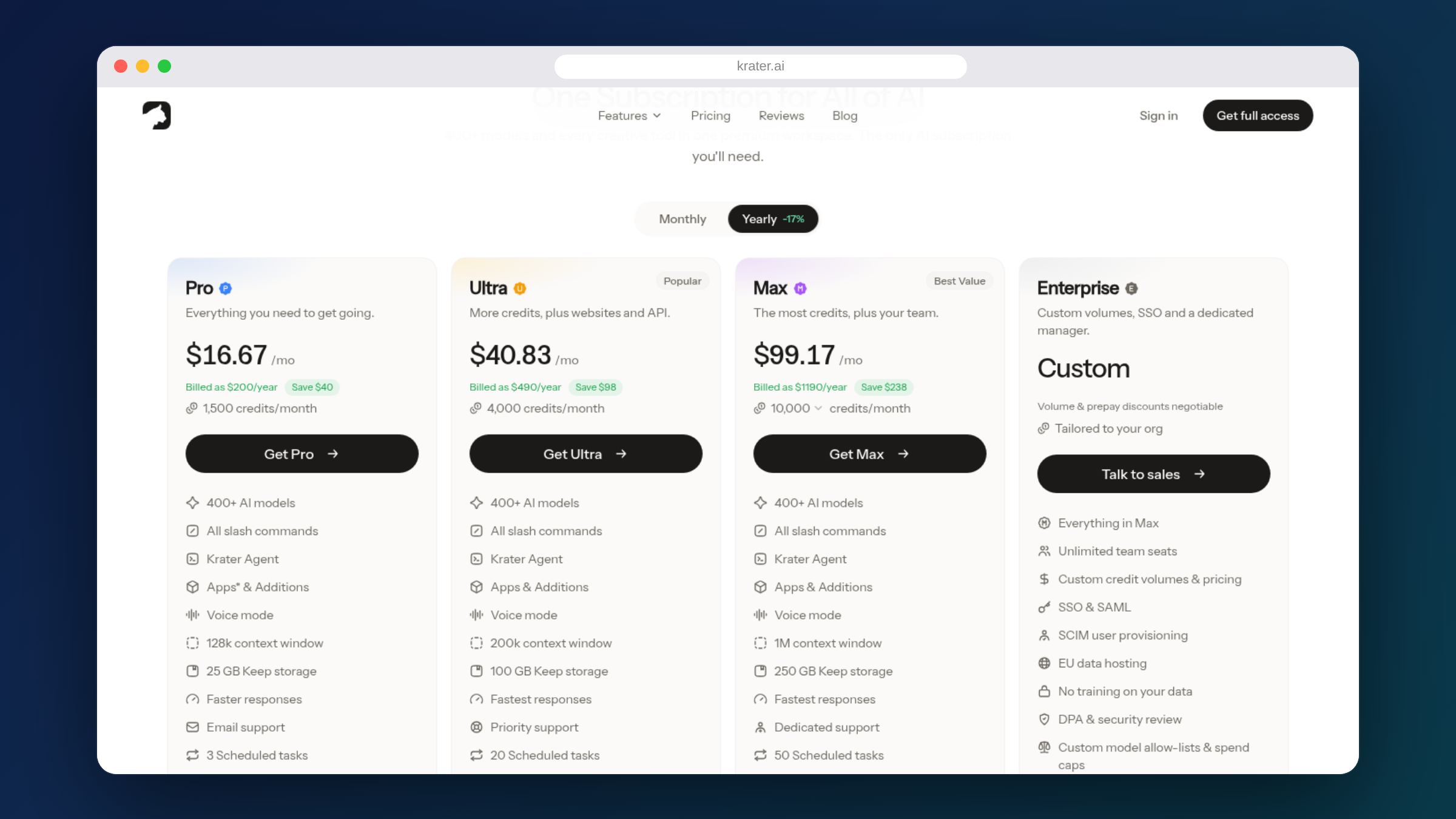
Enterprise pricing exists for procurement departments. If what you actually need is "ten people who can use strong AI models on work," a per-seat contract is the wrong shape: you pay for chairs, not usage. Krater prices access the other way. Individual plans are flat (Pro $20 a month for 1,500 credits, Ultra $49 for 4,000, Max $119 for 10,000), and Krater Enterprise sells a shared credit pool at $1.19 per 100 credits, from 1,000 credits a month up to 10 million, with unlimited seats, SSO and SAML, SCIM, EU hosting, a DPA and a dedicated account manager. There are no seat minimums and no sales call required to see the price.
The practical difference: a 50-seat Business Standard workspace costs $1,000 a month whether half the team uses it or not. The same money on Krater buys roughly 84,000 credits shared across the team, billed per answer by real model usage, so light users do not cost a seat and heavy users do not hit a five-hour window. Krater also puts GPT, Claude, Gemini, Grok and 400+ other models plus image, video and voice tools in one workspace, where ChatGPT Business stays OpenAI only. Details are on the Krater enterprise page.
Fair caveats: Krater's enterprise offer is usage based rather than a mirror of OpenAI's compliance bundle, so teams that need OpenAI's specific certifications, the Microsoft 365 integration depth or a dedicated legal agreement should still run the sales conversations. Krater does not offer a free tier; individual plans start at $20 a month and you can cancel anytime.
Frequently asked questions
How much does ChatGPT Enterprise cost?
OpenAI does not publish a price. Third-party reporting consistently cites around $60 per seat a month with a 150-seat minimum and annual prepayment, roughly $108,000 a year, but every contract is quoted individually and volume discounts apply.
How do I get ChatGPT Enterprise?
Through OpenAI sales. If you have 2 to 200 employees and do not need SCIM, EKM, custom retention or data residency, ChatGPT Business at $20 to $125 a seat a month is the self-serve route and starts immediately.
What does a ChatGPT Enterprise credit cost?
OpenAI sells $100 of workspace credits as 2,500 credits on its help pages, a $0.04 per credit value. Enterprise contracts can be priced per credit or per token instead of per seat, and negotiated rates will differ from the public figure.
Is ChatGPT Pro $200 worth it?
Different product: Pro is an individual plan, not a team plan. It suits one person running heavy reasoning, research and coding workloads. For a team, Business seats start at $20 and cover shared workspace features Pro does not have.
Is there a cheaper way to give a team AI access?
Yes, several. Claude Team starts at $20 a seat annually for up to 150 seats, Gemini comes bundled with Google Workspace editions, and usage-based options like Krater charge a shared credit pool with unlimited seats instead of a per-seat contract, which costs less when usage across the team is uneven.
Sources
- OpenAI business pricing: Business seats, Enterprise feature list, credit and token billing footnotes
- ChatGPT pricing: personal plans for reference
- OpenAI help center: workspace credits and Business seat cap details
- Claude pricing: Team and Enterprise seat pricing
- Microsoft 365 Copilot pricing: $30 per user a month
- Beam's enterprise pricing coverage and Sentra's enterprise pricing coverage: the reported $60 per seat and 150-seat minimum figures
- Krater enterprise and Krater pricing: published Krater rates