


AI Aggregators Explained: What They Are, the Catch, and the Best Ones in 2026
One account, every model, metered per use: how AI aggregators work, the catches Reddit names, and how Poe, Magai, Abacus, Aymo, TypingMind and Krater compare on price.
An AI aggregator is one account that fronts models from many labs, so you chat with GPT, Claude, Gemini and others without separate subscriptions, usually billed per use in credits, points or messages. The best ones in 2026 by use case: Abacus ChatLLM for the lowest entry price ($10 a month with 100+ models), Aymo AI for team workspaces, and Krater for the widest coverage since it includes image and video generation on the same meter as the chat models.
Key Takeaways
- Aggregators resell vendor API access. You pay one bill; they pay OpenAI, Anthropic and Google per token and meter you in credits, points or messages.
- The real catches are metering opacity, slower access to new flagship models, and missing vendor-native features like Projects, Canvas and memory.
- Entry prices today: Abacus ChatLLM $10/mo, Aymo Premium $12/mo, Magai $20/mo, Poe ~$20/mo (reported), Krater Pro $20/mo for 1,500 credits.
- The model output is the same model via API; a side-by-side test by Admix found responses indistinguishable from the vendor apps.
- Use a single vendor when you need their native features or compliance guarantees; use an aggregator when your work spans model families.
What an AI aggregator is
An aggregator buys API access to models from OpenAI, Anthropic, Google, Meta and the rest, then wraps them in one interface and one subscription. Your prompt goes to the aggregator, which calls the vendor's API and returns the answer. Billing is the part that differs: Poe meters in points per message, Krater in credits per answer or per image, TypingMind does not bill for usage at all because you plug in your own API keys and pay providers directly. The models themselves are identical to what the vendors serve; as Admix's side-by-side test put it, GPT through an aggregator produces responses indistinguishable from GPT through the official app, because it is the same underlying model.
The catch, from people who use them
The question "why would you pay $20 for just ChatGPT when you could get GPT plus Claude plus Gemini plus DeepSeek for that price" is exactly what the r/ArtificialInteligence thread on aggregator sites asks, and the answers name the catches:
- Metering replaces the flat cap. Aggregators avoid vendor rate limits by billing per use, so there is no "unlimited" to hit, but heavy use can cost more than a flat subscription. Poe's points burn noticeably fast on premium models per the Admix review.
- Slower access to new models. Aggregators add models when their API integration ships, which can lag the vendor app by days or weeks.
- No vendor-native features. ChatGPT Projects, Canvas, memory, Claude Skills, Gemini's app integrations and Google's storage bundle do not travel through an API.
- Privacy passthrough. Your prompts transit a third party before reaching the lab; the aggregator's logging policy matters as much as the vendor's.
- Reseller risk. You depend on the aggregator maintaining API access and staying in business.
Aggregators compared, prices read today
| Tool | Entry price | Metering | Image and video | Free tier | API access |
|---|---|---|---|---|---|
| Krater | $20/mo Pro, 1,500 credits | Credits per answer, image, per video clip | Yes, full catalog | Free guest tools at /tools (no signup) | From Ultra plan up |
| Abacus ChatLLM Teams | $10/mo | Usage-based | Yes, 15+ image and 15+ video models | Trial pricing first month | Via Abacus platform |
| Aymo AI | $12/mo Premium | Plan limits | Not stated | Yes | Not published |
| Magai | $20/mo | Scheduled task runs | Yes | No | Not published |
| Poe | ~$20/mo, reported by Admix; plans $4.99 to $249.99 per GrayGrids | Points per message | Yes | Yes | No (bot platform instead) |
| TypingMind | $39 one-time, reported by Admix | Your API keys, per-token | Depends on your keys | No | It is the API client |
| ChatHub | Not published on site | Subscription | Yes | Limited | Not published |
| Monica | Not published (JS-gated pricing page) | Credits per use | Yes | Yes | Not published |
Where the models actually come from
Every consumer aggregator sits on the same plumbing: the vendors' paid APIs, sometimes routed through infrastructure layers like OpenRouter, sometimes called directly. That is why a $20 aggregator can offer GPT, Claude, Gemini and DeepSeek together where the labs charge $20 each; the aggregator buys tokens at API rates, which are priced per million tokens rather than per month, and most users consume far less than $20 of tokens. An aggregator operator in the Reddit thread describes the model plainly: pay-per-use with a markup, plus breakage from credits people buy and never spend. The implication cuts both ways: light users genuinely save money, but a power user can burn through a meter faster than a flat subscription would have cost.
The tools, briefly
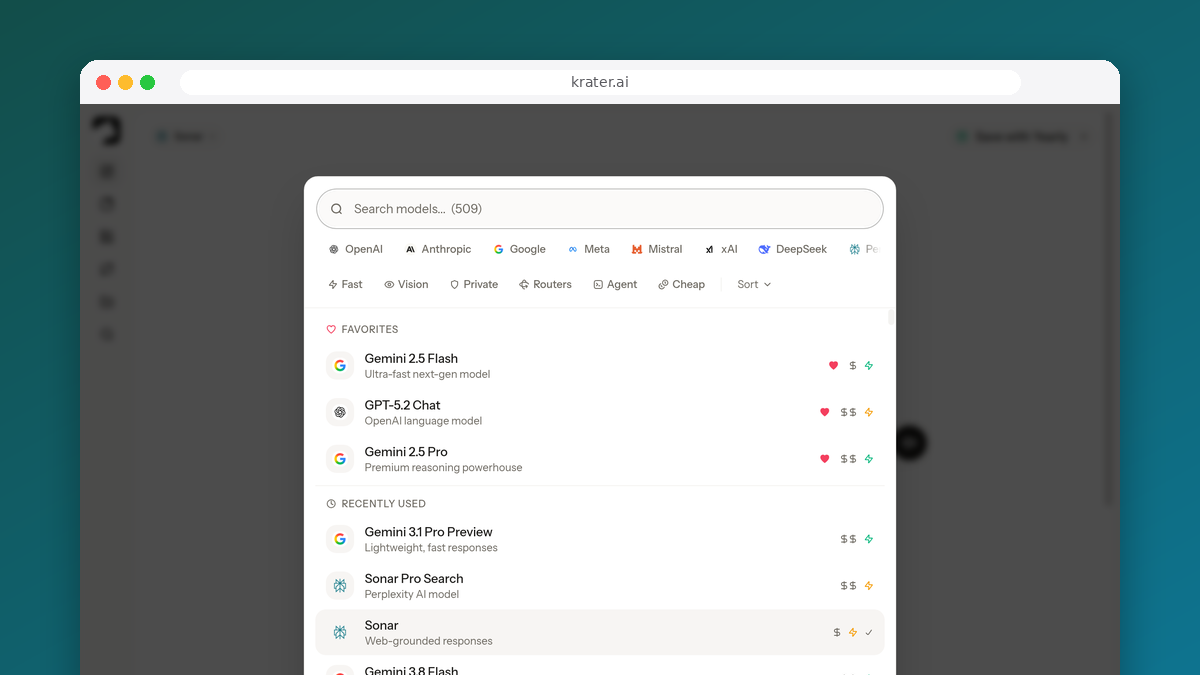
Krater meters everything in one credit pool: chat across OpenAI, Anthropic, Google, Perplexity, Meta, Mistral, xAI and DeepSeek models, plus the full image and video catalog on the same meter. Pro is $20 for 1,500 credits, Ultra $49 for 4,000, Max $119 for 10,000. The honest limits: credits are a meter so a flat subscription wins at extreme volume, there are no vendor-native features like Projects or Canvas, and API access starts at the Ultra tier.
Abacus ChatLLM is the cheapest credible entry at $10 a month and the most feature-dense: 100+ models including the latest flagships, image and video generation, app building and always-on agents. The interface is busy because it does a lot.
Poe (Quora) is the oldest aggregator and the only one with a user-built bot ecosystem. Its points system is the complaint: premium models cost more points per message, so the $20 Premium tier does not behave like an unlimited plan.
Aymo AI targets teams: shared workspaces, 45+ models, $12 a month Premium with a free tier for trying it.
Magai puts every model on every plan from $20, limiting you by scheduled task runs rather than model access, with extra users at $20 each.
TypingMind is the outlier: a $39 one-time license for a polished interface over your own API keys. You pay OpenAI and Anthropic directly at API rates, which is cheapest for technical users but means managing keys and billing yourself.
ChatHub and Monica both pitch multi-model chat plus images; neither publishes pricing openly on the pages we read today, so verify before budgeting.
What the meter costs in practice
Metered billing only makes sense with real numbers, so here are billed amounts from our own runs on Krater in September 2026 at Pro value ($20 per 1,500 credits): a short Gemini 3.8 Flash answer cost 0.69 to 0.76 credits, Sonar 0.2 to 1.09, Claude Sonnet 5 0.6 to 3, and flagship models like Gemini 3.1 Pro or Claude Fable 5.1 ran 3 to 29 credits depending on the task. A 4-credit image on Flux 2 versus a 20-credit image on Nano Banana 2 shows why the meter matters more than the monthly price: the plan cost is fixed, but what each action spends varies by an order of magnitude. On any aggregator, the first thing to learn is what your own typical request costs in their unit.
When a single vendor is better
Stay direct when you need the vendor's native features (Projects, Canvas, memory, Deep Research in the official app, Claude Code), when compliance requires a contract with the lab itself, or when you hammer one model hard enough that a flat $20 subscription beats a meter. The per-image math from our Midjourney comparison shows the same shape: flat subscriptions reward volume, meters reward variety.
How aggregators make money
The economics are worth understanding because they explain the catches. An aggregator buys API tokens at published per-million rates and resells them inside a subscription. Margin comes from three places: markup on the token rate, breakage from credits and allowances that expire unused, and the gap between what a flat fee implies and what most users actually consume. That is why metering opacity is the recurring complaint in the reviews and threads: a points system with different costs per model is harder to audit than a stated credit price shown before you send. It is also why the honest aggregators show the cost per request up front, and why "unlimited" claims on an aggregator deserve scrutiny, since someone is paying real API bills on the other side.
How to evaluate an aggregator in 10 minutes
- Check the model list for the specific flagship versions you use, not just the family names.
- Find the metering unit (credits, points, messages) and what one typical request costs in it.
- Look for the estimated cost shown before you send, the single best transparency signal.
- Send your three most common real prompts on the free tier and compare against the vendor app.
- Read the privacy policy for prompt logging and the training default.
- Check whether image, video and file upload are on the same meter or separate.
- Confirm cancellation terms and whether unused credits roll over or expire.
FAQ
What is the best AI aggregator?
By use case: Abacus ChatLLM for entry price and feature breadth, Aymo for team workspaces, Krater for coverage including image and video on one meter, Poe for its bot ecosystem, TypingMind if you want to bring your own API keys.
What is an AI aggregator?
One account that fronts many vendors' models through their APIs. You pay the aggregator; the aggregator pays the labs per token and meters you in credits, points or messages.
What are the top 3 AI platforms?
For all-in-one multi-model access: Krater, Abacus ChatLLM and Poe are the three most complete in 2026, each with different metering and different extras.
Is Poe an aggregator?
Yes. Poe by Quora is the original consumer aggregator, metering access to GPT, Claude, Gemini and its custom bots through a points system.
Do aggregators train on your data?
It depends on the aggregator's policy and the vendor API terms underneath. API access generally does not train vendor models, but the aggregator itself may log prompts, so check both privacy policies before sensitive work.
Are aggregators allowed by the AI labs?
They operate on paid API access, which the labs sell openly; the labs benefit since aggregators drive token volume. What labs do not offer through the API is the native app feature set, which is a product limit, not a policy one.
Are the answers as good as the real apps?
For the model itself, yes: it is the same model served via API, and side-by-side tests show identical output. What you lose is the surrounding app features, not answer quality.
Related reads
- Best AI subscription 2026
- OpenRouter alternatives
- ChatGPT alternatives
- Perplexity Pricing 2026
- Gemini Pricing 2026
- ChatGPT Business Pricing 2026
- Krater pricing
Bottom line
Aggregators are real API resale, not a trick: same models, one bill, metered use. The trade is vendor-native features and flat-rate headroom for breadth and a single login. Evaluate the metering unit first, and pick the tool whose limiter matches how you actually work.