

ChatGPT Team Pricing 2026: It Is Now ChatGPT Business. Seats, Prices and What Changed
Team is now Business. Standard seats cost $20 a month on annual billing, Premium $100, seats mix and match, and business data is not trained on by default.
ChatGPT Team no longer exists under that name; the plan is now ChatGPT Business. It is sold per seat in two types: Standard at $20 per user per month billed annually ($25 monthly) and Premium at $100 per user per month annually ($125 monthly, 5x usage, no five-hour limit). Seats can be mixed, minimum two seats, for teams up to 200 people, and business data is not used for training by default. Enterprise is custom priced with the compliance and residency features large organizations require.
Key Takeaways
- ChatGPT Team was renamed ChatGPT Business. CloudZero dates the rename to August 2025 and a $5 price cut to 2 April 2026, so older "Team $30" pages are stale.
- Business has two seat types: Standard $20 per seat per month on annual billing ($25 monthly) and Premium $100/$125 with 5x usage and no five-hour limit. Seats mix and match.
- The annual Standard seat costs the same as Plus per month ($20) but adds a contractual no-training default, admin console and connectors; Plus relies on an opt-out toggle.
- The "$1 first month" promo is not on any current vendor page; treat it as expired or unverified.
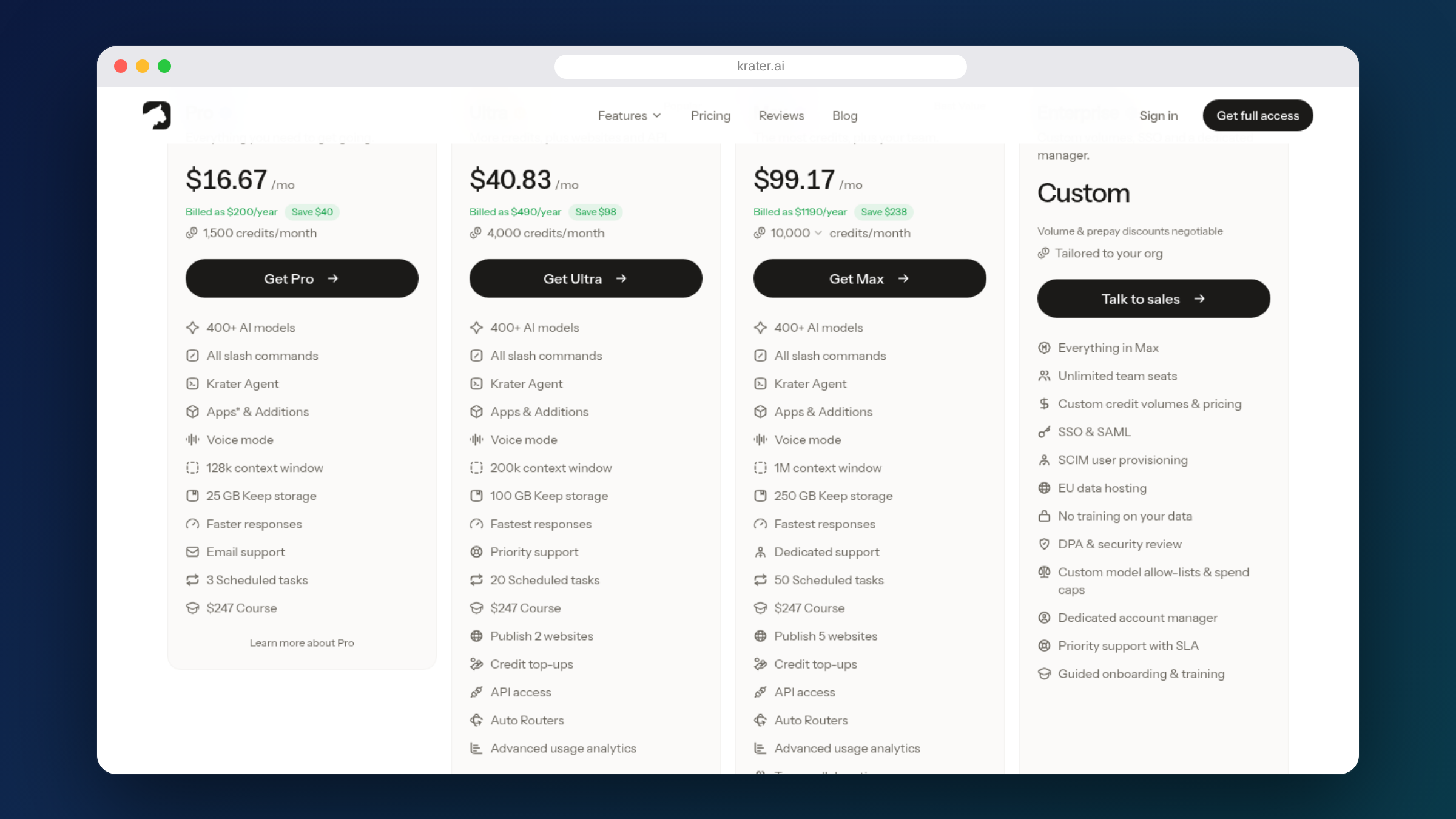
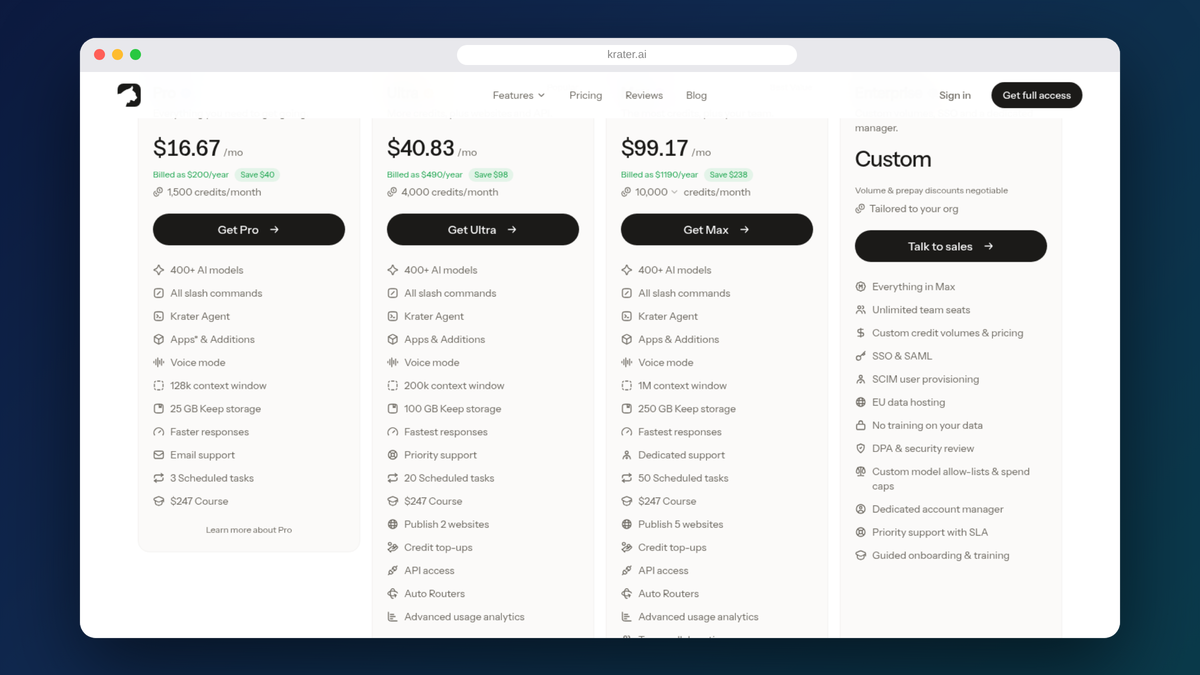
- Krater has no per-seat SKU at all: one flat plan per account (Pro $20 for 1,500 credits, Max $119 for 10,000) with every model family on one meter, which suits small teams that want cost to scale with usage, not headcount.
The answer up front: Team is now Business
If you searched "ChatGPT Team pricing", the page you want is openai.com/business/pricing: the product is called Business, and it replaces the old Team SKU. Per CloudZero"s timeline, Team became Business in August 2025 and got a $5 cut on 2 April 2026. The structure on the live page is two seat types for teams of 2 to 200 employees: Standard at $20 per user per month billed annually ($25 monthly) and Premium at $100 annual ($125 monthly), and you can mix seat types inside one workspace.
Every ChatGPT plan at a glance
| Plan | Price | Who it is for |
|---|---|---|
| Free | $0 | Casual use at lower limits |
| Go | $8 a month; the page footnotes that Go may include ads | Light paid use |
| Plus | $20 a month | Individuals who want the full consumer model set |
| Pro | From $100 a month on the rendered consumer page; third parties report a $200 tier | Heavy individual use |
| Business | $20/$25 per Standard seat, $100/$125 per Premium seat, 2 to 200 seats | Teams needing admin, SSO and no-training defaults |
| Enterprise | Custom | Organizations needing SCIM, EKM, retention and residency controls |
Source: chatgpt.com/pricing and openai.com/business/pricing, read 27 September 2026. The consumer page we rendered shows Pro as "from $100" and does not display a $200 tier; the $200 figure is reported by CloudZero and others.
Standard vs Premium seat: which roles need which
The seat split is the part of Business pricing nobody prices properly. Standard seats give the full Business feature set, the workspace, connectors, admin and no-training default, at Plus-equivalent pricing. Premium seats multiply usage fivefold and remove the five-hour session limit, which matters for the people who live in the tool: engineers running Codex all day, analysts doing long Deep Research sessions, support leads chaining voice and files. For a typical rollout, seat everyone Standard and buy Premium only for the two or three power users who would otherwise hit the session wall before lunch; Premium for the whole team is how a $500 budget becomes a $2,500 invoice.
Business vs Plus: the data-training difference
At annual billing a Standard seat and a Plus subscription both cost $20 a month, so the decision rides on features, not price. The table is the useful part:
| Plus | Business (Standard seat) | |
|---|---|---|
| Price | $20 a month, no seat count | $20 a seat per month annual, $25 monthly, minimum 2 seats |
| Training on your data | Opt-out toggle in settings | No training on business data by default, per the vendor page |
| Admin | None | Central billing, workspace admin, usage analytics |
| SSO | No | SAML SSO and MFA included |
| Connectors | Consumer set | Google Workspace, Slack, GitHub, Microsoft 365, workspace agents |
| Code tools | Codex access at consumer limits | ChatGPT Work plus Codex at Business limits |
The no-training default is the single biggest reason to pay for seats: on Plus the guarantee depends on each user toggling a setting; on Business it is contractual for the workspace.
Business vs Enterprise: what forces the upgrade
Business covers teams up to 200 seats. Enterprise, custom-priced, is what you buy when a compliance requirement outgrows the workspace: SCIM provisioning, encryption key management, domain verification, custom data retention, data residency across ten regions and SLAs are all Enterprise-only on the vendor page. Enterprise also offers credit-based or token-based pricing for organizations whose usage does not fit seats. Third party coverage reports Enterprise landing near $60 a seat at scale, but OpenAI does not publish a figure; treat $60 as reported, not confirmed.
What Business actually includes beyond seats
The vendor page bundles the seat with a workspace, not just a quota. Business includes ChatGPT Work and Codex, connectors into Google Workspace, Slack, GitHub and Microsoft 365, SAML SSO with MFA, centralized billing, usage analytics and workspace agents. Premium seats get 5x the usage and no five-hour session limit on top of the same feature set. Those extras are why a seat costs what a consumer plan costs: the model access is the same, and the money buys the contractual no-training guarantee, provisioning and visibility, not a better model.
Two facts from learn.chatgpt.com"s pricing docs fill in the edges: Business Premium usage is described in the same 5x terms as Pro-level estimates, and voice in the desktop app draws from Codex usage, so heavy voice users burn their allocation faster than the seat price implies. Credit purchase prices also vary by plan, which matters if you expect to top up mid-cycle.
The "$1 first month" offer
Several ranking pages still describe a promotional first month of Business at $1 per seat. That offer does not appear on openai.com/business/pricing or chatgpt.com/pricing as of 27 September 2026, so treat it as expired or unverified and do not budget around it.
Headcount math: 5, 10, 25 people
| Team size | Monthly billing (Standard) | Annual billing (Standard) |
|---|---|---|
| 5 seats | $125 a month | $100 a month ($1,200 a year) |
| 10 seats | $250 a month | $200 a month ($2,400 a year) |
| 25 seats | $625 a month | $500 a month ($6,000 a year) |
Premium seats multiply these by five. The honest comparison is against what each seat does: for teams where three people carry all the AI usage, three seats at $60 annual-equivalent buys the same model access as twenty-five idle seats at $500.
The flat alternative
Krater does not sell seats at all. Every account is a flat subscription with a credit meter billed per answer across Claude, GPT, Gemini, Sonar and the image and video models: Pro is $20 a month for 1,500 credits, Ultra $49 for 4,000, Max $119 for 10,000. For a small team the shapes differ: five individual Pro accounts cost $100 a month flat regardless of who is hired next quarter, versus $125 monthly or $1,200 a year for five Business seats that scale with headcount. The honest limits run the other way too: Krater has no SSO below Enterprise, no shared admin console like Business, and every person needs their own account, so teams that need provisioning, audit and contractual data controls should still buy seats. Teams that need model variety at a flat cost should price the per-answer shape before signing per-seat.
When per-seat stops making sense
Seat pricing assumes everyone uses the tool enough to justify a license. In practice AI usage inside a small team is lumpy: two or three people run it all day and everyone else drafts an email a week. Business"s own math exposes this, because seats bill whether or not they are used, while the metered alternative only bills for answers actually generated. For a ten-person team where three are heavy users, three seats at $75 monthly (annual equivalent $60) buys the heavy users their plan and leaves $150 a month or $1,800 a year unspent on licenses the rest of the team never burns. The flip side is administrative: seats are how you get offboarding, no-training guarantees and SSO, so the moment a compliance officer or IT policy enters the picture, flat accounts stop being a substitute and the seat price becomes the cost of governance rather than the cost of tokens.
Related reading
FAQ
Is ChatGPT Team now called Business?
Yes. The plan is sold as ChatGPT Business on openai.com/business/pricing, with the rename dated to August 2025 per CloudZero.
How much is a ChatGPT business plan?
Standard seats are $20 per user per month billed annually ($25 monthly) and Premium seats are $100 annual ($125 monthly), minimum two seats, up to 200. Enterprise is custom.
What is the difference between Plus and Business?
Plus is an individual $20 plan where training opt-out is a user setting. Business adds a contractual no-training default, SAML SSO, admin analytics, workspace connectors and per-seat billing from two seats up.
Is there a $1 first month offer?
Not on any current vendor page we checked on 27 September 2026. It may have existed earlier; treat it as expired or unverified.
Is ChatGPT Pro at $200 worth it?
The rendered pricing page shows Pro "from $100" and does not display a $200 tier; the $200 figure is reported by third parties. At any price above Plus, Pro is for individuals hitting session ceilings daily, not a team tool.
Does Business include a BAA?
OpenAI"s public pricing page does not state HIPAA BAA terms for Business; Enterprise markets compliance features including configurable controls. If a BAA is a hard requirement, confirm with OpenAI sales rather than assuming Business covers it.
Is API usage included in Business seats?
No. ChatGPT subscriptions and the OpenAI API are billed separately, the same split as Plus and Pro.
Is there a nonprofit or education discount?
Third party pages report nonprofit and education pricing, but it is not published on the business pricing page; contact OpenAI sales for a current figure.
Related reads
- ChatGPT Plus vs Pro
- Gemini Pricing 2026
- Perplexity Pricing 2026
- Midjourney Pricing 2026
- Claude Pricing 2026
- ChatGPT alternatives
- Claude vs ChatGPT, tested
Bottom line
ChatGPT Team is dead as a name: Business is the seat product now, at $20 a seat annual for Standard and $100 for Premium, mixed as needed. Buy Standard seats broadly and Premium narrowly, treat the $1 promo as gone, and only pay Enterprise"s custom price when compliance forces you to. If your team"s constraint is budget rather than admin, the flat per-answer alternative is worth costing before you sign seats.