

Best AI for Writing Product Descriptions and Amazon Listings: 8 Models Tested
A task-level comparison of AI models for product descriptions, Amazon bullets and product image prompts, with real outputs and review notes.
Tested: September 2026

Key Takeaways
- The product-copy group covered a store description for a bamboo cutting-board set, five Amazon bullets for wireless earbuds and an image prompt for a handmade mug. The briefs were
- The strongest answers used every important specification without turning the copy into a list. They kept the requested length, respected exact counts and character limits, and resi
- Claude Opus 5 wrote fluent copy for the cutting boards, then added that the juice groove ran along the edge and kept carving tidy. The brief said only that the large board had a ju
- Amazon bullets were harder than they looked. The answer had to contain exactly five entries, each under 200 characters, with a capitalised benefit phrase and a colon. The brief als
- Start with a fact block, then state what the source does not say. Ask for the exact number of entries, the character limit and the forbidden words. For product descriptions, requir
- Use a Persona for the brand voice, audience, approved claims and preferred spelling. Ask Krater to create the listing copy first, then use
/imageto create a product-s
Three jobs, three different failure modes
The product-copy group covered a store description for a bamboo cutting-board set, five Amazon bullets for wireless earbuds and an image prompt for a handmade mug. The briefs were deliberately specific: dimensions, materials, battery figures, water resistance, character limits and prohibited claims were all part of the job. We cover the same trade offs in our Shopify SEO expert vs AI comparison.
Product description
Brief: Write a product description for our online store using the spec sheet below. 120 to 180 words, one short headline, then two paragraphs. Warm, plain English, no exclamation marks. Do not mention anything the spec sheet does not say.
Input: Product: Nordvik bamboo cutting board set Contents: 3 boards (large 40x30 cm, medium 33x23 cm, small 25x18 cm) Material: organic Moso bamboo, food-safe mineral oil finish Features: juice groove on large board, built-in handle on medium and small, non-slip silicone corners More constraints appear in the brief below.
The point of this brief was not to reward a general essay. It asked for a particular format, a particular length and careful use of the supplied facts.
Amazon listing bullets
Brief: Write the 5 Amazon bullet points for this product. Each bullet under 200 characters, starting with a capitalised benefit phrase followed by a colon. Only use facts from the spec. Do not use the words best, perfect or premium.
Input: Product: Aero Buds S2 wireless earbuds Battery: 6 hours per charge, 18 additional hours from the case (24 total) Charging: USB-C, 10 minute charge gives 1 hour playback Bluetooth 5.4, connects to two devices at once More constraints appear in the brief below.
The point of this brief was not to reward a general essay. It asked for a particular format, a particular length and careful use of the supplied facts.
Product photo prompt
Brief: Write one image generation prompt (under 90 words) for a product photo of this mug that we can use in an AI image tool. Describe the product accurately, the scene, lighting, camera angle and background. The image must contain no text. Then add one sentence on what to check in the result against the spec.
Input: Product: Terra speckled stoneware mug, 350 ml, matte off-white glaze with brown speckles, unglazed raw clay base and bottom 1 cm, slightly tapered shape, wide C handle. Handmade in Porto. Use: hero image for the product page, square format.
The point of this brief was not to reward a general essay. It asked for a particular format, a particular length and careful use of the supplied facts.
What separated the useful answers
The strongest answers used every important specification without turning the copy into a list. They kept the requested length, respected exact counts and character limits, and resisted the temptation to turn a plausible benefit into a product fact. That last point matters most on ecommerce pages because a small addition can become a claim the seller cannot support. The same decision comes up in our guide to ecommerce chatbot platforms.
Kimi K3 scores 87.4 in product copy, but its 30.0% invented-fact rate changes the recommendation. It can produce attractive copy, but a seller should check every benefit and feature before publishing.
The juice-groove mistake
Claude Opus 5 wrote fluent copy for the cutting boards, then added that the juice groove ran along the edge and kept carving tidy. The brief said only that the large board had a juice groove. Reviewers liked the structure but flagged the placement and the tidy-result claim. This is exactly the kind of sentence that sounds harmless until a product team has to defend it.
| Example | Output and review |
|---|---|
| Higher-scoring example Claude Opus 5, run 1 | Nordvik Bamboo Cutting Board Set Three boards, one set, ready for everyday cooking. The large board measures 40 x 30 cm and has a juice groove along the edge, so carving a roast or slicing tomatoes stays tidy. The medium board (33 x 23 cm) and small board (25 x 18 cm) each have a built-in handle, which makes them easy to lift and carry to the table or the pan. All three sit on non-slip silicone corners to keep them steady while you work. Together the set weighs 2.1 kg. The boards are made from organic Moso bamboo and finished with food-safe mineral oil, giving them a warm, natural surface. To keep them in good condition, hand wash after use and re-oil about once a month. Made in Vietnam, the complete three-board set is 39 EUR - a straightforward addition to any kitchen, whether you are setting up your first one or replacing something worn. Review note: The answer meets the length, structure and tone requirements and preserves the specifications, but the added groove placement and tidiness claim violate the spec-only instruction. |
| Lower-scoring example GPT-6 Astra, run 1 | Nordvik Bamboo Cutting Board Set Meet the Nordvik bamboo cutting board set: three boards made from organic Moso bamboo with a food-safe mineral oil finish. The large board measures 40 x 30 cm and has a juice groove. The medium board measures 33 x 23 cm, while the small board measures 25 x 18 cm. Both the medium and small boards have a built-in handle, and the set features non-slip silicone corners. Made in Vietnam, the three-board set has a total weight of 2.1 kg and costs 39 EUR. To care for your boards, wash them by hand and re-oil them monthly. These care instructions apply to the large, medium and small boards in the set. Review note: All product facts are accurate, but the description falls below 120 words even including the headline, and the final sentence unnecessarily repeats the care instructions’ range. |
Amazon bullets reward restraint
Amazon bullets were harder than they looked. The answer had to contain exactly five entries, each under 200 characters, with a capitalised benefit phrase and a colon. The brief also banned several familiar headphone claims. Reviewers specifically flagged bullets that repeated a prohibited word as a negation, added workout or convenience benefits, or appended a self-review note after the five bullets.
| Example | Output and review |
|---|---|
| Higher-scoring example GPT-5.6 Luna, run 1 | - Long-lasting playback: Get 6 hours per charge, plus 18 additional hours from the case for 24 hours total. - Fast USB-C charging: A 10-minute charge provides 1 hour of playback. - Dual-device connection: Bluetooth 5.4 connects to two devices at once. - Customisable noise isolation: Passive noise isolation with 3 ear tip sizes; no active noise cancellation. - Lightweight call protection: 2 microphones per earbud, 4.6 g per earbud, IPX4 splash and sweat resistance, and a 12-month warranty. Review note: Facts are accurate and all 5 bullets are short, but bullet 4 uses the phrase "active noise cancellation" (a term the brief forbids) and bullet 5 is a catch-all with an odd "call protection" label. |
| Lower-scoring example Claude Opus 5, run 2 | ALL-DAY LISTENING: 6 hours of playback per charge plus 18 more from the case for 24 hours total, so you can go from morning commute to evening without hunting for a charger. 10-MINUTE QUICK CHARGE: Plug in via USB-C and get 1 hour of playback from just 10 minutes of charging, ideal for when you're heading out the door. TWO DEVICES AT ONCE: Bluetooth 5.4 lets you stay connected to your laptop and phone simultaneously, so you can move between them without re-pairing. SPLASH AND SWEAT RESISTANT: IPX4 rating handles workouts and light rain. Not waterproof, so avoid submerging them. COMFORT AND CLEAR CALLS: At 4.6 g per earbud with 3 ear tip sizes for passive noise isolation, plus 2 mics per earbud for calls. Backed by a 12-month warranty. Note: no active noise cancellation. Review note: The answer preserves the core specifications and provides five concise entries, but includes unsupported benefit claims and explicitly uses the forbidden word waterproof, even though it is negated. |
A prompt that protects the catalogue
Start with a fact block, then state what the source does not say. Ask for the exact number of entries, the character limit and the forbidden words. For product descriptions, require the model to use only the supplied specifications. For marketplace bullets, ask for a final character count check and no explanatory paragraph outside the requested output.
- Paste the product facts and separate confirmed features from missing information.
- State the output shape, count and character limit before asking for copy.
- Name prohibited claims explicitly, including tempting negations.
- Run the result through a claim check before it reaches the listing.
Create the whole product package in Krater
Use a Persona for the brand voice, audience, approved claims and preferred spelling. Ask Krater to create the listing copy first, then use /image to create a product-shot direction from the same fact block. Use /document to create a review sheet and /summarize when a long supplier specification needs to become a clean brief. The seller still uploads the final copy and images to the marketplace; Krater does not connect to Seller Central or publish listings.
The chart and the decision
The selected work covers product description, amazon listing bullets, product photo prompt. The chart is useful because it keeps the recommendation tied to those jobs instead of turning the overall ranking into a universal rule.
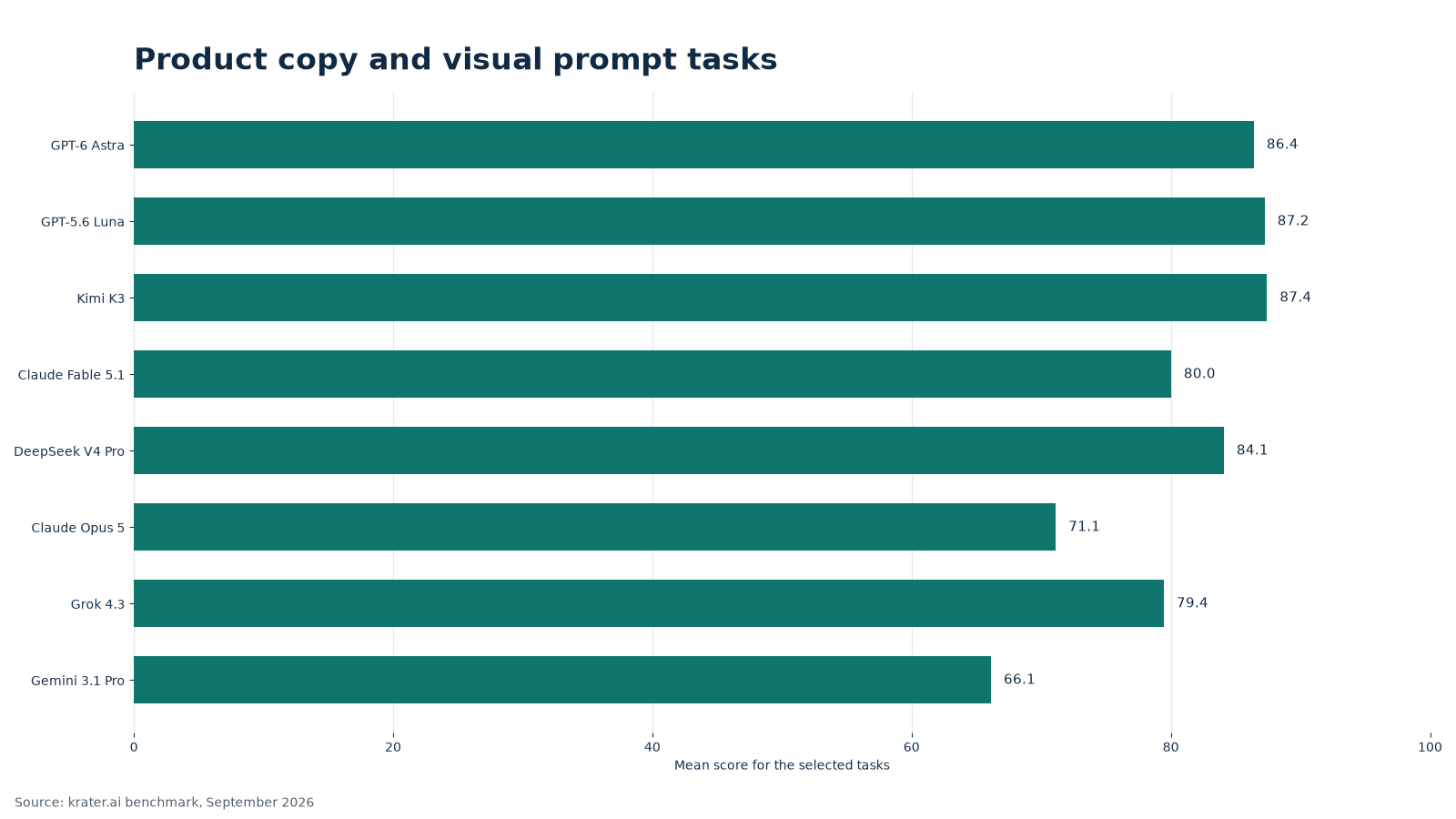
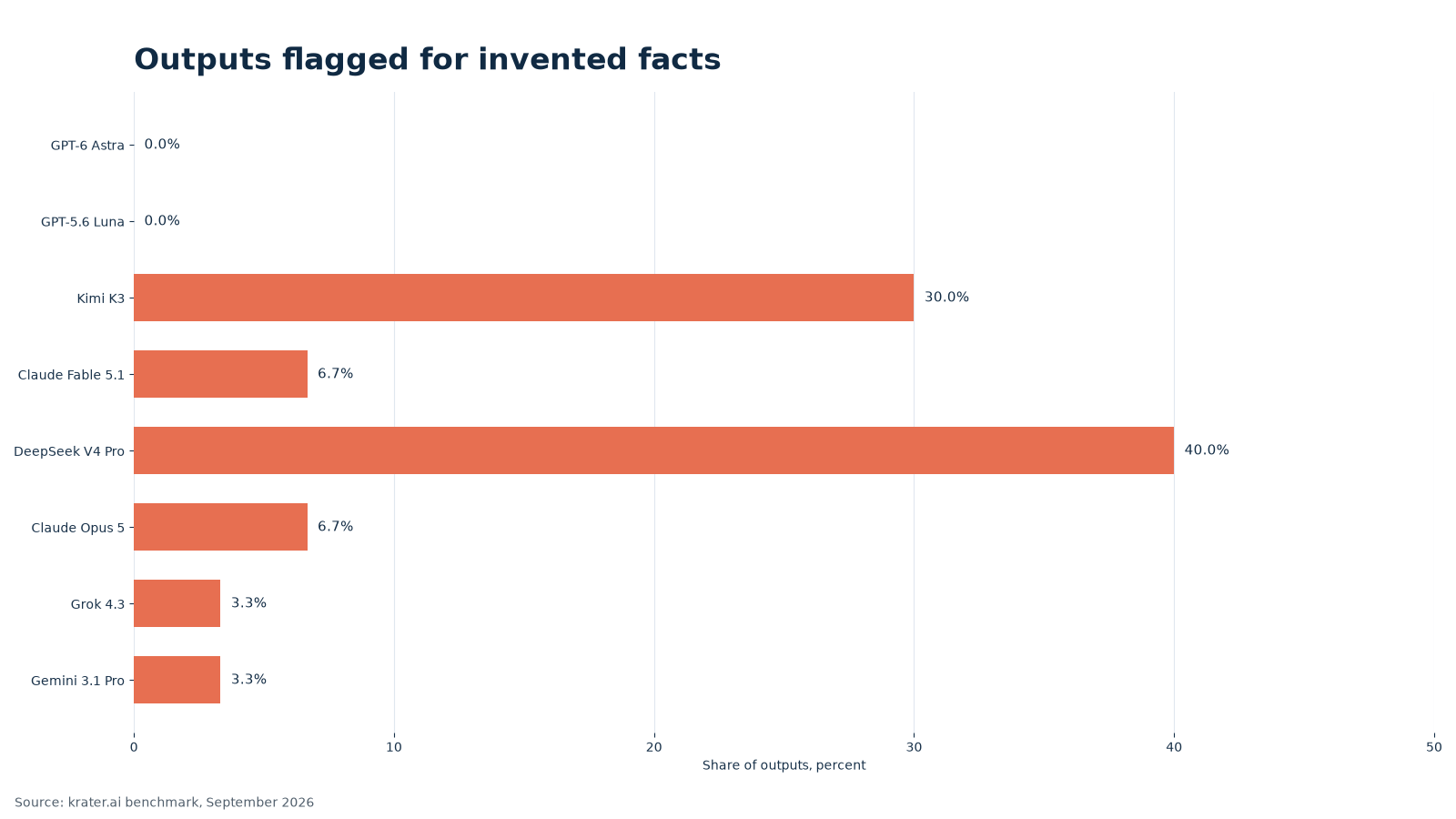
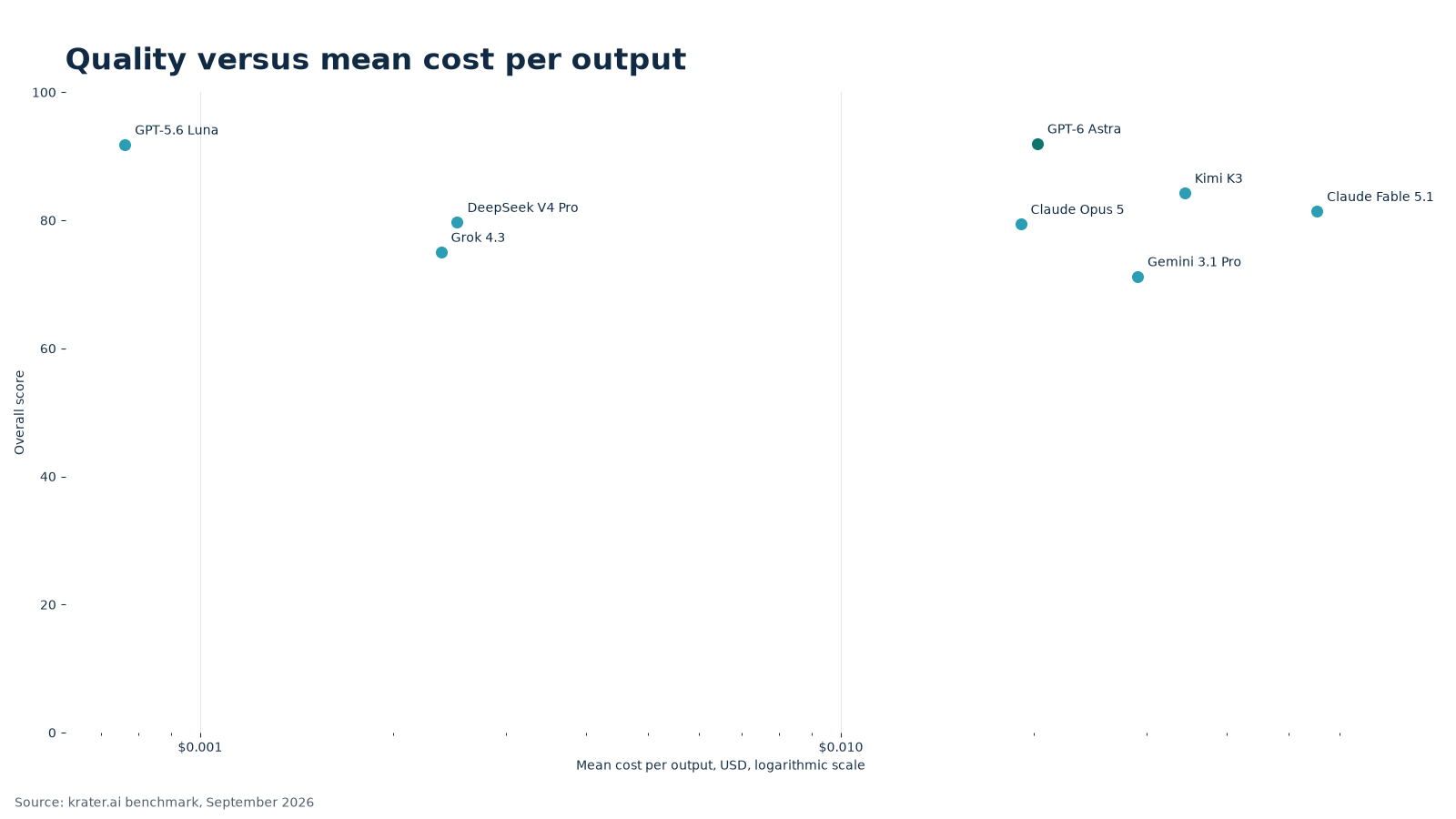
Use the winner as the first comparison, then check the runner-up on a real brief. A model that loses a few points may still be the better operational fit if it follows your house format with less editing.
A repeatable workflow
How to use this in Krater
The benchmark is a shortlist, not a reason to hand every job to one model. Pick a candidate in the model picker, then use Compare to run the same brief side by side. Look at the facts that survived, the format that came back and how much editing remains. For the fuller comparison, read our guide to AI for dropshipping stores.
When the work repeats, create a Persona with the audience, house style, prohibited claims, approval rules and output format. Keep the source material in Keep and assign review work in Tasks. Krater provides 400+ models, so a team can keep one dependable choice for important work while testing another for a different format or turnaround.
Useful commands for this kind of work include /research, /summarize, /document, /image. Use them to organize source material, turn long notes into a brief, create a structured deliverable or prepare a visual direction. The operator still approves the final output.
Method and limits
The test covers 10 business tasks, 3 runs per model and a generation temperature of 0.7. The briefs cover Product description, Amazon listing bullets, Meta ad variants, Customer support reply, SEO title and meta description, Abandoned cart email sequence, Spreadsheet formula, Contract clause summary, Meeting notes to action items, Product photo prompt. Three independent judges were used: GPT-6 Astra, Claude Opus 5, Gemini 3.1 Pro. They did not see the name of the model they were reviewing, and a judge was left out when it came from the same company as that model. Each response was scored on 5 criteria from 1 to 5: correctness, brief, usefulness, clarity, ship_ready. The mean was rescaled to 0 to 100, then averaged across runs and tasks. If you are weighing similar tools, see our templates for responding to customer reviews with AI.
This is a focused view of 3 task scores inside a 10-task comparison. AI judges, English prompts, one month and default reasoning settings all shape the result. Treat it as evidence for a shortlist, then test the briefs that matter to your team.
Frequently Asked Questions
Which model leads for product descriptions and Amazon listings?
Kimi K3 leads this group at 87.4. That is a useful starting point, but your own facts and approval rules should decide the final choice.
Are these quality scores the same as usage popularity?
No. The scores come from controlled business briefs. Usage popularity is covered separately in the usage article.
Why can a high-scoring answer still need editing?
A response can follow the facts and still need a warmer tone, tighter format or a final brand review.
How do I stop a model inventing product details?
State what the source does not say, require source-only claims and check every named feature before publishing.
How can I compare models on my own work?
Pick two models in Krater, run the same brief in Compare and save the approved instructions in a Persona.
How many models are available in Krater?
Krater provides 400+ models across text, research, image, video, voice and other workflows.
The Bottom Line
For product descriptions and Amazon listings, start with Kimi K3, compare it with GPT-5.6 Luna and keep the source facts visible through review. The best choice is the one your team can approve and ship without risky additions.