

Best AI Model for Business in 2026: We Tested 8 Models on 10 Real Tasks
GPT-6 Astra leads this business comparison, while task-level scores show where each model fits for product copy, marketing, support and operations.
Tested: September 2026

Key Takeaways
- GPT-5.6 Luna is within 0.2 points of the overall leader at a much lower cost.
- Kimi K3 and DeepSeek V4 Pro need a fact check despite strong copy scores.
- Customer service rewards policy control and a sendable human tone.
- The best model changes by category, so compare the work your team actually ships.
- Krater's Compare feature makes a two-model check easy before setting a default.
The leaderboard
| Rank | Model | Provider | Score | Invented fact rate | Median latency | Cost per output |
|---|---|---|---|---|---|---|
| 1 | GPT-6 Astra | OpenAI | 92.0 | 0.0% | 8.9s | $0.02 per output |
| 2 | GPT-5.6 Luna | OpenAI | 91.8 | 0.0% | 7.9s | under a cent per output |
| 3 | Kimi K3 | Moonshot | 84.3 | 30.0% | 15.8s | $0.03 per output |
| 4 | Claude Fable 5.1 | Anthropic | 81.4 | 6.7% | 16.4s | $0.06 per output |
| 5 | DeepSeek V4 Pro | DeepSeek | 79.7 | 40.0% | 22.6s | under a cent per output |
| 6 | Claude Opus 5 | Anthropic | 79.4 | 6.7% | 8.8s | $0.02 per output |
| 7 | Grok 4.3 | xAI | 75.1 | 3.3% | 5.7s | under a cent per output |
| 8 | Gemini 3.1 Pro | 71.2 | 3.3% | 17.3s | $0.03 per output |
The three findings that matter
GPT-6 Astra leads overall at 92.0, but the gap between the two OpenAI models is only 0.2 points. GPT-5.6 Luna costs about 25 times less per output than GPT-6 Astra, making it the sensible default for high-volume work when the brief does not need the extra margin at the top.
Kimi K3 and DeepSeek V4 Pro are strong copy models, yet they invented details in 30.0% and 40.0% of outputs respectively. That combination is useful for ideation, but it calls for a claim check before anything reaches a product page, advert or customer.
Gemini 3.1 Pro's 39.2 customer service score reflects tone and policy handling more than a lack of knowledge. Its replies often explained the internal rule or mentioned missing input instead of writing a sendable answer. The support section below shows the contrast.
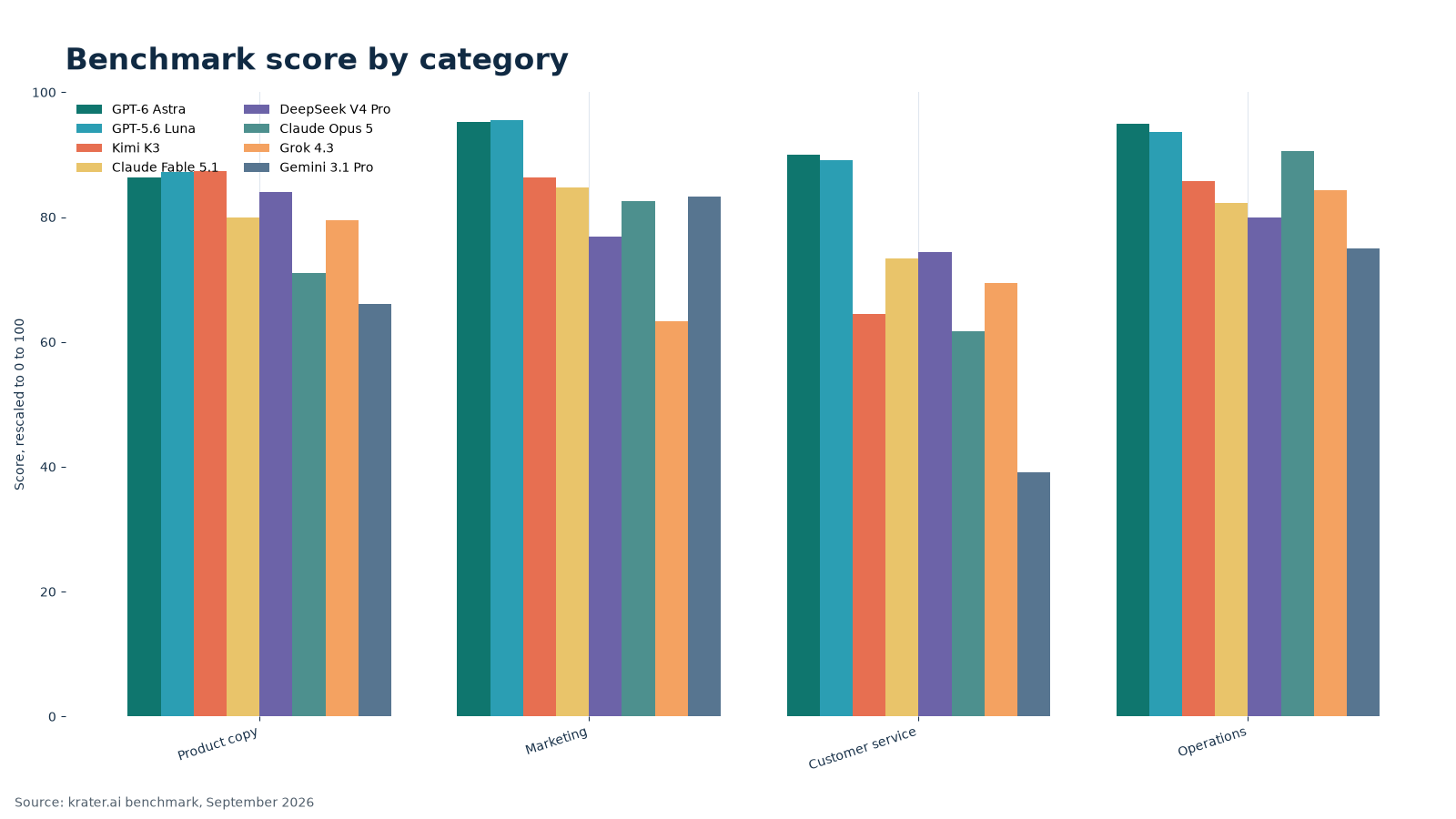
The overall score is a useful map, not a delegation rule. The category sections below show where the ranking changes once the brief becomes product copy, campaign work, customer care or operations.
For a small team, that distinction changes the buying conversation. A general winner can handle many jobs, while a category specialist may save editing time on one recurring queue. Treat the numbers as a shortlist for your own checks, not as permission to remove review from high-stakes work.
Product copy
Product copy: a closer read
Kimi K3 tops product copy at 87.4, only 0.2 points ahead of GPT-5.6 Luna. The lead is real, but it is not a clean publishing recommendation: its invented-fact rate is 30.0%. Reviewers praised answers that covered the product specifications and kept the image prompt within its requested shape. They also flagged the danger of adding unsupported benefits or leaving a prompt shorter than requested. Those comments describe a capable copy editor that still needs a claims pass before a listing goes live. The safe choice is the model that gives the catalogue team fewer factual surprises.
Claude Fable 5.1: Nordvik Bamboo Cutting Board Set Three boards, one simple set. The Nordvik set gives you a large board at 40 by 30 cm, a medium at 33 by 23 cm and a small at 25 by 18 cm, so there is a size to suit whatever you are preparing. Each board...
Recommendation: Use GPT-5.6 Luna as the safer default at 87.2 with an invented-fact rate of 0.0%; keep Kimi K3 for drafts that receive a deliberate fact check.
Marketing
Marketing: a closer read
GPT-5.6 Luna leads marketing at 95.6, 0.3 points above GPT-6 Astra. Reviewers credited it with keeping hard constraints intact and placing the discount in the correct email. They also found that the voice could be flatter than a marketer wants and that an SEO answer included an unnecessary explanatory note. The result is strong campaign plumbing, even when the voice may need a marketer's final pass for freshness. Campaign teams should read every variant once for distinctiveness before scheduling it. Use Luna when compliance and sequencing matter more than an instantly distinctive voice.
Claude Fable 5.1: 1. Routine angle - Primary text: Add one step, brighten the look of your skin. Lumen Vitamin C serum: lightweight, absorbs fast, fragrance free. - Headline: One step to brighter-looking skin 2. Ingredients angle - Primary text:...
Recommendation: Use GPT-5.6 Luna as the campaign default at 95.6, then compare one complete brief against GPT-6 Astra before launch.
Customer service
Customer service: a closer read
GPT-6 Astra leads customer service at 90.0, with a 0.8-point margin over GPT-5.6 Luna. The strongest replies gave the allowed remedies, avoided a delivery promise and stayed within the requested length. Reviewers specifically praised that the answer handled the conditional policy without promising an immediate refund. Another judge still called out the defensive wording around what the company would not do. In other words, Astra gets the operational boundary right, but its best wording still deserves a human tone check. Choose Astra for policy-heavy queues where remedy accuracy comes before conversational polish.
GPT-6 Astra: Hi, I’m sorry your linen duvet cover hasn’t arrived and for the frustration this has caused. Order 48213 shipped on 28 August, but tracking shows it has been stuck at a sorting hub since 1 September. It is now four working days late. ...
Recommendation: Put GPT-6 Astra first in a policy-heavy queue, but have an editor soften the wording before the reply reaches a customer.
Operations
Operations: a closer read
GPT-6 Astra leads operations at 95.0, 1.4 points ahead of GPT-5.6 Luna. Reviewers liked its accurate structure and its care around uncertain decisions. The meeting-note judges also found the same weakness: the warehouse stock-number action could be turned into an ownership discussion, causing its deadline to disappear from the action table. The lesson is practical: Astra is the strongest operations starting point, but teams should verify owners and dates row by row. That makes it particularly useful for recurring meeting notes and spreadsheet work with named deadlines. Keep the final handoff tied to the original source record. Use it when structured summaries need a careful human sign-off. For the workflow side of this, see our tested ranking of the best AI for meeting notes.
Claude Fable 5.1: `=SUMPRODUCT((Orders!B2:B="BK-101")*(Orders!A2:A>=DATE(2026,8,1))*(Orders!A2:A<DATE(2026,9,1))*Orders!C2:C*Orders!D2:D)` SUMPRODUCT multiplies units by unit price row by row and only keeps rows where the SKU is "BK-101" and the date falls...
Recommendation: Use GPT-6 Astra for structured operational work and verify every owner and date against the source notes before distribution.
Quality against cost
The quality versus cost chart makes the practical tradeoff visible. GPT-6 Astra and GPT-5.6 Luna occupy the top of the quality ranking, but Luna is the much easier choice when a team is processing large volumes. Kimi K3 combines strong copy scores with a higher invention risk, while some lower-cost models make more sense for a narrow task than for an unattended workflow.
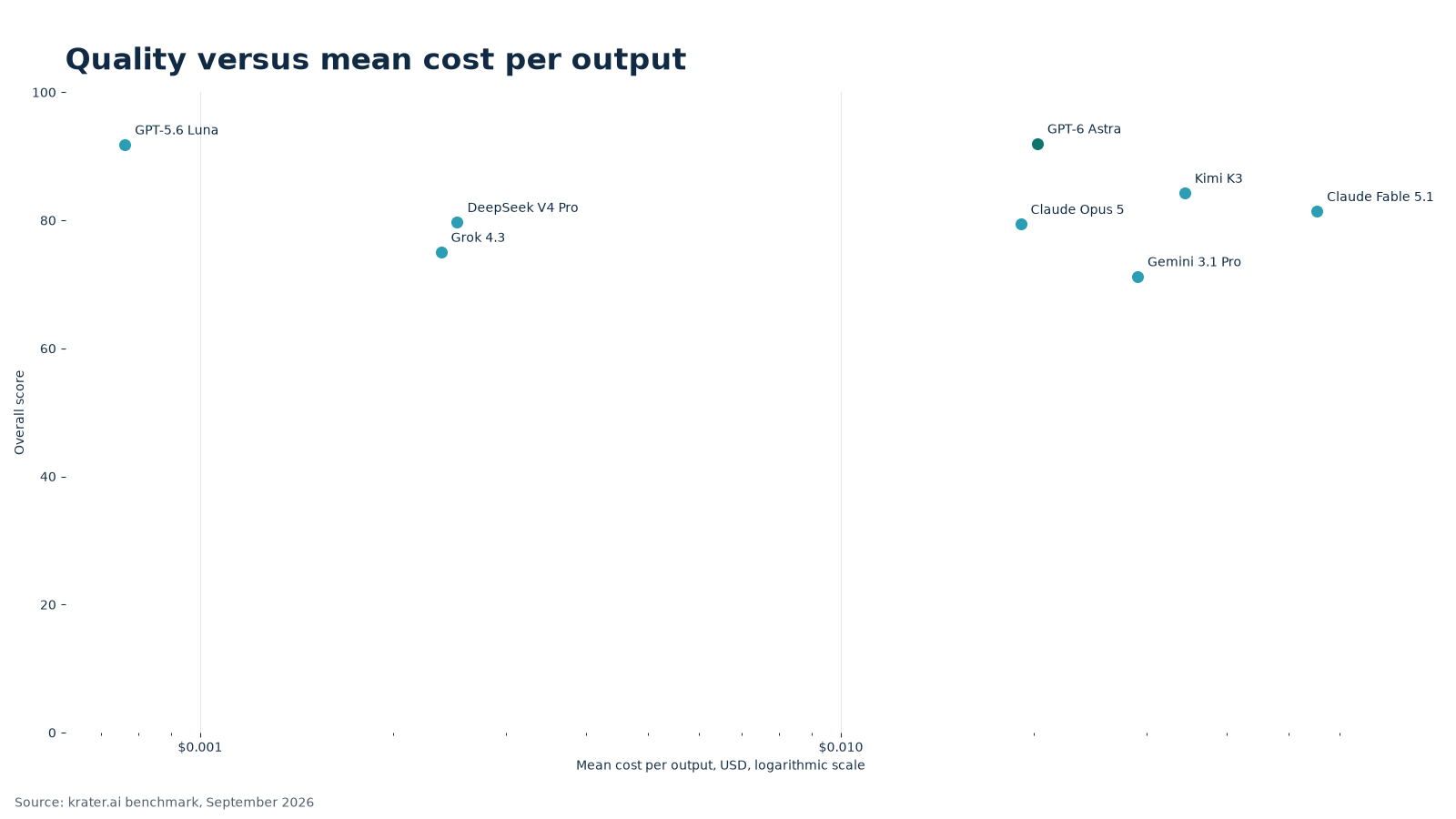
Cost is only one part of the decision. A slightly more expensive answer can be the better choice when it removes review time. A lower-cost answer can be the better choice when the team has a reliable approval step and the brief is repetitive.
Speed and the review queue
Grok 4.3 has the lowest median latency in this run, while DeepSeek V4 Pro is much slower. That does not make latency a quality score. It tells an operator how quickly a comparison may return and how much capacity a high-volume workflow may need.
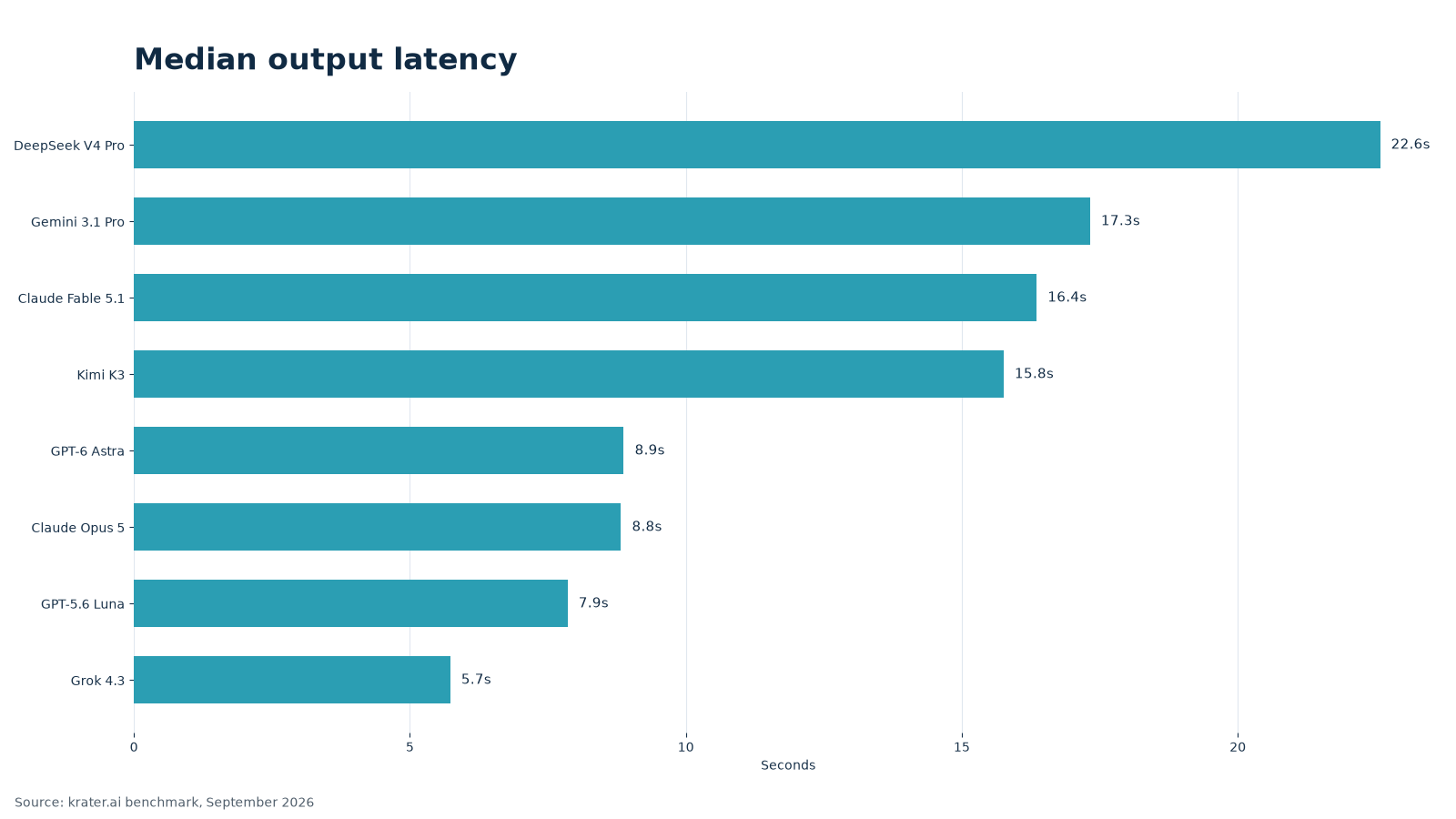
When speed matters, run the same short brief through two candidates before committing. Fast output that needs a long fact check is not necessarily faster in the real workflow.
What the test asked models to do
The set contains 10 ordinary business jobs: product copy, marketing, customer service and operations. The tasks were product description, Amazon bullets, Meta ads, SEO metadata, an abandoned-cart sequence, a spreadsheet formula, a contract summary, meeting actions, a support reply and an image prompt. Each brief supplied the facts, requested format and limits that a useful answer had to respect. We go deeper on this in our tested ranking of the best AI for contract review.
Method and limitations
Methodology
The test covers 10 business tasks, 3 runs per model and a generation temperature of 0.7. The briefs cover Product description, Amazon listing bullets, Meta ad variants, Customer support reply, SEO title and meta description, Abandoned cart email sequence, Spreadsheet formula, Contract clause summary, Meeting notes to action items, Product photo prompt. Three independent judges were used: GPT-6 Astra, Claude Opus 5, Gemini 3.1 Pro. They did not see the name of the model they were reviewing, and a judge was left out when it came from the same company as that model. Each response was scored on 5 criteria from 1 to 5: correctness, brief, usefulness, clarity, ship_ready. The mean was rescaled to 0 to 100, then averaged across runs and tasks. The next step is our tested ranking of the best AI for spreadsheet formulas.
The models received the same system instruction and the same business input through the OpenRouter IDs that Krater uses. Each model kept its default reasoning setting. The judges reviewed the answers without the model name, using the same five criteria for every task.
An overall score is the average of the ten task scores, not a weighted average of the four categories. For invented facts, an output counts when at least two of the remaining judges identify a non-empty list of unsupported details. That measure sits beside the quality score because a fluent answer can still be unsafe to publish when it adds a plausible fact.
The evaluation used English prompts and small-business briefs during one month. It cost about $16 in API credits. The result is useful for choosing what to compare, not a permanent claim about every model in every workflow.
The limits are straightforward. There were 10 small-business briefs in one month, written in English, and the answers were assessed by AI judges rather than a human panel. Default reasoning settings were used through OpenRouter. That is enough to compare behavior on these briefs, but not enough to declare a permanent winner for every company.
A practical Krater workflow
How to use this in Krater
The benchmark is a shortlist, not a reason to hand every job to one model. Pick a candidate in the model picker, then use Compare to run the same brief side by side. Look at the facts that survived, the format that came back and how much editing remains.
When the work repeats, create a Persona with the audience, house style, prohibited claims, approval rules and output format. Keep the source material in Keep and assign review work in Tasks. Krater provides 400+ models, so a team can keep one dependable choice for important work while testing another for a different format or turnaround.
Useful commands for this kind of work include /research, /summarize, /document, /image. Use them to organize source material, turn long notes into a brief, create a structured deliverable or prepare a visual direction. The operator still approves the final output.
Frequently Asked Questions
Did Krater run these models through the app?
No. The comparison used the same OpenRouter model IDs Krater uses, with a shared brief and a shared review method.
How many models were tested?
The comparison covers 8 models, 10 business tasks and 3 runs per task.
Why were same-company judges left out?
Leaving them out reduces the chance that a model is scored by a judge from its own provider.
Does the winner guarantee the best answer for my team?
No. It is a useful starting point. Your own product facts, policies and review standards still decide what ships.
How can I compare models on my own brief?
Pick two models in Krater, use Compare with the same brief and save the approved instructions in a Persona.
How many models does Krater provide?
Krater provides 400+ models for text, research, images, video, voice and other business work.
The Bottom Line
GPT-6 Astra is the strongest general starting point at 92.0, but GPT-5.6 Luna is the better default for volume work when its lower cost and 91.8 score cover the brief. Use the category results to choose deliberately, then make the final call on your own source material.